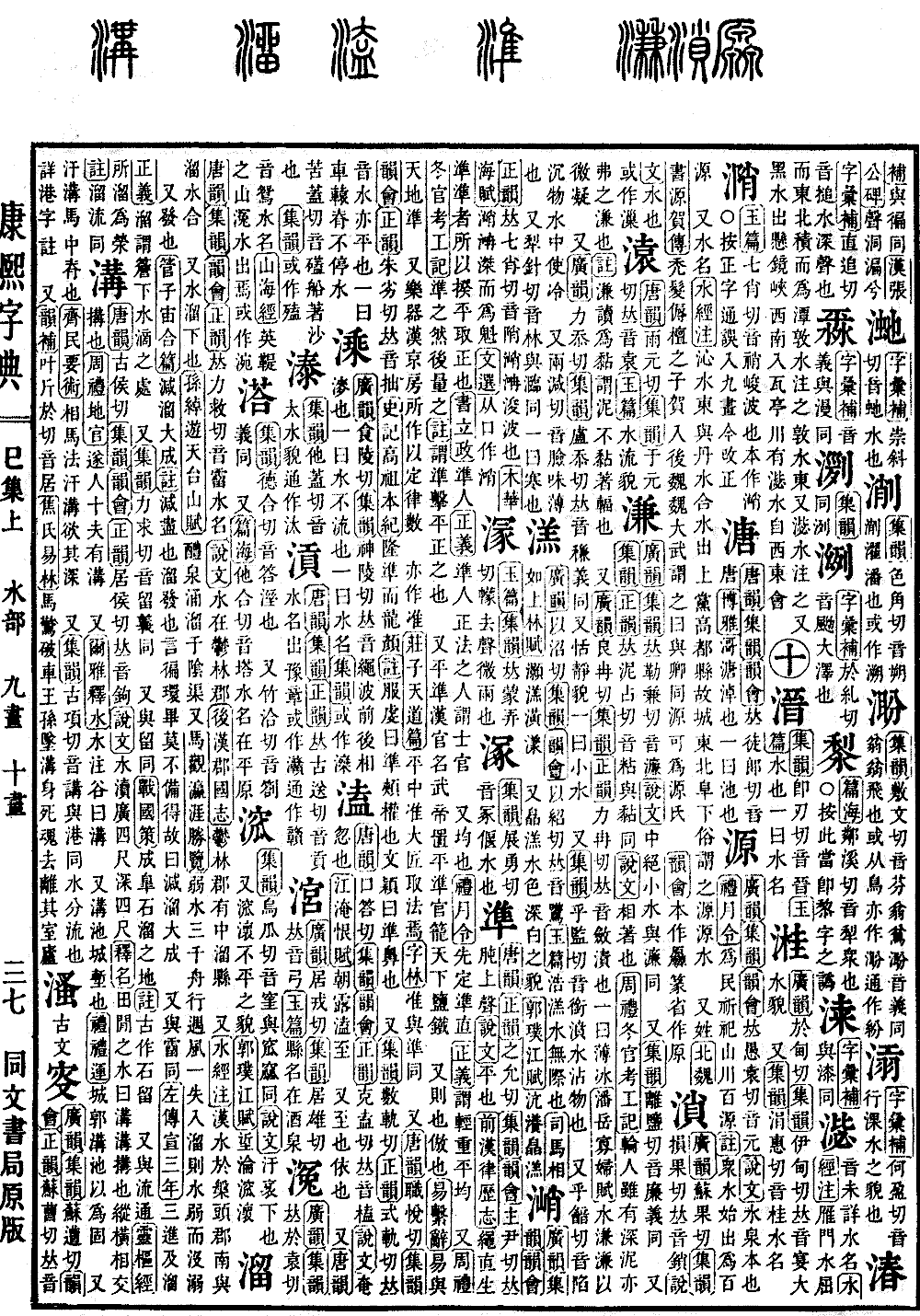
Si Collection, Upper Volume
Radical: Water (shuǐ)
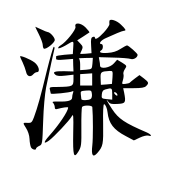
Entry: Lian
Kangxi stroke count: 14
Page 639, Entry 19
Guangyun and Jiyun dictionaries record the pronunciation as Lian. According to the Shuowen Jiezi (Shuowen), it refers to a small stream of water that is interrupted. It is the same as the character for a waterfall (lian).
Also, according to Jiyun, it is pronounced Lian. The meaning is the same.
Also, according to Jiyun and Zhengyun dictionaries, it is pronounced Nian. It is the same as the character for sticky (nian). According to the Shuowen Jiezi, it means to adhere to one another. In the Rites of Zhou (Zhouli), section Winter Officials, Artificers Record (Kaogongji), it is stated that even if a carriage wheel sinks into deep mud, it will not be stuck. The commentary states that this is read as nian, meaning the mud does not adhere to the carriage spokes.
Also, according to Guangyun, it is pronounced Lian (rising tone). According to Jiyun and Zhengyun dictionaries, it is pronounced Lian (rising tone). It means to soak or immerse. One source states it refers to thin ice. In the Widow's Rhapsody (Guafu Fu) by Pan Yue, it is written that the surface of the water is lian-lian, gently freezing.
Also, according to Guangyun, it is pronounced Tian. According to Jiyun and Zhengyun dictionaries, it is pronounced Tian. The meaning is the same. It also refers to a quiet and calm appearance. One source states it refers to a small stream of water.
Also, according to Jiyun, it is pronounced Xian. It refers to splashing water that moistens an object.
Also, it is pronounced Xian (falling tone). It refers to immersing an object in water to cool it down.
Also, it is pronounced Lian (dipping tone). It refers to a bland or light taste.
Also, it is pronounced Lin. It is the same as the character for a drizzling rain (lin). One source states it refers to coldness.