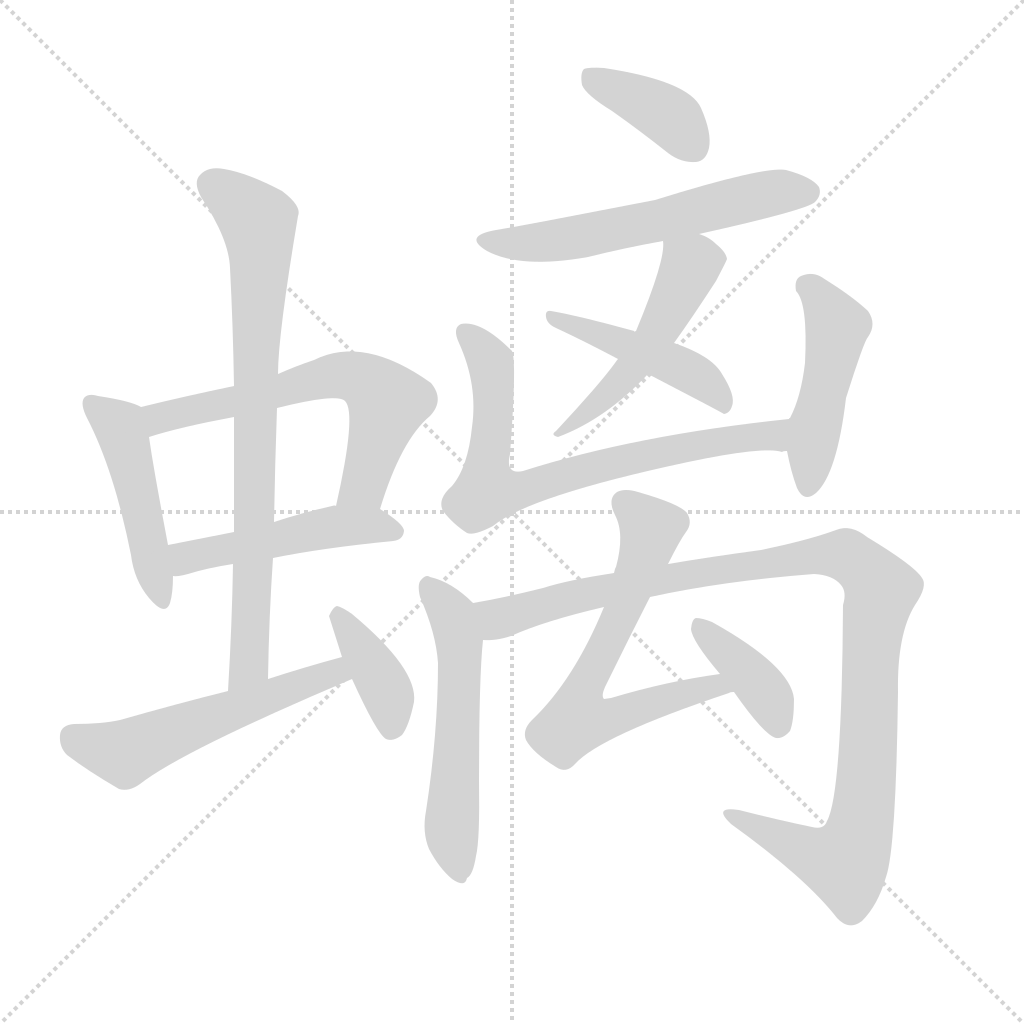
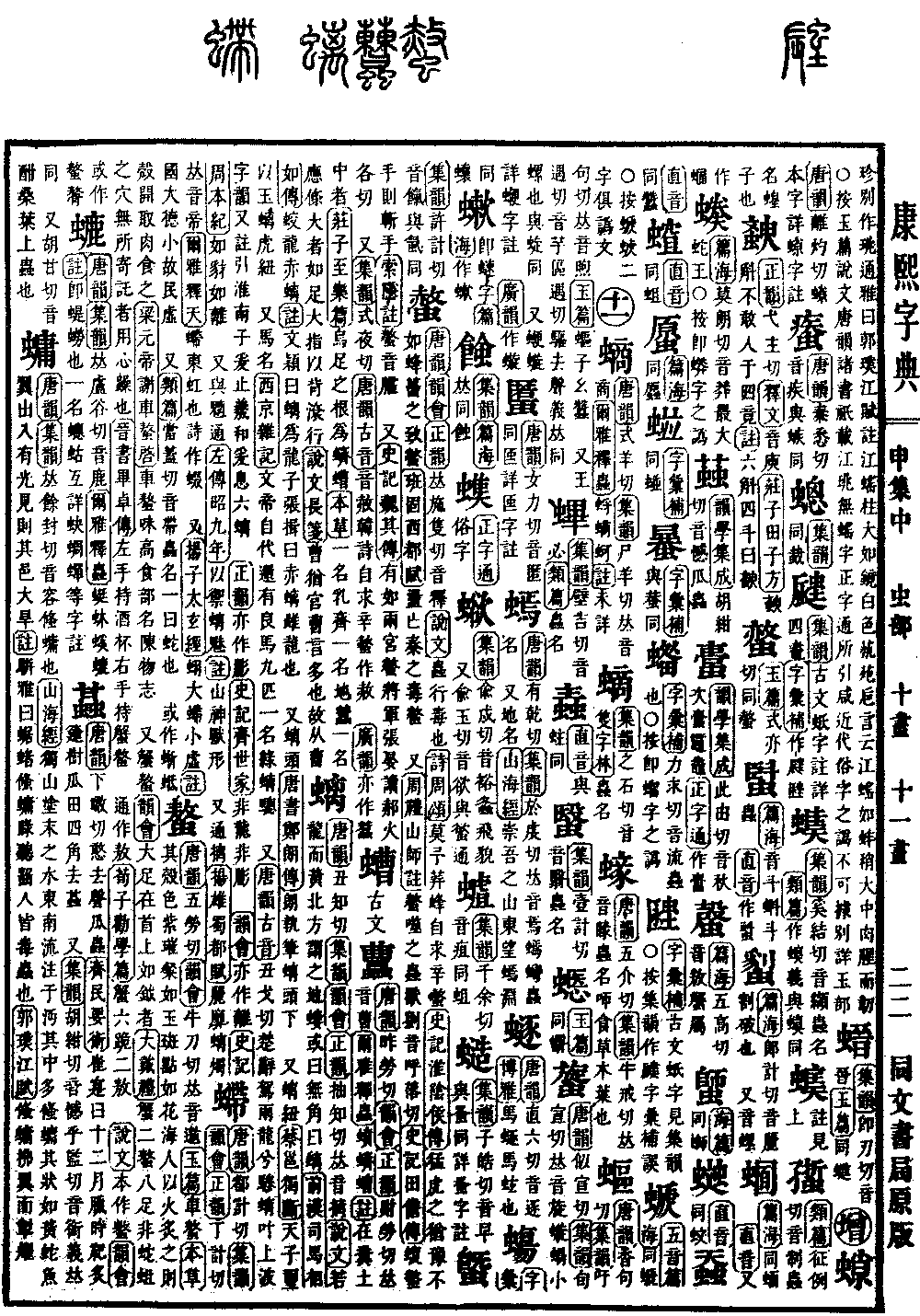
Shen Collection, Middle Volume
Radical: Insect (chóng)
17 strokes
Page 1094, Entry 51
Pronounced chi. According to the Explanation of Writing (Shuowen), it is a creature that resembles a dragon but is yellow in color; in the north, it is called a di lou. Others say that a dragon without horns is called a chi. In the Biography of Sima Xiangru in the History of the Former Han (Qianhan shu), it mentions water dragons and red chi. The commentary by Wen Ying states that the chi is the offspring of a dragon. Zhang Yi states that a red chi is a female dragon. It also refers to a chi head. In the Biography of Zheng Lang in the History of the Tang (Tang shu), it is written that Zheng Lang held his brush beneath the chi head. It also refers to a chi knob. According to the Sole Decisions (Duduan) by Cai Yong, the imperial seals of the Son of Heaven used jade-carved chi tigers as knobs. It is also the name of a horse. According to the Miscellaneous Records of the Western Capital (Xijing zaji), when Emperor Wen of Han returned from the Dai region, he possessed nine fine horses, one of which was called the green chi stallion. Also pronounced chi. In the Songs of Chu (Chuci), there is a line about driving two dragons and whipping the chi, which rhymes with the character bo in the preceding line. The commentary cites the Huainanzi, saying to command Xihe to halt and allow the six chi dragons to rest. Also written in a variant form (chi). In the Hereditary House of Qi in the Records of the Grand Historian (Shiji), it states neither dragon nor chi. Also written in a variant form (li). In the Basic Annals of Zhou in the Records of the Grand Historian, it mentions resembling jackals and the li beast. It is also interchangeable with chi (demon). In the Zuo Tradition (Zuo zhuan), Year 9 of Duke Zhao, it is used to ward off demons and mountain spirits. The commentary defines this as a mountain god with the shape of a wild beast. It is also interchangeable with chi (to spread out). In the Rhapsody on the Capital of Shu (Shudu fu) by Yang Xiong, it describes things as being magnificently spread out like a chi candle.