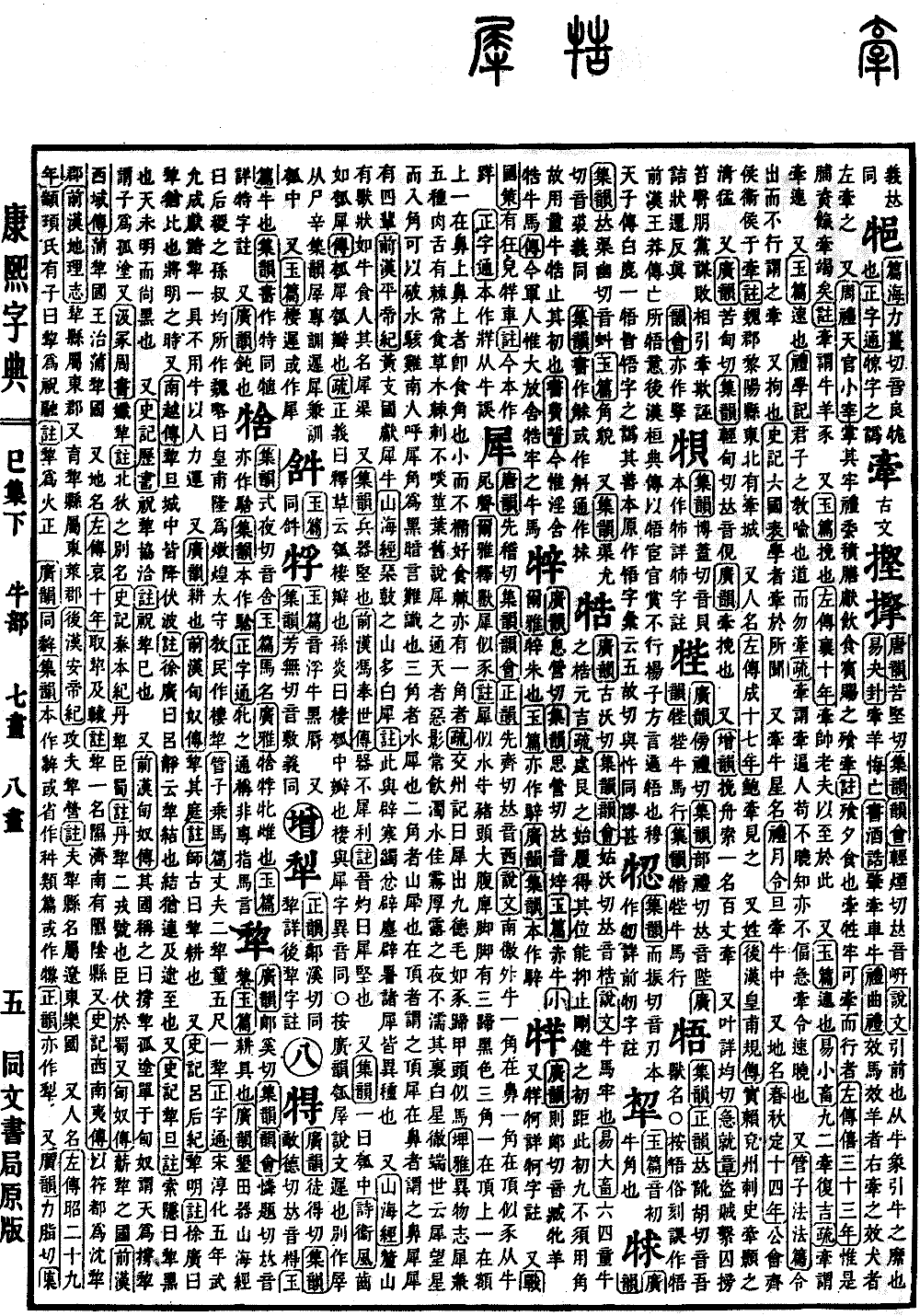
Si Collection, Lower Volume
Radical: Ox (niú)
Character: Plow
Kangxi Stroke Count: 12
Page 701, Entry 20
Guangyun: Pronounced li
Jiyun, Yunhui: Pronounced li
Yupian: An agricultural tool used for tilling fields.
Guangyun: An implement for plowing land. Classic of Mountains and Seas (Shanhaijing) states: Invented by Shujun, the grandson of Houji. Weilue states: When Huangfu Long served as Administrator of Dunhuang, he taught the people to construct the lou-li (a type of seed-drill plow).
Guanzi, Chapter on Riding Horses (Chengma Pian): Adult men are assigned two plows, and children five feet in height are assigned one plow.
Zhengzitong: In the fifth year of the Chunhua era of the Song dynasty, Wu Yuncheng presented a foot-operated plow that did not require oxen, relying on human labor.
Also, Guangyun: Refers to the act of tilling fields.
History of the Former Han (Qian Hanshu), Biography of the Xiongnu: To plow level their royal court.
Commentary: Shigu states: Plow means the same as tilling.
Also, Records of the Grand Historian (Shiji), Annals of Empress Lu: Plow-dawn.
Commentary: Xu Guang states: Plow is like comparison; it refers to the time when the sky is about to brighten.
Also, Records of the Grand Historian, Biography of Southern Yue: At plow-dawn, all people in the city surrendered to General Fubo.
Commentary: Xu Guang states: Lu Jing believes that plow means to connect; to connect implies linking, arriving, or waiting.
Also, Records of the Grand Historian, Commentary on Plow-dawn: Suoyin states: Plow means black; it refers to the time before dawn when the sky is still pitch black.
Also, Records of the Grand Historian, Treatise on the Calendar: Zhu-li (name of a year-sign).
Commentary: Zhu-li refers to the earthly branch Si.
Also, History of the Former Han, Biography of the Xiongnu: Their state is called the Chengli Gudu Shanyu. In the Xiongnu language, heaven is called chengli, and son is called gudu.
Also, Jizhong Zhoushu: Xianli.
Commentary: The name of a northern Di tribe.
Records of the Grand Historian, Annals of Qin: Danli submitted to the state of Shu.
Commentary: Danli is the title of two Rong tribes.
Also, Records of the Grand Historian, Biography of the Xiongnu: The state of Xinli.
History of the Former Han, Treatise on Geography: The King of Puli State governed Puli State.
Also refers to a place name.
Zuo Commentary (Zuozhuan), Tenth Year of Duke Ai: Captured the lands of Li and Yuan.
Commentary: Li is also known as Xiji; there is a Xiyin County in Jinan.
Also, Records of the Grand Historian, Biography of the Southwestern Barbarians: Established Zedu as Shenli Commandery.
History of the Former Han, Treatise on Geography: Li County was under the jurisdiction of Dong Commandery. There is also Yuli County, under the jurisdiction of Donglai Commandery.
History of the Later Han (Hou Hanshu), Annals of Emperor An: Attacked Fuli Camp.
Commentary: Fuli is the name of a county, under the jurisdiction of the Liaodong Dependent State.
Also refers to a person's name.
Zuo Commentary, Twenty-ninth Year of Duke Zhao: A son of the Zhuanxu clan named Li served as Zhurong.
Commentary: Li was the Fire Officer (official in charge of fire).
Guangyun: Same as the variant form (zhan).
Jiyun: Originally written as the variant form (zhan), or abbreviated as the current character. Leipian alternatively writes it as the variant form (zhan).
Zhengyun: Also written as the variant form (li).
Also, Guangyun: Pronounced li
Jiyun, Yunhui: Pronounced li
Guangyun: Refers to an ox with mottled fur.
Analects (Lunyu): The offspring of a mottled ox.
Commentary: Li refers to the mottled pattern.
Also, Jiyun: One source suggests it refers to tilling fields.
Also, Book of Documents (Shangshu), Great Declaration (Taishi): Abandon the hunchbacked elderly.
Commentary: Hunchbacked elderly are called li-lao.
Sub-commentary: Sun Yan states: Gou refers to a complexion darkened by cold, as if covered with grime.
Exposition of Texts (Shiewen): Pronounced li, also pronounced li.
Also, Spring and Autumn Annals (Chunqiu), Sixth Year of Duke Ding: The people of the Jin state detained the Song diplomat Le Qi-li.
Also, Zuo Commentary, Tenth Year of Duke Ai: Captured the land of Li.
Exposition of Texts: Pronounced li, also pronounced li; both pronunciations are acceptable.
Jiyun: Alternatively written as the variant form (li).
Yunhui: Commonly written as the variant form (li).
Also, Jiyun: Pronounced liu. Liran refers to the appearance of being clear and distinct.
Zhuangzi, Chapter on Mountain Trees (Shanmu Pian): My heart clearly and distinctly feels in harmony with the human heart.
The pronunciation provided is not liu.