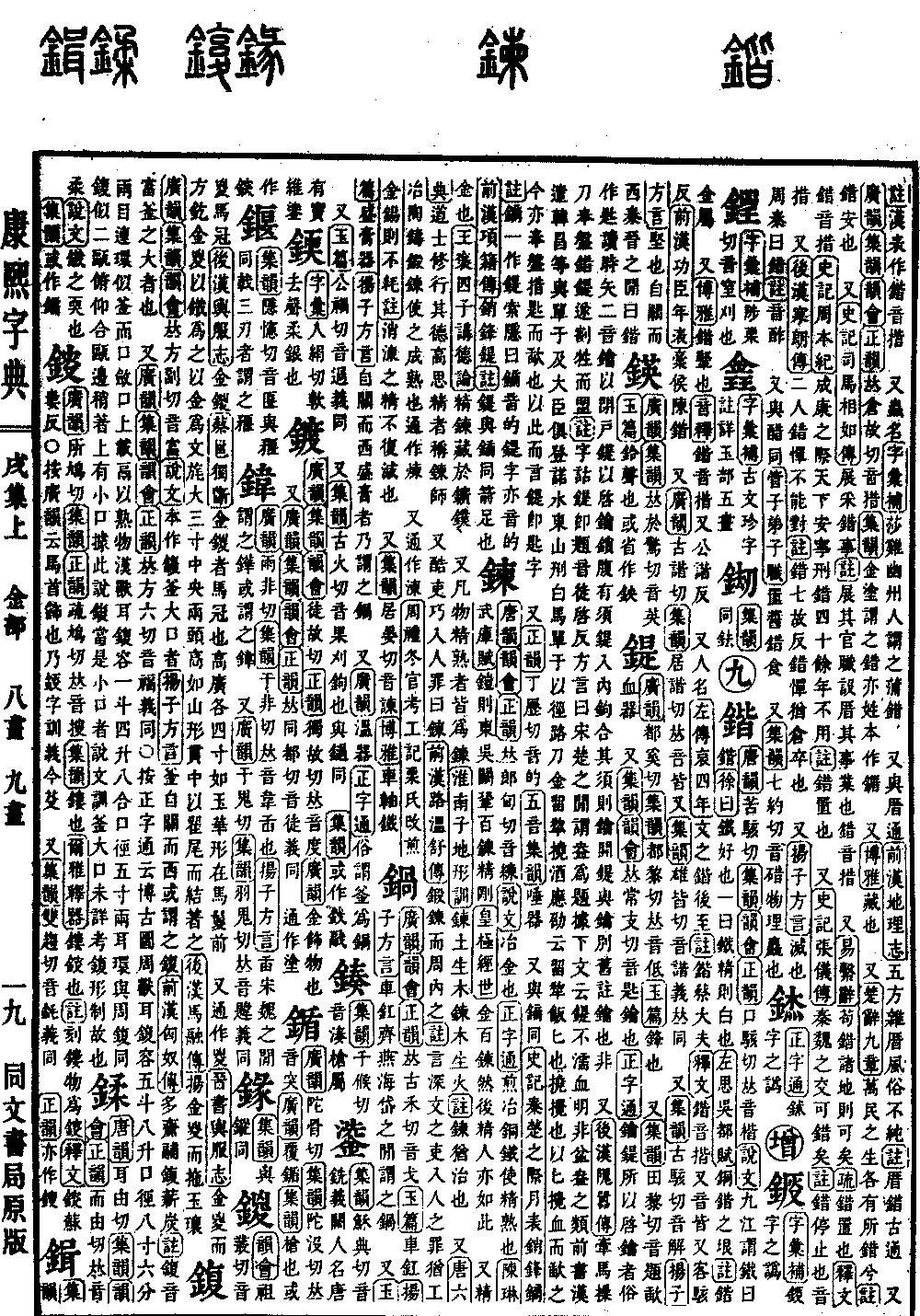
Xu Collection, Upper Volume
Radical: Metal (jīn)
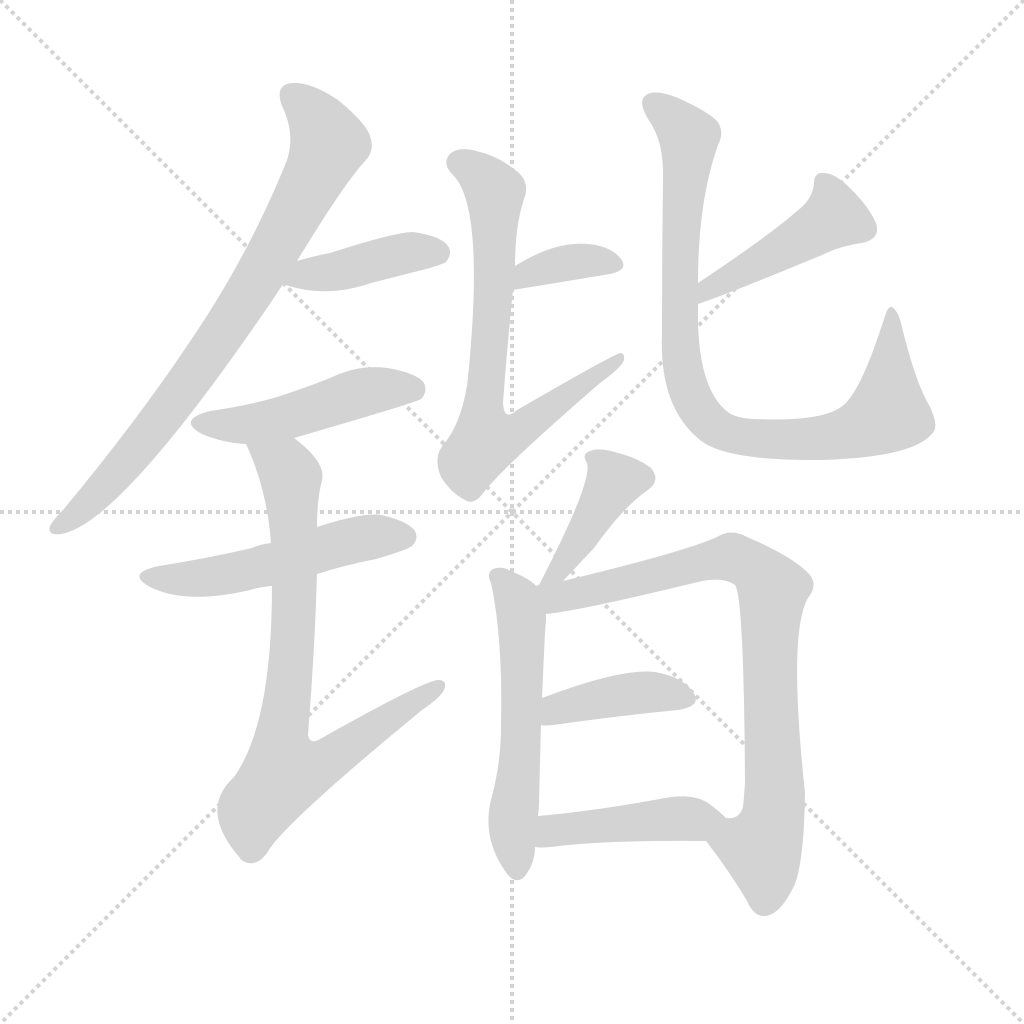
Kai
Kangxi strokes: 17
Page 1313, Entry 01
Pronounced kai.
According to the Explaining Graphs and Analyzing Characters (Shuowen Jiezi), in the Jiujiang region, iron is referred to as kai. Xu states that this refers to fine quality iron. Another interpretation is that when iron is refined to its essence, it appears white. In the Rhapsody on the Capital of Wu (Wudu Fu) by Zuo Si, it mentions the banks of copper and iron. The commentary notes that kai is a type of metal.
According to the Erudite Gloss (Boya), it is also written as kai. The Phonetic Explication notes that the sound is kai. It is also pronounced as gong-xie.
Also used in a personal name. In the Zuo Tradition (Zuozhuan), during the fourth year of Duke Ai, Wen Zhi Kai arrived late. The commentary notes that Kai was a grand officer of the state of Cai. The Explanation of Sounds notes the pronunciation as kai, and also as jie. It is also pronounced as ke-hai.
In the Table of Meritorious Officials of the Former Han (Qianhan Gongchen Nianbiao), there is the Marquis of Gao, Kai.
According to the Expanded Rhymes (Guangyun), pronounced jie. According to the Collected Rhymes (Jiyun), pronounced jie.
According to the Collected Rhymes (Jiyun), pronounced xie. The meaning is the same.
According to the Collected Rhymes (Jiyun), pronounced jie. According to the Dialects (Fangyan) by Yang Zi, it means hard. From the mountain pass to the west, in the regions of Qin and Jin, it is called kai.