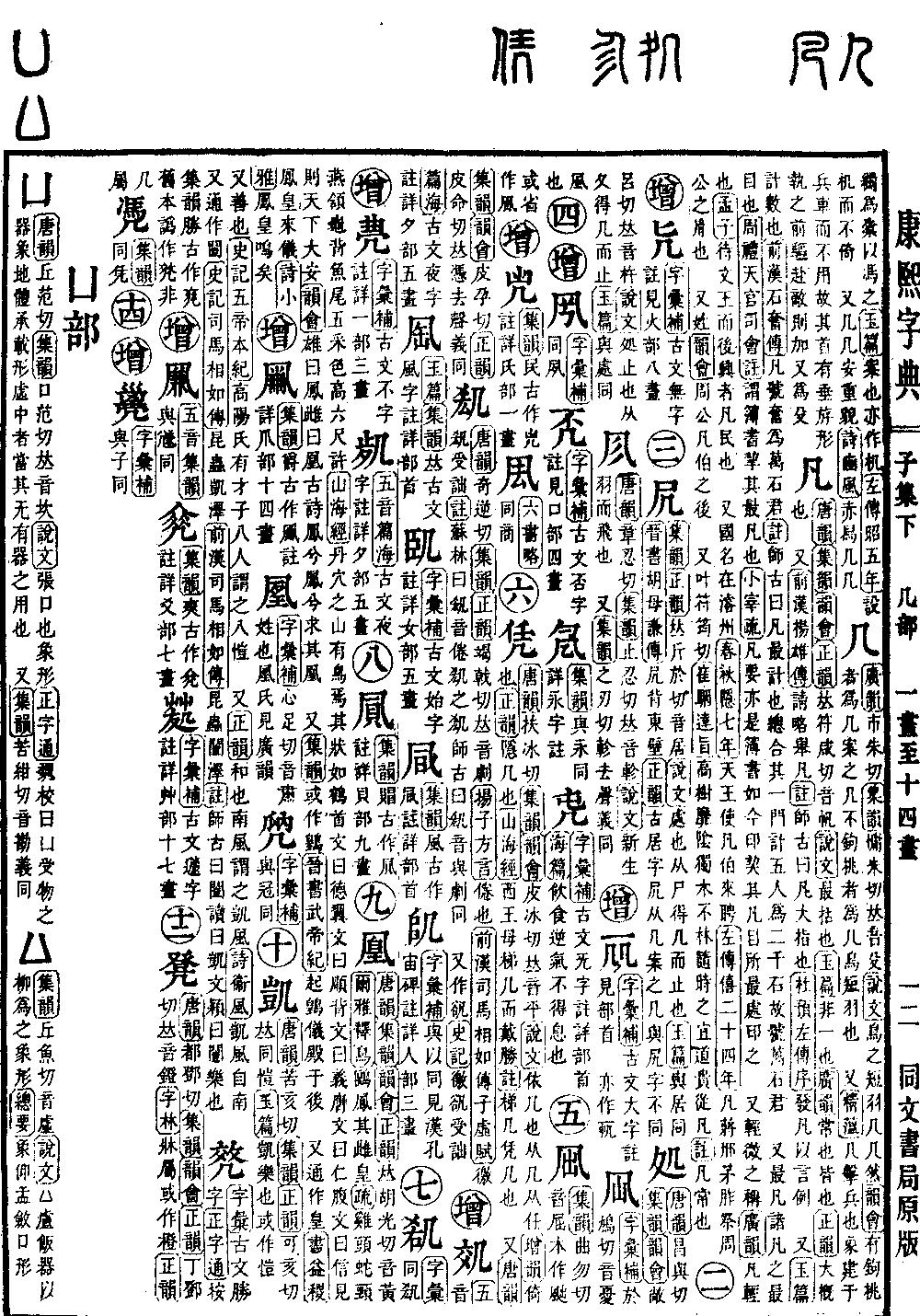
Zi Collection, Page Position: Lower
Radical: Small Table (jī)
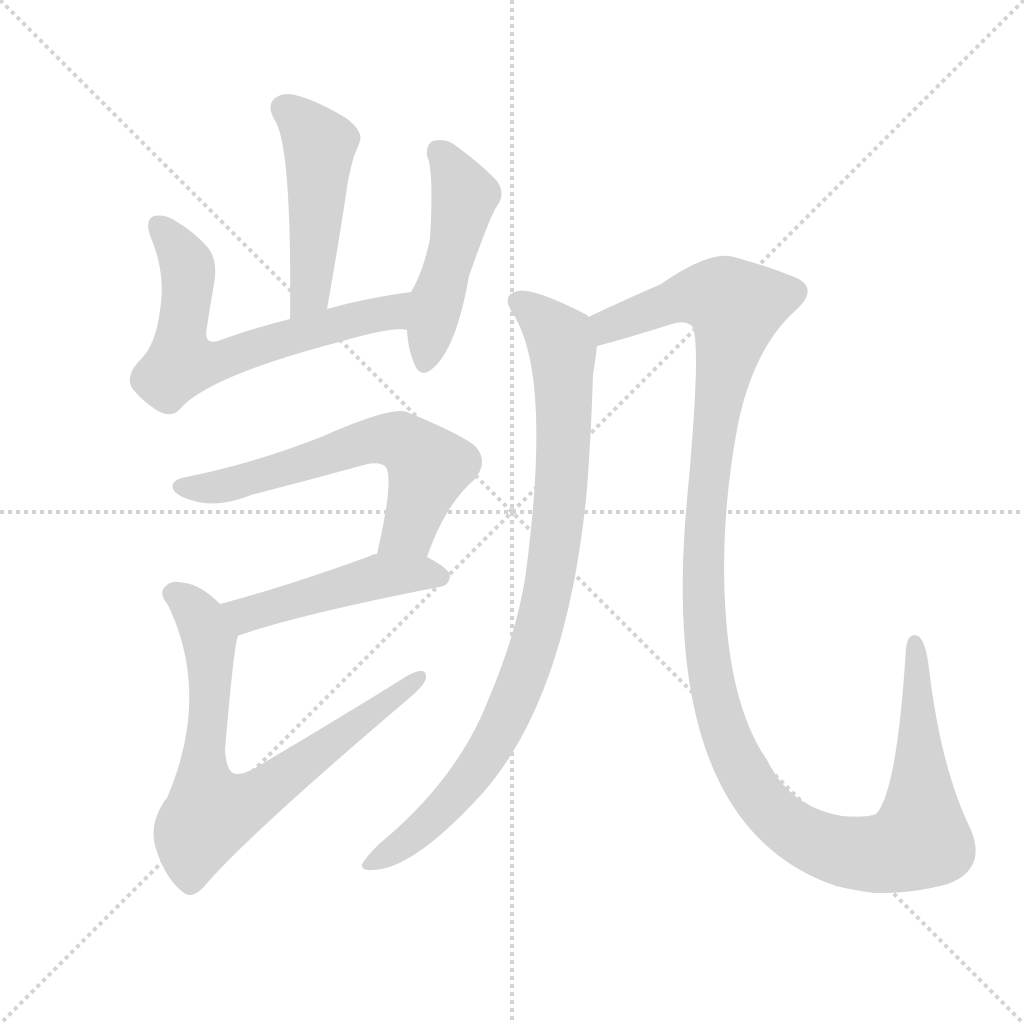
Kǎi; Kangxi strokes: 12; Page: 134, entry 22
According to the Tangyun (Tángyùn), pronounced kǔhài qiè. According to the Jiyun (Jíyùn) and Zhengyun (Zhèngyùn), pronounced kěhài qiè. It is interchangeable with 恺 (kǎi). According to the Yupian (Yùpiān), kǎi means joy or music. Sometimes written as 恺 (kǎi). It also means good or virtuous. In the Records of the Grand Historian (Shiji), Annals of the Five Emperors, it states: "The Gaoyang clan had eight talented sons, who were called the Eight Kǎi." Also, according to the Zhengyun (Zhèngyùn), it means harmony. A south wind is called a kǎi wind. In the Book of Odes (Shijing), Odes of Wei, it says: "The kǎi wind blows from the south." It is also interchangeably written as 闿 (kǎi). In the Records of the Grand Historian (Shiji), Biography of Sima Xiangru, it says: "Insects are joyful and prosperous." In the History of the Former Han (Qian Han), Biography of Sima Xiangru, it says: "Insects are joyful and prosperous." The commentary notes: Shi Gu said: 闿 is read as kǎi. Wen Ying said: 闿 means joy.