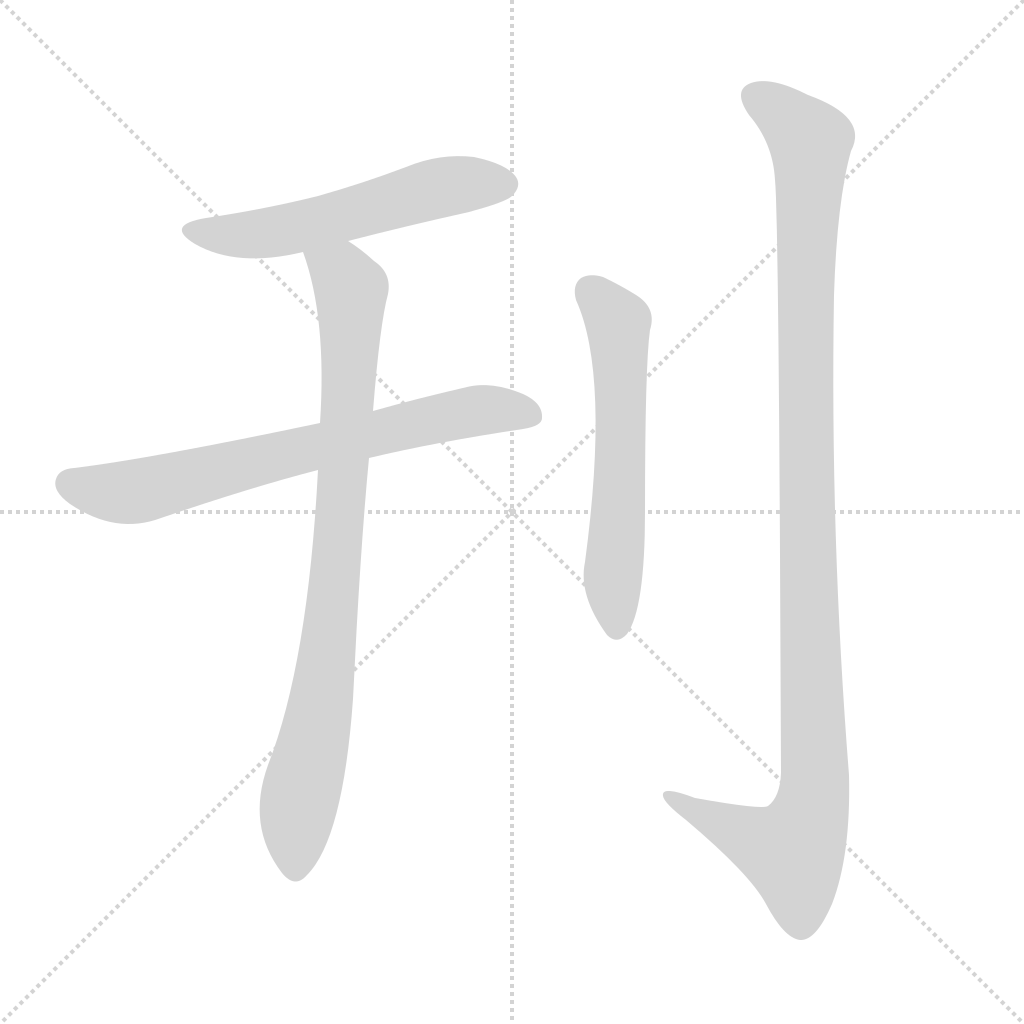
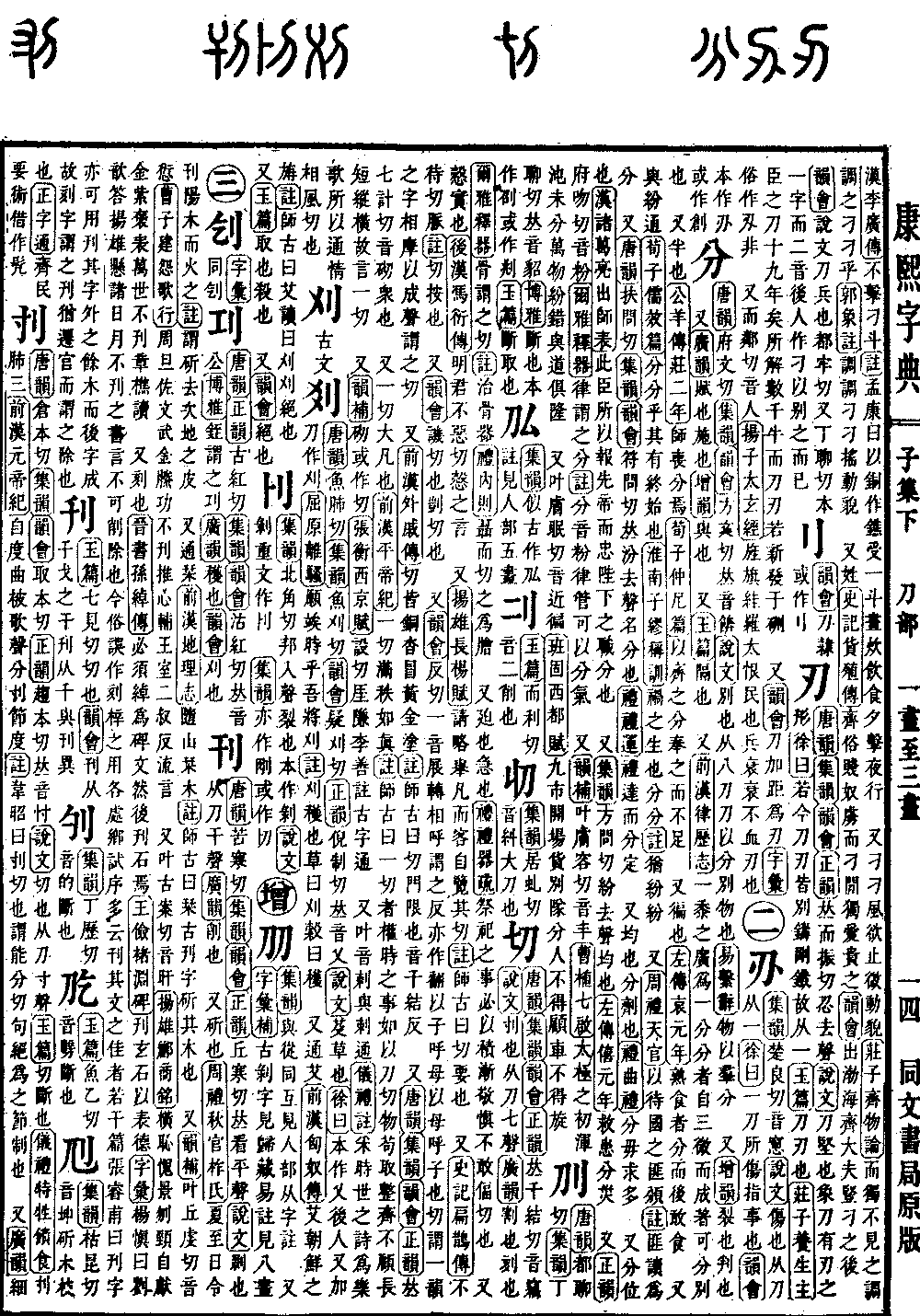
Zi Collection, Page Position: Lower. Radical: Knife (dāo). Character: kan. Kangxi Stroke Count: 5. Page 136, Position 16.
According to the Tang Rhymes (Tangyun), the sound is derived from ku and han. According to the Collected Rhymes (Jiyun), the Rhyme Assembly (Yunhui), and the Correct Rhymes (Zhengyun), the sound is derived from qiu and han. It is pronounced like the level tone of the word kan.
The Explanation of Graphs and Analysis of Characters (Shuowen Jiezi) defines it as to shave off or prune. The character is composed of the Knife (dao) radical, with gan providing the sound.
The Expanded Rhymes (Guangyun) defines it as to shave. It is also defined as to chop or hack.
The Rites of Zhou (Zhouli), Ministry of Justice (Qiuguan), Master of the Woods (Zuoshi) section records: At the summer solstice, an order is issued to hack off the bark of trees on the sunny side and burn them. The commentary explains that this refers to hacking off bark from secondary growth.
It is also interchangeable with the character kan, which is sometimes written in a variant form pronounced zhuan. The History of the Former Han (Qian Hanshu), Treatise on Geography (Dilizhi) records: Clearing trees along the mountains. Yan Shigu notes that the variant form is the ancient form of the character kan, meaning to fell trees.
In the Rhyme Supplement (Yunbu), it rhymes with the sound derived from qiu and qian, pronounced like qian. From the poem Song of Resentment (Yuange Xing) by Cao Zhi: The Duke of Zhou assisted King Wen and King Wu; his achievements were recorded in the Golden Casket (Jinteng) and are indelible. He devoted his heart to the royal house, yet the uncles Guan and Cai spread rumors.
It also rhymes with the sound derived from gu and an, pronounced like gan. From the Inscription for Li Shang (Li Shang Ming) by Yang Xiong: Facing unexpected shame and dishonor, he sacrificed himself. Honored with a gold seal and purple ribbon for his merit, his legacy is indelible for ten thousand generations. This is the interpretation provided by Zhang Qiao.
It is also defined as to engrave. The Book of Jin (Jin Shu), Biography of Sun Chuo records: It was necessary for Sun Chuo to write the stele inscription before it could be engraved in stone. From the Stele of Chu Yuan by Wang Jian: Engraving a dark stone monument to illustrate his virtue.
In the Lexicon (Zihui), Yang Shen says: When Liu Xin replied to Yang Xiong, he used the phrase a book hung before the sun and moon that cannot be deleted, meaning a book that is unalterable. Nowadays, it is commonly used to mean woodblock printing. Prefaces to provincial examinations often mention printing a certain number of excellent essays. Zhang Ruifu says that the character can be used this way because by paring away the excess wood around a character, the character is revealed; thus, engraving is called kan, just as an official appointment is called chu.