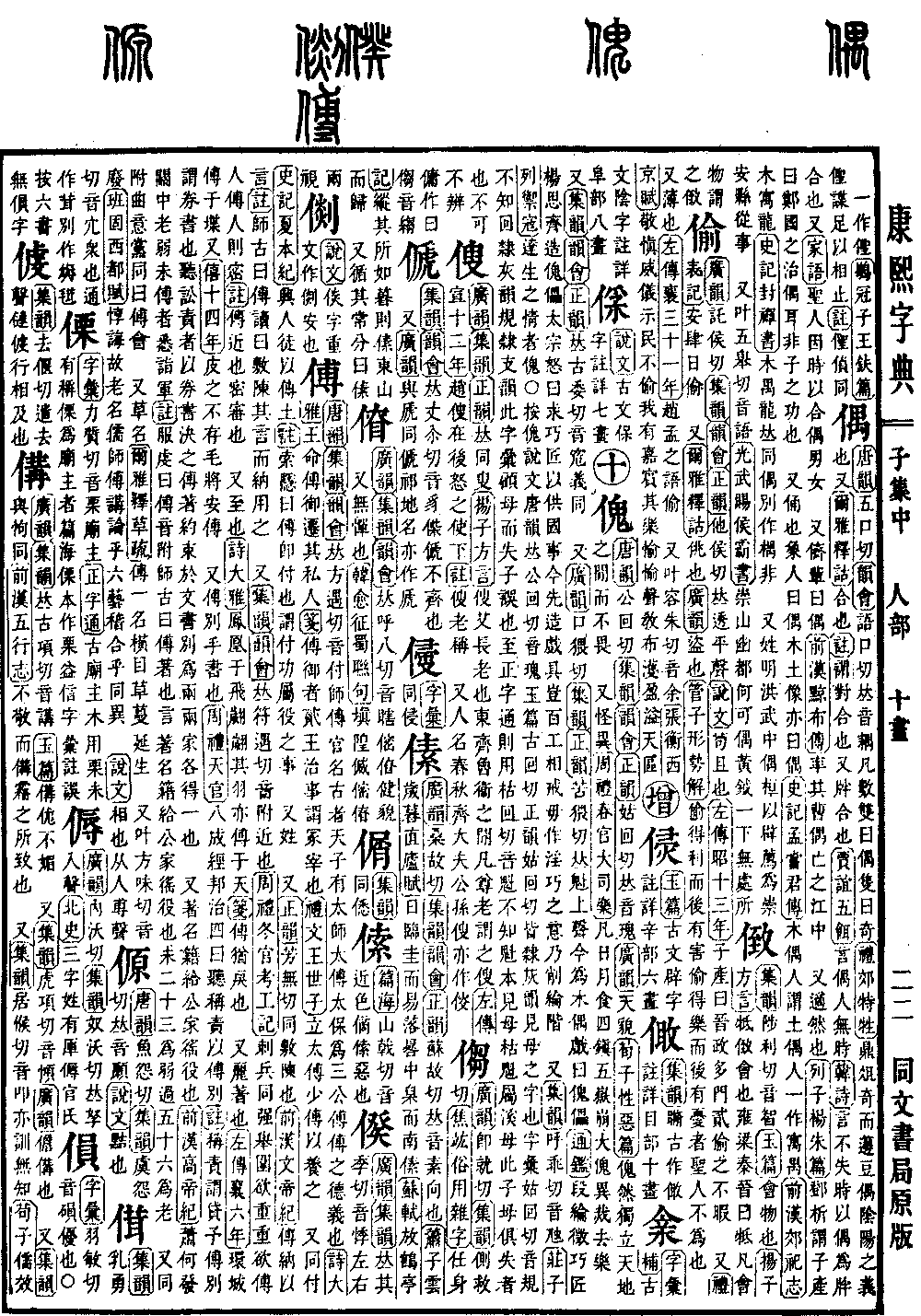
Zi Collection, Middle Volume
Radical: Person (rén)
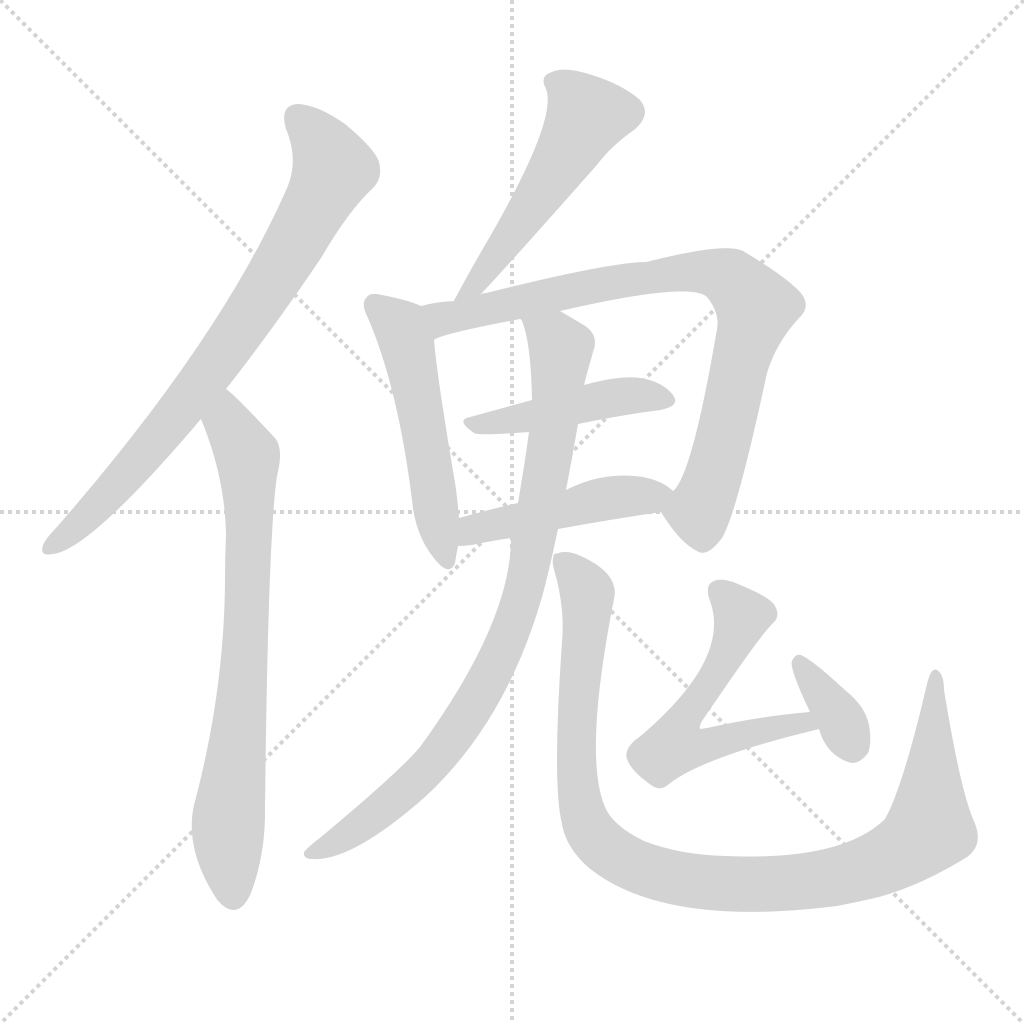
Kua
Kangxi Strokes: 12
Page 112, Entry 08
Pronounced hui.
In Tang Rhymes (Tangyun), also defined as resembling something huge.
In Xunzi (Xunzi), regarding the chapter on the Evil Nature of Human Beings: Standing alone, upright and firm between heaven and earth, without fear. Also refers to something strange or bizarre.
In Rites of Zhou (Zhouli), regarding the Office of Spring and the Great Director of Music: Whenever there is a solar or lunar eclipse, or the collapse of the four guardian mountains or the five sacred mountains, or other major calamitous anomalies, the playing of music must be ceased.
Also pronounced wei (rising tone). The meaning remains the same.
Also pronounced kui (rising tone). Presently, puppet shows are called kuilei. In the Comprehensive Mirror for Aid in Government (Tongjian): Duan Lun recruited skilled craftsmen, and Yang Siqi created puppets. Tang Taizong was angry and said: I sought skilled craftsmen for the benefit of the state; yet now, you first produce tools for frivolous entertainment. Is this the intended meaning of having the hundred artisans warn one another against crafting overly intricate items? Consequently, he demoted Duan Lun.
Also pronounced hui. In Zhuangzi (Zhuangzi): Those who comprehend the reality of life have expansive minds.
Note: Regarding the character Kua, the Shuo Wen Jie Zi and Tang Rhymes provide the pronunciation as hui. The Jade Chapters (Yupian) provides it as hui, and the Correct Rhymes (Zhengyun) as hui, all of which belong to the hui rhyme group with the initial consonant j. The Dictionary of Characters (Zihui) provides the pronunciation as gui, though it fails to realize that hui belongs to the hui rhyme group and gui belongs to the zhi rhyme group; this is an error where the Dictionary of Characters (Zihui) considered the initial sound of the pronunciation guide but mistook the rhyme group of the final sound. As for the Correct Meaning of Characters (Zhengzitong), it provides the pronunciation as kui, failing to realize that kui belongs to the initial consonant j, whereas ku and kui belong to the initial consonant k; this is an error where both the initial and final components of the pronunciation guide are incorrect. This must be distinguished clearly.
Textual Research: In Guangyun, it is defined as heavenly appearance. Note: In the original text, this has been corrected from heavenly appearance to great appearance.