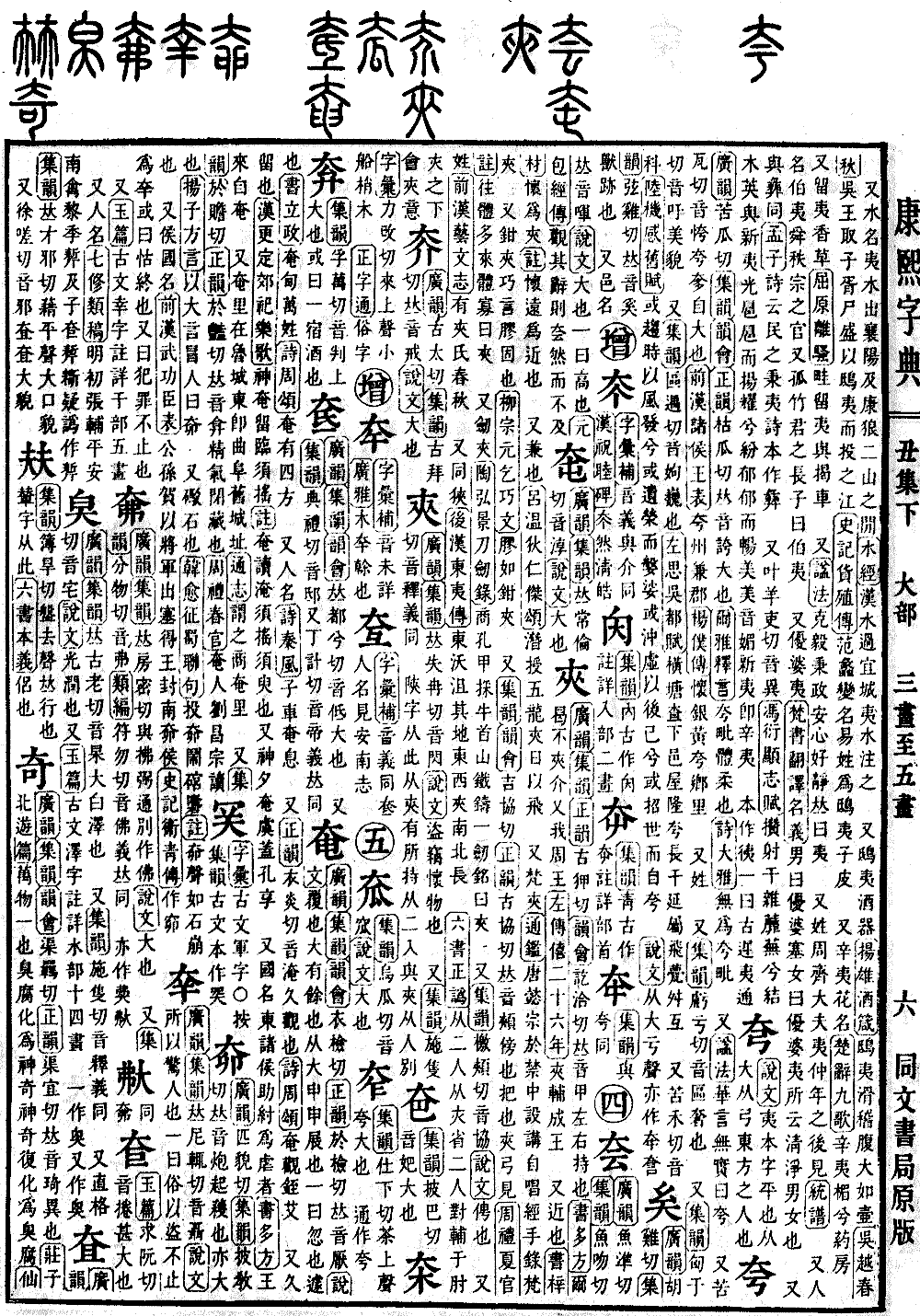
Chou Collection, Lower Volume
Radical: Big (dà)
Kangxi strokes: 13
Page 250, Entry 02
Pronounced kua. Meaning: big.
Book of Etymology (Erya), Explanations of Words: Kua-pi refers to a weak body or someone who is servile.
Book of Odes (Shijing), Greater Odes (Daya): Contains the phrase, do not be servile.
Also, according to the Law of Posthumous Names (Shifa), language that is flowery but impractical is called kua.
Also pronounced kua. Meaning: boastful, being arrogant.
History of the Former Han (Qian Hanshu), Table of Feudal Lords: Contains the phrase to boast of provinces and annex commanderies.
Biography of Yang Pu: Contains the phrase to carry silver and gold to show off in one's home village.
Also a surname.
Also, according to the Collected Rhymes (Jiyun), pronounced qu. Meaning: extravagant.
Also, according to the Collected Rhymes (Jiyun), pronounced xu. Meaning: having a beautiful appearance.
Also, according to the Collected Rhymes (Jiyun), pronounced xu. Meaning: tall and large.
Rhapsody on the Capital of Wu (Wudu Fu) by Zuo Si: Writes, the cross-dike lies below, the houses and dwellings are lofty and large. The long causeway stretches out, the flying eaves are staggered and interlaced.
Also pronounced ke.
Rhapsody on Reflecting on the Past (Ganjiu Fu) by Lu Ji: Contains the line, some rush to the times like the wind, some abandon glory and are carefree. Some are humble and put themselves last, some beckon the world and boast of themselves.
Explanations of Graphs and Analysis of Characters (Shuowen Jiezi): Explained as composed of the radical big and the phonetic kui. Also written in a variant form.