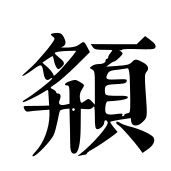
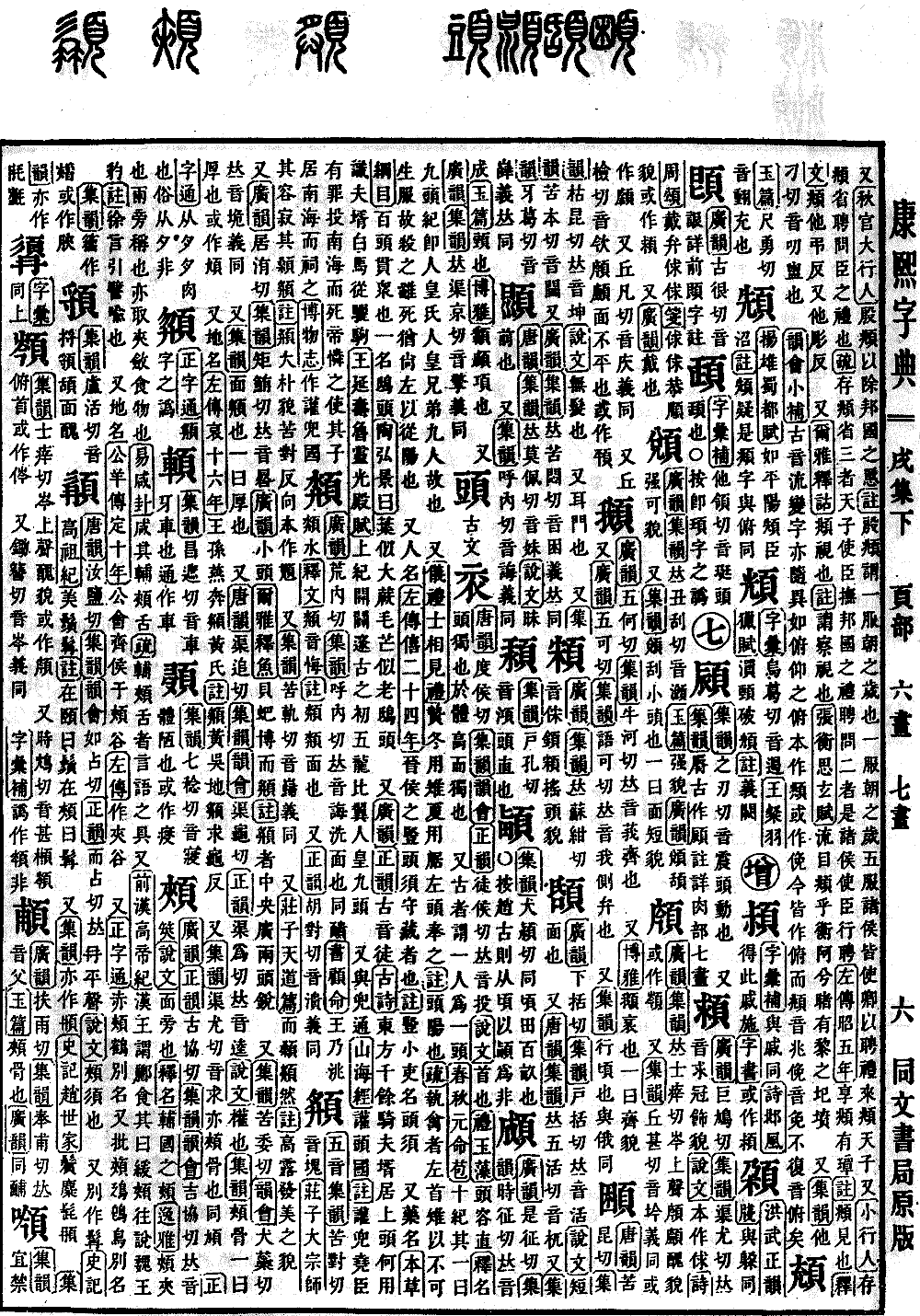
Xu Collection, Lower Volume
Radical: Page (yè)
Kangxi Strokes: 16
Page 1404, Entry 23
Five Tones Collected Rhymes (Wuyin Jiyun) Pronounced kuai.
Zhuangzi, The Great and Venerable Teacher (Dazongshi): His face was tranquil, his forehead broad and simple.
Annotation: Kui, describing a broad and simple appearance. Pronounced kuai. Xiang Xiu's version is written with a variant form.
Also, Collected Rhymes (Jiyun) Pronounced kui. The meaning is the same.
Also, Zhuangzi, The Way of Heaven (Tiandao): The appearance of a forehead being high and glossy.
Annotation: Describing a high, exposed, and radiant beautiful facial appearance.
Also, Broad Rhymes (Guangyun), Collected Rhymes (Jiyun) Pronounced gui.
Broad Rhymes (Guangyun) refers to a small head.
Erya, Explaining Fishes (Shiyu): The shellfish known as ba, which is broad in the middle and pointed at both ends.
Annotation: Kui, in this context, refers to being broad in the middle and pointed at both ends.
Also, Collected Rhymes (Jiyun), Rhyme Meetings (Yunhui) Pronounced gui. The meaning is the same.
Also, Collected Rhymes (Jiyun) refers to the cheek. Another meaning is thick.
Also, Tang Rhymes (Tangyun), Collected Rhymes (Jiyun), Rhyme Meetings (Yunhui), Correct Rhymes (Zhengyun) Pronounced kui.
Explanation of Simple and Compound Characters (Shuowen): Refers to the cheekbone.
Collected Rhymes (Jiyun): The bone on the cheek. Another meaning is thick. Sometimes also written in a variant form (qiú).
Also refers to a place name.
Zuo Commentary (Zuozhuan), Sixteenth Year of Duke Ai: Wangsun Yan fled to the place called Kuihuang.
Annotation: Kuihuang is a location in the state of Wu. Kui is pronounced qiu.
Also, Collected Rhymes (Jiyun) Pronounced qiu. Also refers to the cheekbone. Same as the variant form (qiú).
Correct Meanings (Zhengzitong): The character structure includes the radical for flesh. The common variant form using the radical for evening is incorrect.