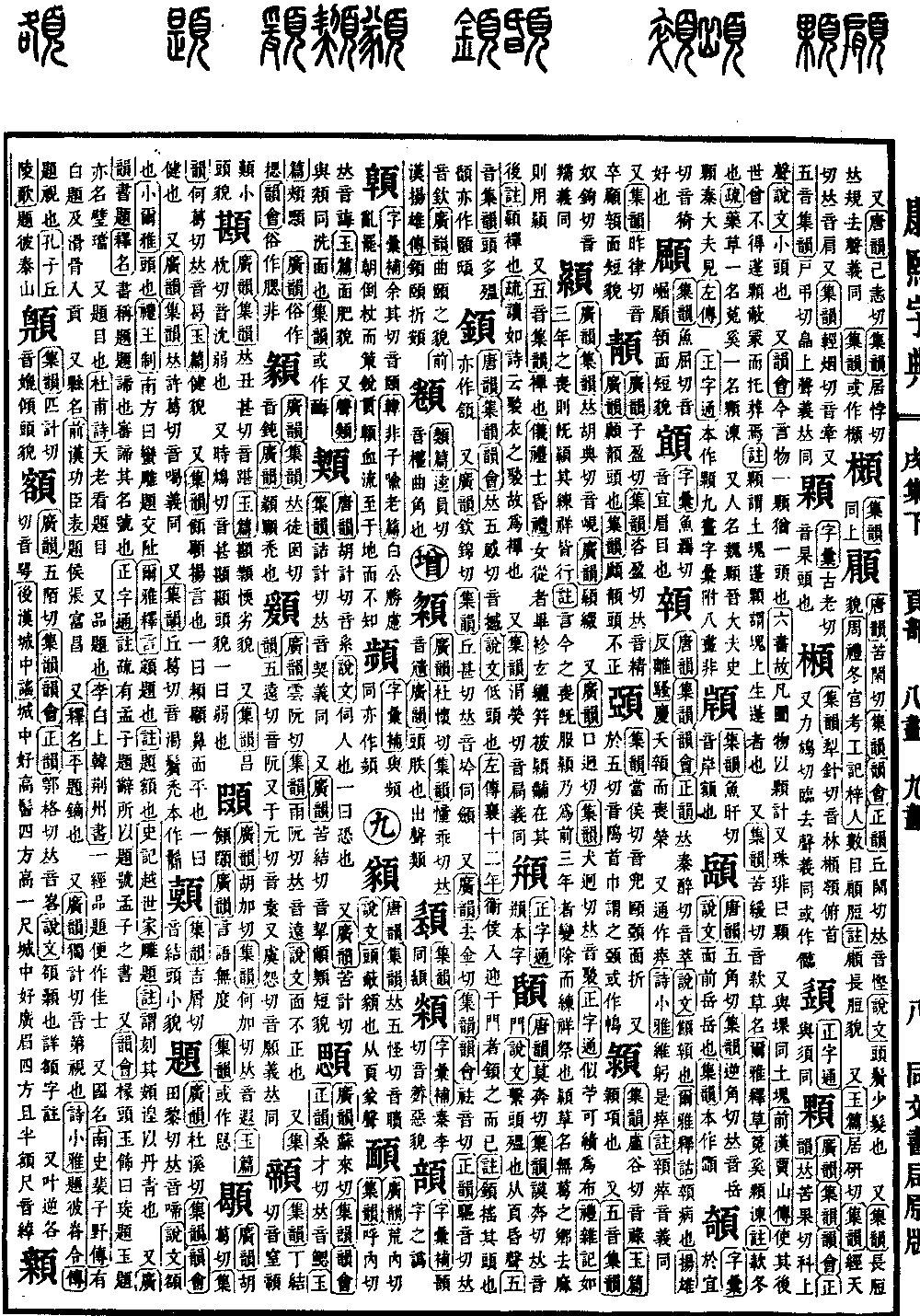
Xu Collection, Lower Volume
Radical: Leaf (yè)
Kangxi stroke count: 17
Page 1406, Entry 06
Pronounced ke (rising tone).
Shuowen Jiezi (Explanation of Graphs and Analysis of Characters) defines it as a small head.
Yunhui (Collection of Rhymes) notes that current usage of the term to count objects, as in a single unit, is equivalent to saying a single head.
Liushu Gu (Origins of the Six Writings) states that all circular objects are counted using this term. It also refers to a string of beads.
Also synonymous with the character duo. It refers to a clod of earth.
Hanshu (Book of Han), Biography of Jia Shan: His descendants would not even be able to obtain a clod of earth covered in weeds to cover a grave. Commentary: This refers to a clod of earth. Pengke refers to a clod of earth overgrown with mugwort.
Also, according to Jiyun (Collection of Rhymes), pronounced kuan (rising tone). It is the name of a type of plant.
Erya (Approaching Elegance), Interpretation of Grasses: Tuxi, also known as kedong. Commentary: This is kuandong. Commentary and Sub-commentary: A type of medicinal herb. Also called Tuxi, also called kedong.
Also used in personal names. Wei Ke was a high-ranking official of the Jin state. Shi Ke was a high-ranking official of the Qin state. Found in Zuo Zhuan (Commentary of Zuo).
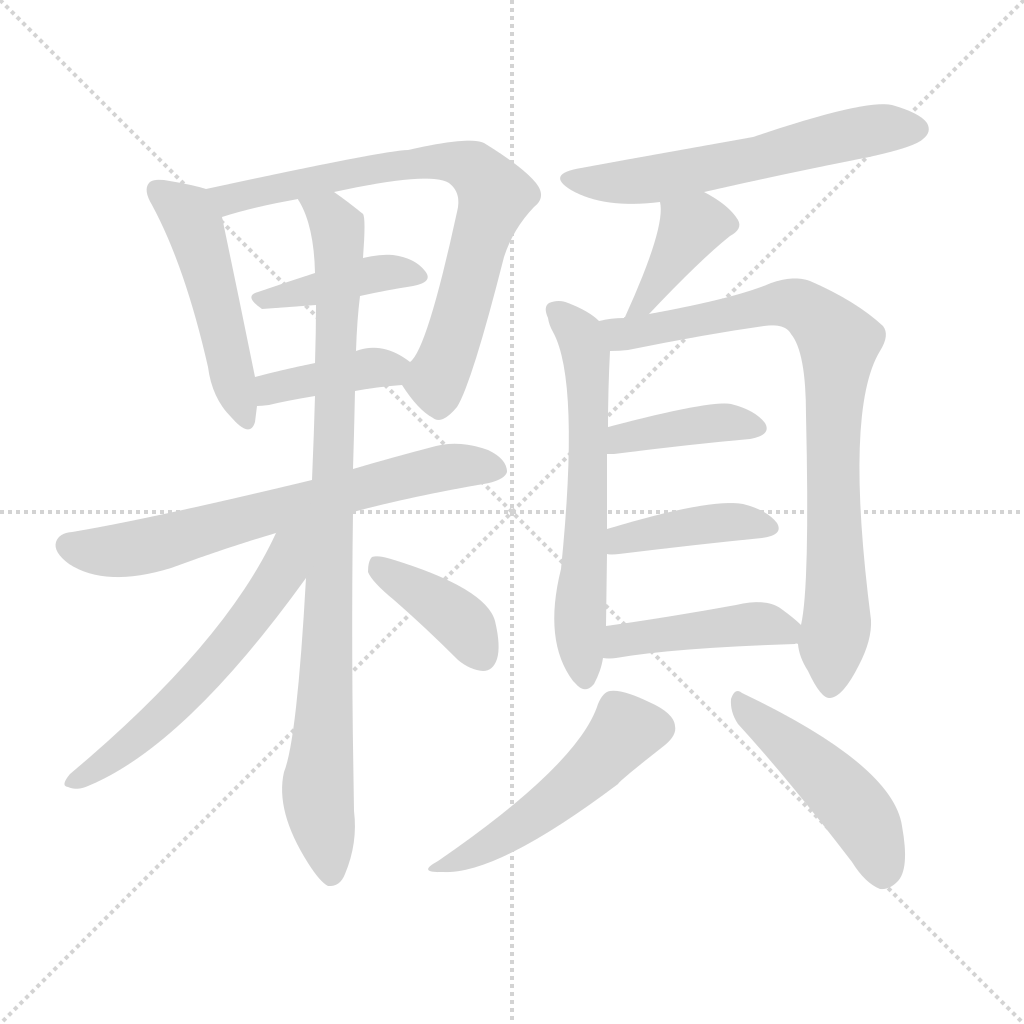
Zhengzitong (True Meaning of Characters) states that it was originally written with seventeen strokes. The Zihui (Compendium of Characters) categorizes it under eight strokes, which is incorrect. The left side of the character was originally composed of the field radical over the wood radical.