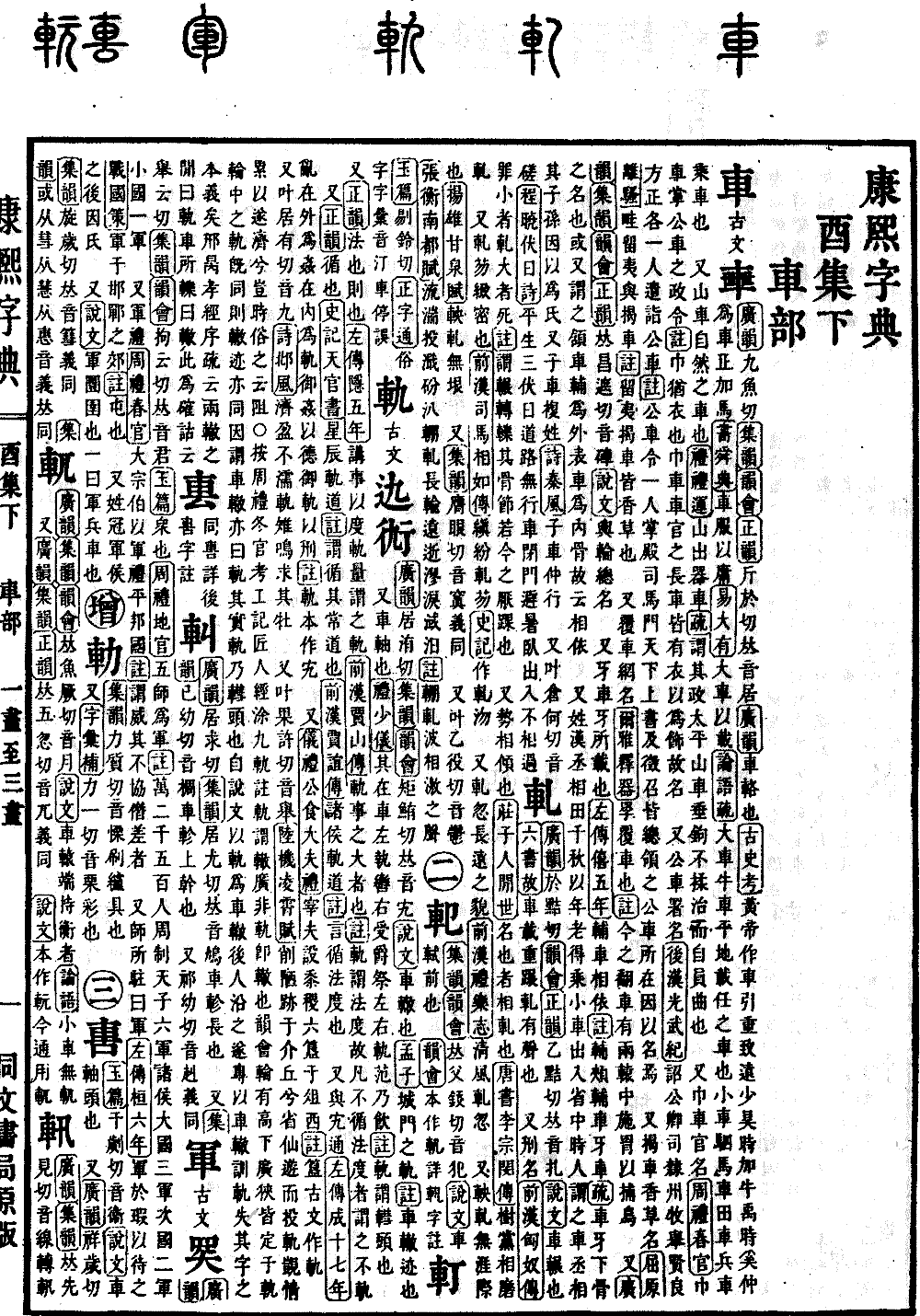
You Collection, Lower Volume
Radical: Carriage (chē)
军
Kangxi strokes: 9
Page 1239, Entry 11
Ancient form.
According to the Broad Rhymes (Guangyun), pronounced jun.
According to the Collected Rhymes (Jiyun) and the Rhyme Collection (Yunhui), pronounced jun.
According to the Jade Chapters (Yupian), it means a multitude.
In the Rites of Zhou (Zhouli), Earth Offices: Five divisions form a military corps. Note: Twelve thousand five hundred people. According to the institutions of the Zhou dynasty, the Son of Heaven possessed six military corps. Great states of the feudal lords had three, medium states had two, and small states had one.
Also, military rites. In the Rites of Zhou (Zhouli), Spring Offices: The Grand Minister of Religion uses military rites to pacify the states. Note: This refers to intimidating those who are disobedient or who exceed their proper station.
Also, a place where an army is stationed is called a military camp. In the Zuo Tradition (Zuozhuan), Sixth Year of Duke Huan: Stationed the army at Xia to wait. In the Strategies of the Warring States (Zhanguoce): Stationed the army in the outskirts of Handan. Note: This means to garrison.
Also, a surname. Descendants of the Marquis of Guanchun took Jun as their surname.
Also, according to the Explanation of Writing (Shuowen): Jun means to surround and guard. Another theory states that Jun refers to military carriages.