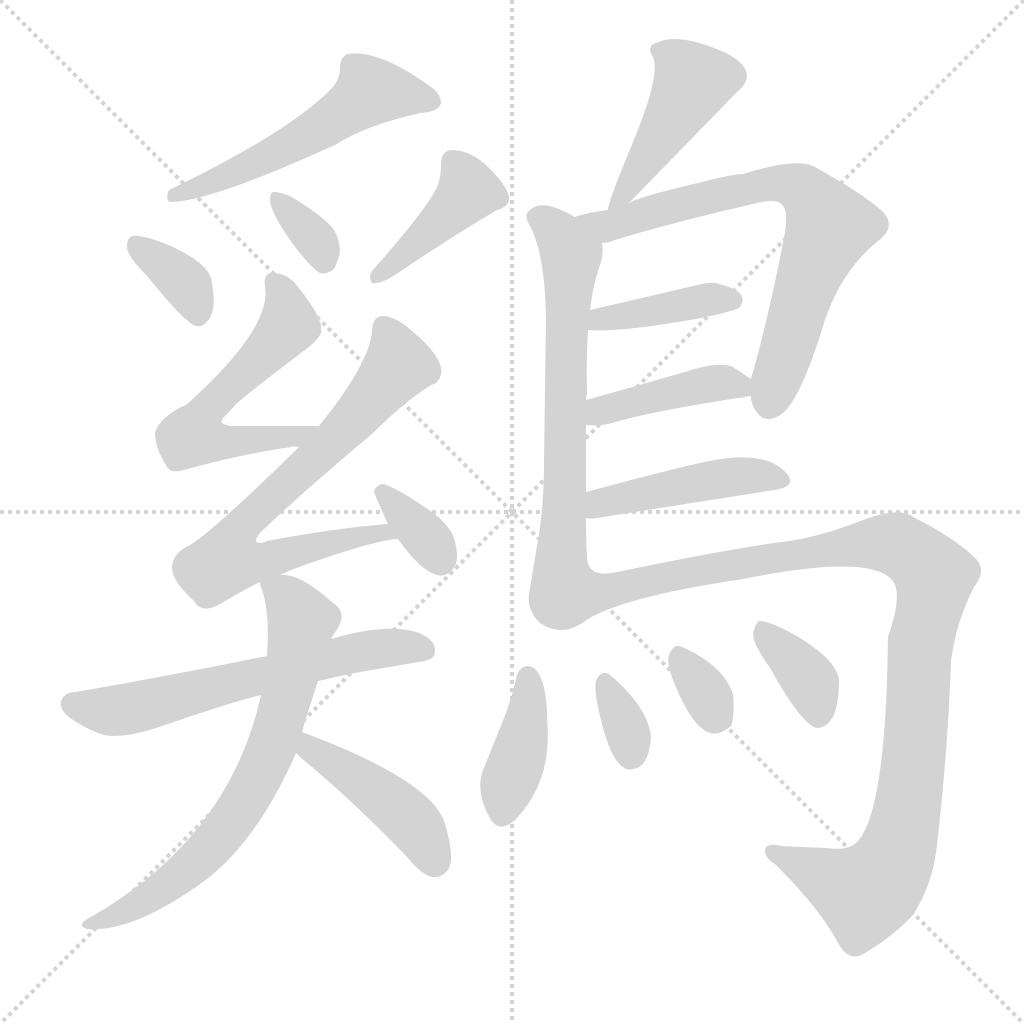
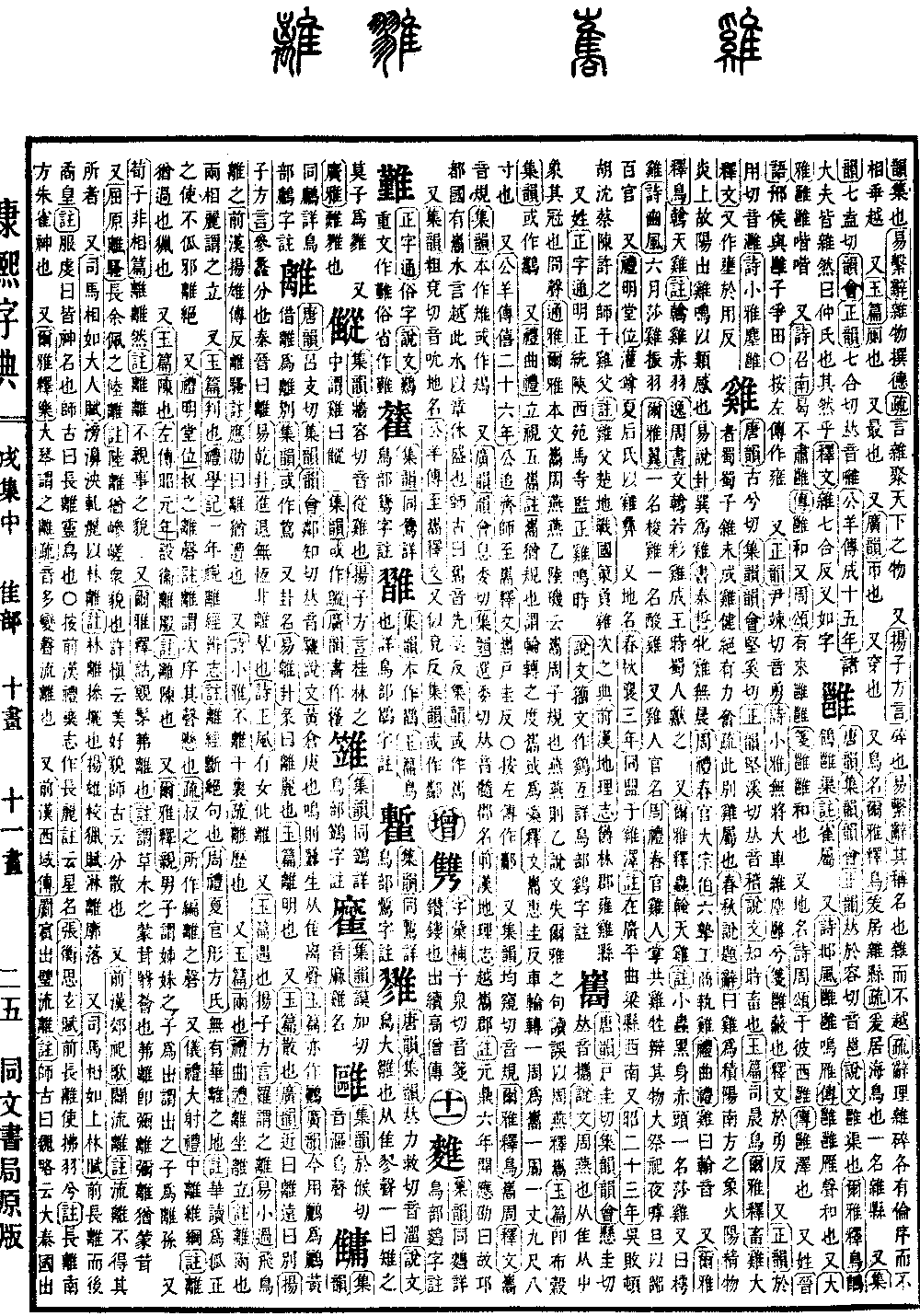
Hai Collection, Middle Volume
Radical: Bird (niǎo)
Ji; Kangxi stroke count: 21; Page 1369
Pronounced ji
Pronounced ji
According to the Explaining Graphs and Analyzing Characters (Shuowen Jiezi), it is an animal that understands time. Xu Xuan states: The chicken is an examiner; it is able to examine the time.
Book of Changes (Yijing), Section on Discussion of Trigrams (Shuogua): Wind (xùn) is the chicken.
Book of Odes (Shijing), Zheng Odes (Zhengfeng): The woman says the chicken is crowing.
Book of Rites (Liji), Section on Summary of Propriety (Quli): The chicken is called the bird with the resonant voice.
Han's Commentary on the Book of Odes (Hanshi Waizhuan): The chicken possesses five virtues: the comb on its head represents literary refinement; the spurs on its feet represent martial prowess; it dares to fight when an enemy is in front; it calls others when it sees food, which represents benevolence; and it keeps watch at night without failing in its duty, which represents trustworthiness.
Book of Elegantiae (Erya), Explanation of Domestic Animals (Shichu): Large chickens are called shu, and the young of the shu is called wei. Guo's commentary: Today these are the Shu chickens. The Lu chicken is an even larger variety. Others say the chicken is the accumulation of yang and is also called the lantern of the night. The Spring and Autumn Chronicle of the Spinning Wheel of Fate (Chunqiu Yundou Shu) says: The essence of the Jade Pivot Star scattered to become the chicken.
Li Shizhen states: There are many varieties of chickens. In Joseon, there is a long-tailed chicken with a tail three to four feet long. In Liaoyang, there is a variety raised for food, and another called the horned chicken. In Nanyue, there is a long-crowing chicken that calls day and night. In Shu, there is a variety called the kun chicken, and in Chu, there is the can chicken, which stands three to four feet tall. In Jiangnan, there is a dwarf chicken with legs only two inches long.
The Guangzhi says: The large ones are called shu, the small ones are called jing, and their chicks are called.
Also, the fire chicken. Records of Penetrating the Mysterious (Dongming Ji) states: In the Kingdom of Malacca, there is a fire chicken that eats fire and exhales steam; the islanders use its eggs as drinking vessels.
Also, the bamboo chicken, which resembles a francolin; it lives in bamboo groves and loves to cry. The people of Shu call it the chicken-head bird.
Also, the cedar chicken. Chen Cangqi states: It comes from Zezhou where there is quartz; it frequently eats crushed quartz, has reddish fur under its belly, and cannot fly far.
Also, the rail bird, which has white cheeks, a long beak, and a short tail, with white spots on its back. It cries from after the summer solstice until dawn and stops after autumn.
Also, Records of Things Previously Overlooked (Shiyi Ji): In the second year of the Dachu reign of Emperor Wu of Han, the Yuezhi Kingdom presented a two-headed chicken with four feet and one wing; when they cried, they cried in unison.
Also, Records of Penetrating the Mysterious (Dongming Ji): The far-flying chicken flies across the four seas at dawn and returns to rely on humans at dusk.
Also, the heavenly chicken, a star name. Book of Northern Qi (Beiqi Shu): When Emperor Wucheng ascended the throne, he issued a great amnesty and built a golden chicken outside the palace gate. The meaning was not clear. When asked, Sima Yingzhi replied: According to ocean sun divination, when the heavenly chicken star moves, there should be an amnesty; the emperor believed this.
Also, Former Han, Astronomical Treatise (Tianwen Zhi): The wild chicken, a star, is located in the military market.
Also, a mountain name. Records of the Grand Historian (Shiji), Annals of the Five Emperors: The Yellow Emperor went west to Kongtong and ascended the Chicken Head. Commentary: The Suoyin states: Chicken Head is the name of a mountain.
Also, Classic of Mountains and Seas (Shanhaijing): Chicken Mountain; it contains much gold on its heights and much cinnabar on its lower parts, and the Black River originates there.
Also, Baoji, a county name.
Also, Chicken Official, a title. Book of Zhou (Zhouli), Offices of Spring (Chunguan): The chicken official manages the sacrificial chickens, distinguishes their characteristics, and also calls out the dawn at night to signal the hundred officials.
Also, a god name. Records of the Grand Historian (Shiji), First Year of Shenjue of Emperor Xuan of Han: He dispatched the admonishing official Wang Bao to seek the god of the Golden Horse and Jade Chicken in Yizhou; Bao composed the Ode to the Sage Lord Finding Worthy Ministers to satirize this.
Also, Chicken Crowing, the name of a song. Former Han, Annals of Emperor Gao (Gaodi Ji): At night, Yu heard the Han army singing Chu songs from all four sides. Ying Shao states: These were the Chicken Crowing songs.
Also, an insect name. Book of Elegantiae (Erya), Explanation of Insects (Shichong): The mantis is the heavenly chicken. Guo's commentary: A water insect with a black body and a red head; another name is the sha chicken, also called the chu chicken. Book of Odes (Shijing), Bin Odes (Binfeng): In the sixth month, the sha chicken beats its wings. Zhu's Commentary: This is the cricket.
Also, the vinegar chicken. Zhuangzi Commentary: This is a type of small gnat.
Also, tree chicken, a type of mushroom. Wang Jian's poem: I no longer recall the heavenly flowers of Yanmen, let alone the mulberry goose and the tree chicken.
Also, chicken poison. Gao You states: This is monkshood.
Also, chicken head, which is the euryale ferox (a water lily).
Also, chicken ginger, chicken egg, names of herbs.
Also, bi-ji (a minced meat dish). Book of Rites (Liji), Inner Rules (Neize): The muntjac is made into bi-ji. Commentary: A type of pickled dish, sliced and minced.
Also, Customs and Traditions (Fengsu Tong): The chicken was originally transformed from the Master of the Zhu clan, hence it is called zhu-zhu. Zhu Chicken Old Man was good at raising chickens, hence it is called zhu-zhu.