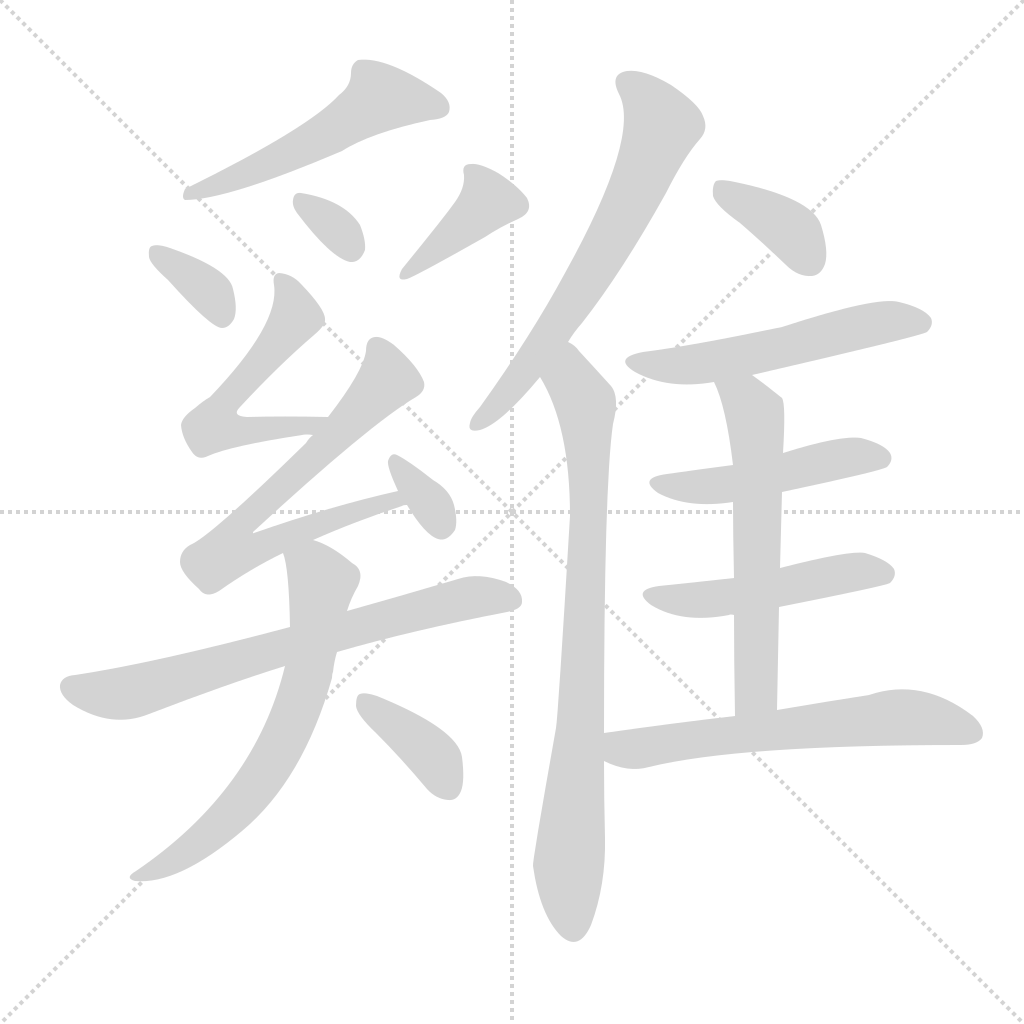
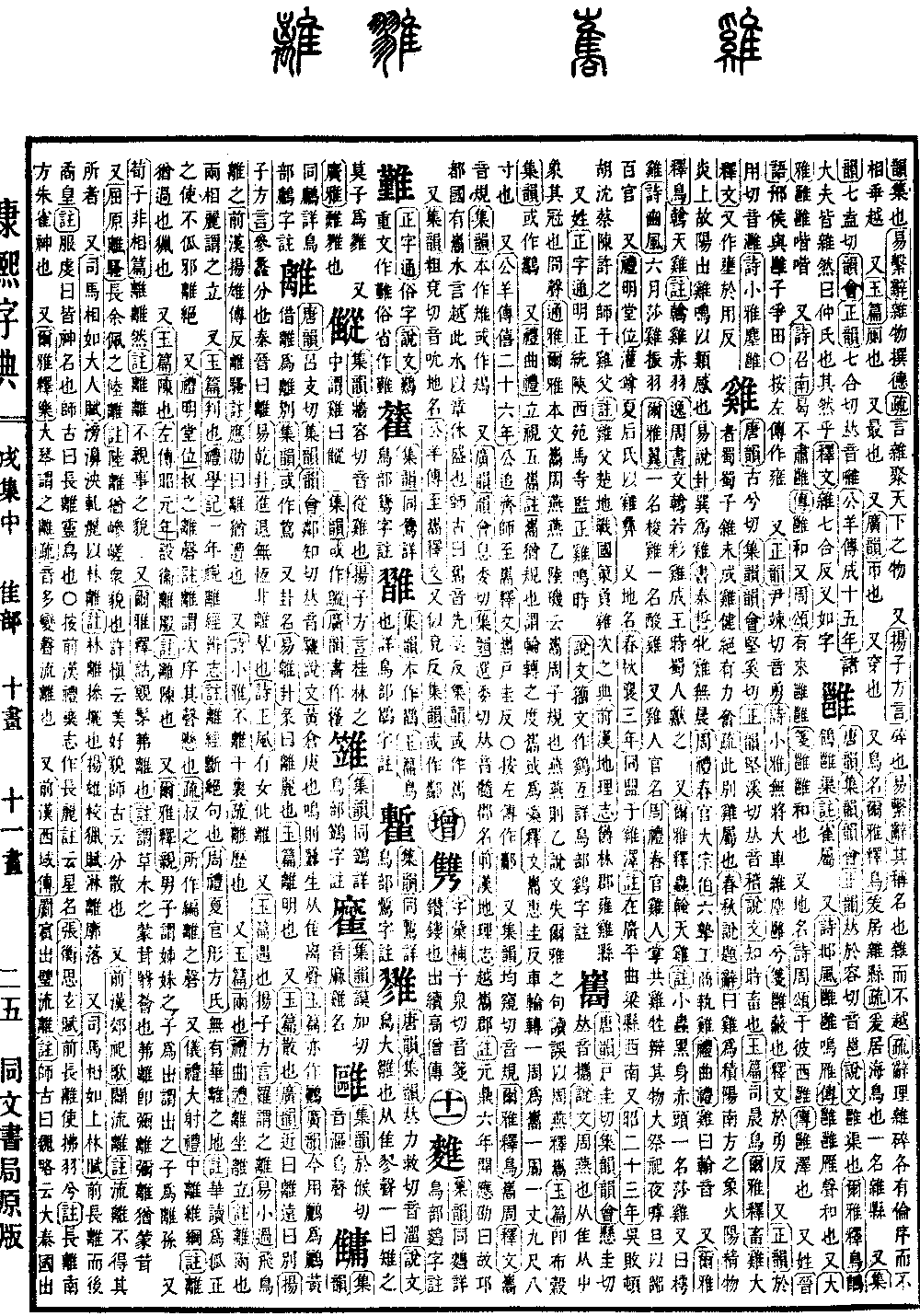
Xu Collection, Middle Volume
Radical: Short-tailed bird (zhuī)
Kangxi Strokes: 18
Page 1369, Entry 02
Pronounced ji.
Explaining Graphs and Analyzing Characters (Shuowen Jiezi): A domestic animal that knows the time.
Jade Chapters (Yupian): A bird that governs the dawn.
Approaching the Classics (Erya): In the interpretation of livestock, large chickens are called shu. The young of the shu are called yu, and an immature chicken is called lian. A particularly strong and vigorous one is called fen.
Commentary: This distinguishes the types of chickens.
Spring and Autumn: Explaining Topic Words (Chunqiu Shuotici) states: The chicken is that which accumulates yang energy, and is the symbol of the south. Fire is the essence of yang, and flames rise upward; therefore, when yang energy appears, the chicken crows. This is due to the resonance between things of the same kind.
Book of Changes (Yijing): The Xun trigram represents the chicken.
Book of Documents (Shangshu): The hen does not take responsibility for heralding the dawn.
Rites of Zhou (Zhouli): Regarding the six types of presentation gifts, craftsmen and merchants use chickens as gifts.
Book of Rites (Liji): The chicken is called the sound of wings.
Additionally, in Approaching the Classics (Erya): In the interpretation of birds, the han is the heavenly chicken.
Note: The han chicken has red feathers.
Lost Book of Zhou (Yi Zhoushu): The patterned han resembles a colorful chicken; the people of Shu presented it during the reign of King Cheng of Zhou.
Additionally, in Approaching the Classics (Erya): In the interpretation of insects, the han is the heavenly chicken.
Note: A type of small insect with a black body and red head; also called the sha-chicken or the chu-chicken.
Book of Odes (Shijing): In the sixth month, the sha-chicken vibrates its wings.
Wings of the Classics (Eryayi): Also called the suo-chicken or the suan-chicken.
Also, the Chicken-Officer is a title for an official.
Rites of Zhou (Zhouli): The Chicken-Officer is in charge of supplying sacrificial chickens, distinguishing their breeds, and calling out the dawn during great sacrifices to awaken the various officials.
Book of Rites (Liji): Regarding sacrificial wine vessels, the Xia dynasty used the chicken-yi vessel.
Also a place name.
Spring and Autumn (Chunqiu): In the third year of Duke Xiang, a covenant was held at Jize.
Note: Located southwest of Quliang County in Guangping.
Also: In the twenty-third year of Duke Zhao, the state of Wu defeated the armies of Dun, Hu, Shen, Cai, and Xu at Jifu.
Note: Jifu was land belonging to the state of Chu.
Strategies of the Warring States (Zhanguo Ce): Carrying the tradition of Jici on one's back.
Book of Han (Hanshu): Yulin Commandery had Yongji County.
Also a surname.
Correcting the Meanings (Zhengzitong): During the Zhengtong era of the Ming dynasty, there was an official overseeing the horse pastures in Shaanxi named Jimingshi.
Explaining Graphs and Analyzing Characters (Shuowen Jiezi): The ancient form is written as ji. See the entry for ji under the bird radical for further details.