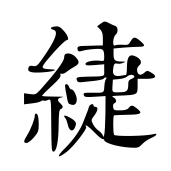
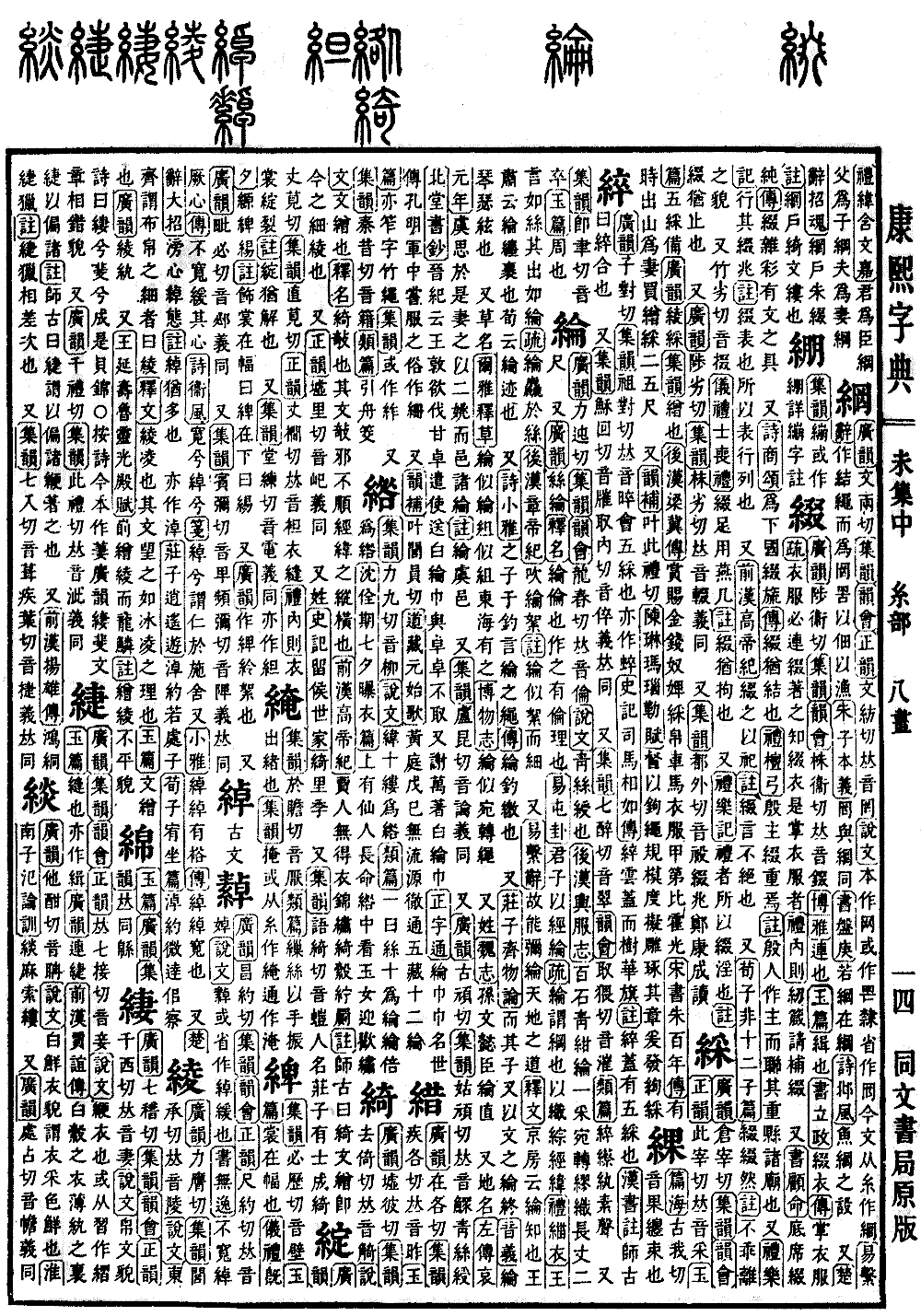
Wei Collection, Middle Volume. Radical: Silk (mì); Kangxi stroke count: 14; Page 928, Entry 19.
Broad Rimes (Guangyun), Collected Rimes (Jiyun), Dictionary of Rhymes (Yunhui), and Orthodox Rimes (Zhengyun) state it is pronounced qie. It has the same pronunciation as the character for concubine.
Explaining Graphs and Analyzing Characters (Shuowen) states it refers to the hem of a garment. Some editions write it in a variant form.
Jade Chapter (Yupian) states the meaning is to sew. It is also written as the character for collecting or gathering (ji).
Broad Rimes (Guangyun) states the meaning is to connect or join.
History of the Former Han (Qianhan Shu), Biography of Jia Yi: Uses white crepe as a face, thin silk as lining, and is bordered with decorative trim. Commentary by Yan Shigu states: The character refers to using decorative trim to border garments.
Also, History of the Former Han (Qianhan Shu), Biography of Yang Xiong: Describes a procession appearing orderly and continuous like a flight of geese. Commentary states: It refers to being arranged in sequence.
Also, Collected Rimes (Jiyun) states it is pronounced qi, synonymous with the character for repairing (qi). It is also pronounced jie, synonymous with the character for victory (jie). The meaning remains the same.
Textual Research: In the Biography of Jia Yi in the History of the Former Han (Qianhan Shu), the original text reads, "A garment of white crepe, lining of thin silk, bordered with decorative trim." The current text has been corrected to replace the character for garment with the character for surface.