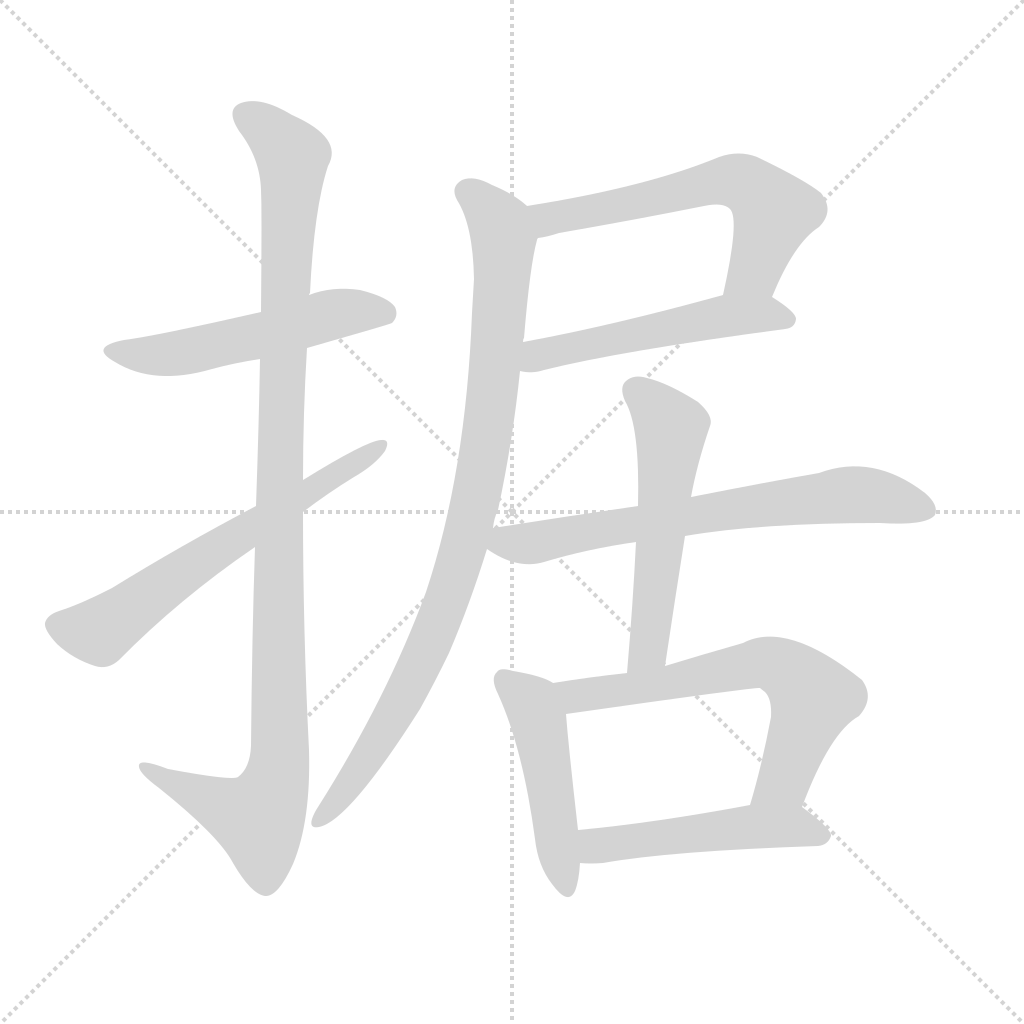
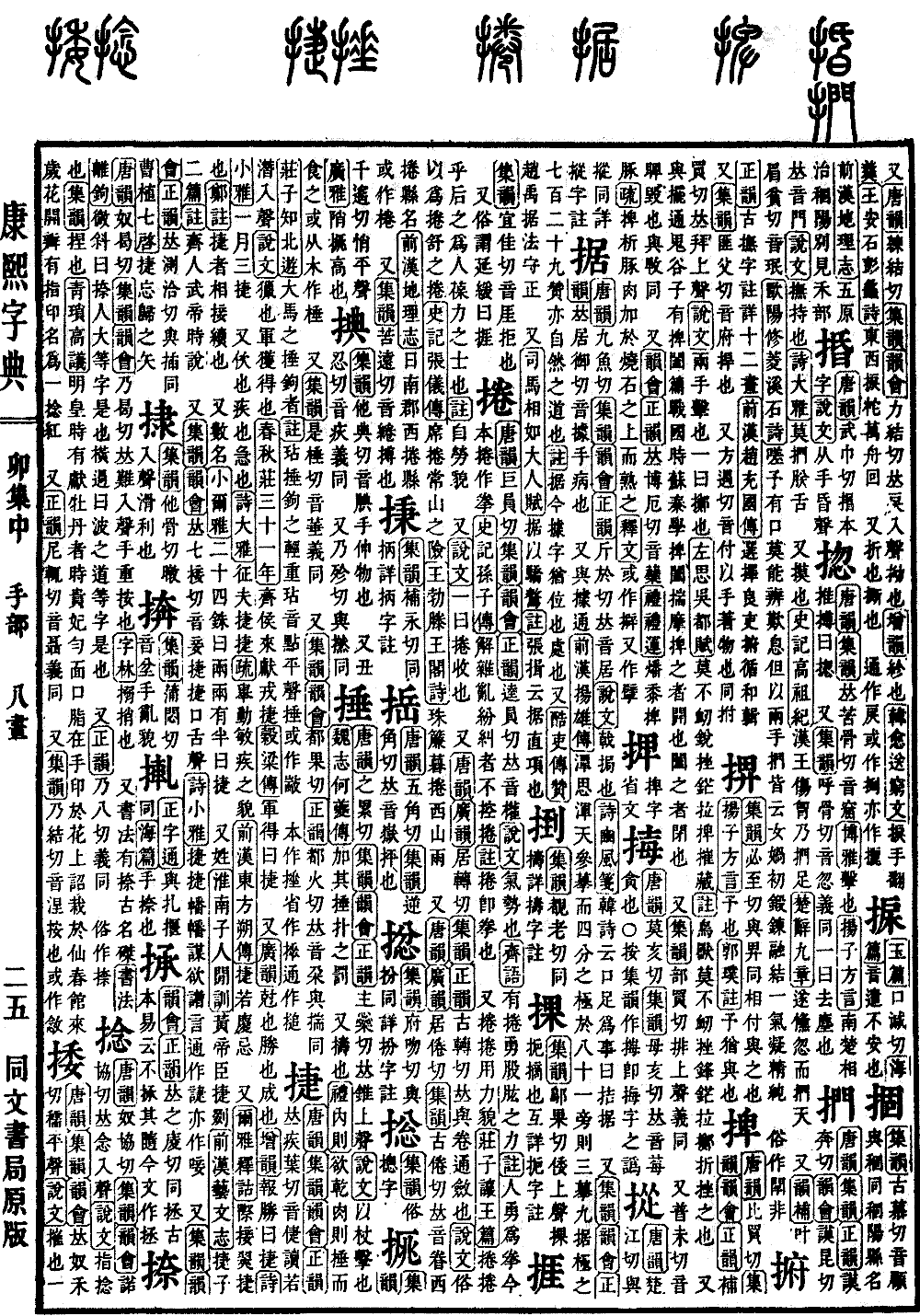
Mao Collection, Middle Volume
Radical: Hand (shǒu)
Kangxi stroke count: 17
Page 435, Entry 12
Tang Rhyme (Tang Yun): Pronounced ju
Collected Rhymes (Jiyun), Rhyme Compendium (Yunhui), Correct Rhymes (Zhengyun): Pronounced ju
Shuowen Jiezi: To hold a halberd.
Book of Odes (Shijing), Bin Customs commentary: Han Shi states: Using the mouth and feet to perform a task is called jieju (to be in strained circumstances).
Also, Collected Rhymes (Jiyun), Rhyme Compendium (Yunhui), Correct Rhymes (Zhengyun): Pronounced ju (falling tone)
Hand pain.
Also interchangeable with the character meaning to rely upon.
History of the Former Han (Qian Hanshu), Biography of Yang Xiong: Thinking deeply about the celestial sphere, modeling it and dividing it into four, reaching eighty-one, with three models and nine foundations on the side, reaching seven hundred and twenty-nine stanzas, this is also the way of nature.
Commentary: The character here is the modern character for rely, meaning position or place.
Also, Biography of Cruel Officials: Zhao Yu relied upon the law to maintain integrity.
Also, Sima Xiangru, Great Man Rhapsody: Relying upon it to gallop arrogantly.
Commentary: Zhang Yi says: Rely, to straighten the neck.
The character meaning to grasp.
Tang Rhyme (Tang Yun), Collected Rhymes (Jiyun), Rhyme Compendium (Yunhui), Correct Rhymes (Zhengyun): Pronounced ju (falling tone)
Shuowen Jiezi: To hold a staff.
Analects of Confucius (Lunyu): To rely upon virtue.
Also, Broad Rhyme (Guangyun): To depend on.
Book of Changes (Yijing), Kun Hexagram: Oppressed by stones, leaning on thorns.
Book of Odes (Shijing), Bei Customs: Even if one has brothers, one cannot rely upon them.
Zuo Tradition (Zuo Zhuan), Year 5 of Duke Xi: Sacrifices are abundant and pure, the spirits will certainly support us.
Commentary: Support here means to settle.
Also, to pull or to cite.
Exegesis of the Erya (Erya Shu) Preface: When matters are obscure or blocked, cite evidence to support them.
Also, to press down.
Book of Rites (Liji), Jade Beads: When the ruler grants a gift, bow with the head to the ground, press the palms together, and lower them to the ground.
Commentary: Placing the left hand over the right hand and pressing down.
Laozi, Classic of the Way and Virtue (Daodejing): Fierce beasts do not claw.
Commentary: To press and seize with claws is called ju.
Also, to resist or defend.
Records of the Grand Historian (Shiji), Biography of Zhao She: Those who first occupy the northern mountain will be victorious.
Also, a surname. Ming dynasty, Doctor of the Water Clock, Ju Cheng.
Also, Collected Rhymes (Jiyun): Pronounced ju (falling tone)
The appearance of something having form. Identical to the character qu (to be awakened and startled) in the Zhuangzi.
Also, Records of the Grand Historian (Shiji) Commentary: Pronounced ji
Annals of Empress Lu: Saw a creature like a gray dog, pressing upon the armpit of the Empress Dowager.
Also, rhyming with the sound ju.
Records of the Grand Historian (Shiji), Treatise on Divination by Tortoise Shell: Matters have their haste and their slowness. Things have their constraints and their supports. Commonly written as the character meaning to rely upon. See the note for the character meaning to rely upon.