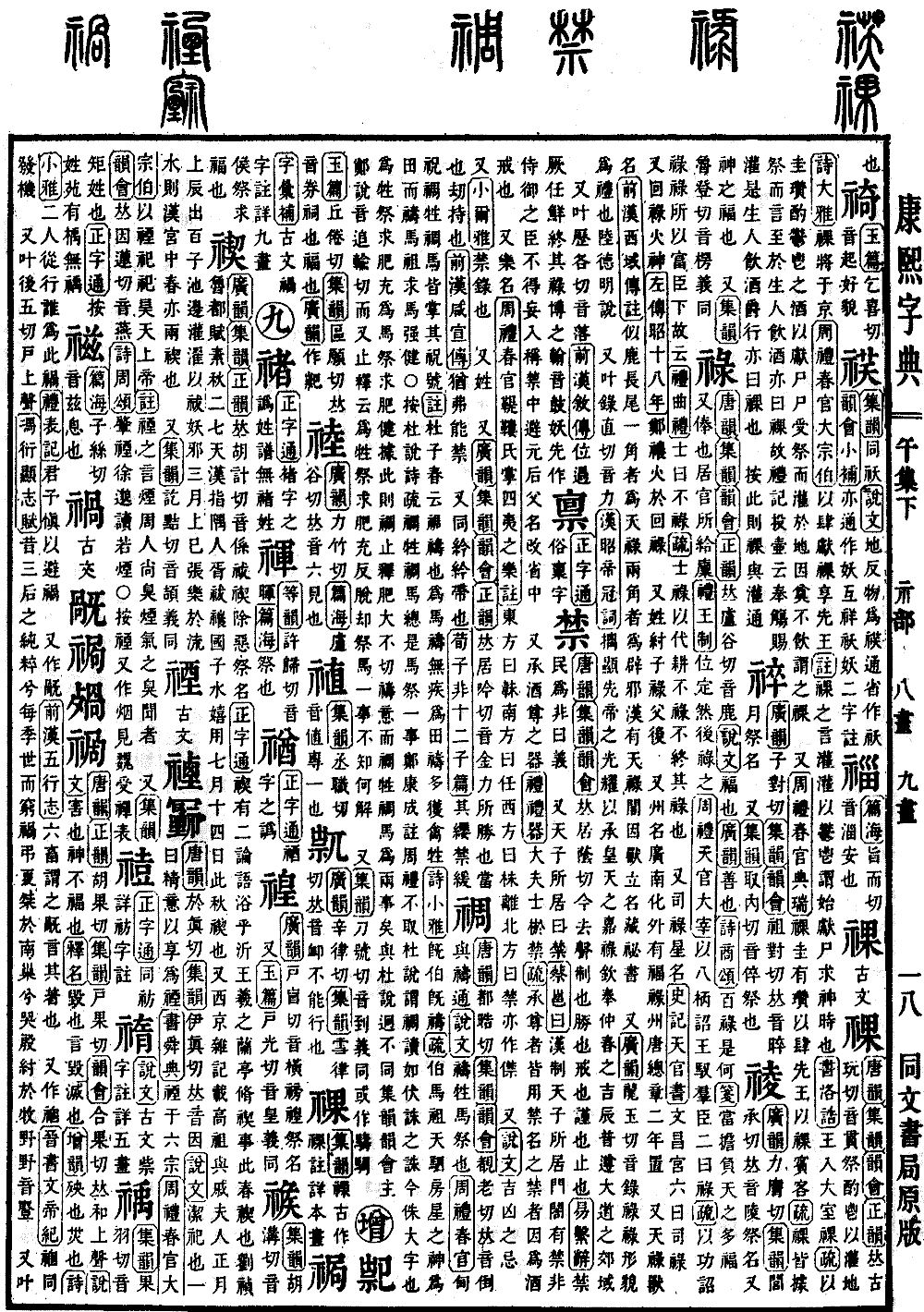
Wu Collection, Lower Volume
Radical: Sign (shì)
Kangxi Strokes: 13
Page 844, Entry 10
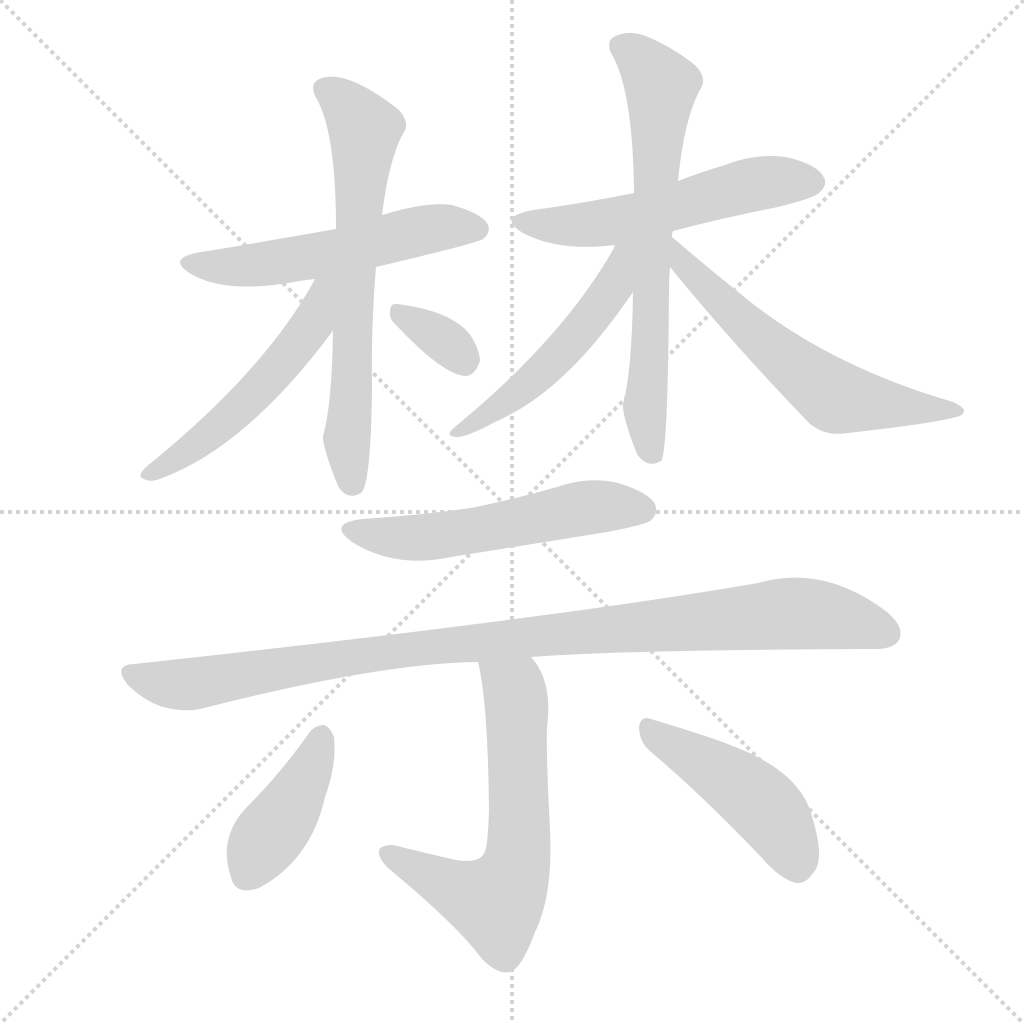
Pronounced jìn (departing tone). Meaning: to restrain, to control, to caution, to be prudent, to prohibit. Book of Changes (Yijing), Appendix of Appended Statements: To prohibit the common people from committing evil acts is called righteousness.
It also refers to the place where the Son of Heaven resides, called the forbidden palace (jin). Cai Yong says: In the regulations of the Han Dynasty, the gates where the Son of Heaven resides had prohibitions; those who were not ministers serving as guards could not enter freely, thus it was called the forbidden middle. To avoid the naming taboo of the Empress Dowager's father, it was changed to the department middle (sheng zhong).
It also refers to a vessel for holding wine containers. Book of Rites (Liji), Ritual Vessels: Great officers and scholar-officials use the yu and the jin. The commentary states: Vessels used to hold wine containers are all called jin; they are called jin because they are meant to serve as a warning against excessive drinking.
It also refers to a name of a musical piece. Rites of Zhou (Zhouli), Spring Officials: The official in charge of the music of the four border regions, in the commentary: The music of the East is called mei, that of the South is called ren, that of the West is called zhuli, and that of the North is called jin. It is also written in a variant form (jìn).
According to the Shuowen Jiezi, it refers to taboos regarding good and bad omens. According to the Xiao Erya, it refers to restraint. It also refers to a surname.
Pronounced jīn. Meaning: strength able to endure or bear; also refers to coercion or intimidation. Book of Han (Hanshu), Biography of Xian Xuan: Still unable to endure it.
Also equivalent to jin. Jin refers to a garment belt. Xunzi, In Refutation of the Twelve Masters: Their hats and garment belts were loose.
Textual Research: Rites of Zhou, commentary on the official in charge of the music of the four border regions: The music of the West is called zhuli, that of the North is called jin. Following the original text, zhuli has been corrected to zhuli.