Wu Collection, Upper Volume
Radical: Field (tián)
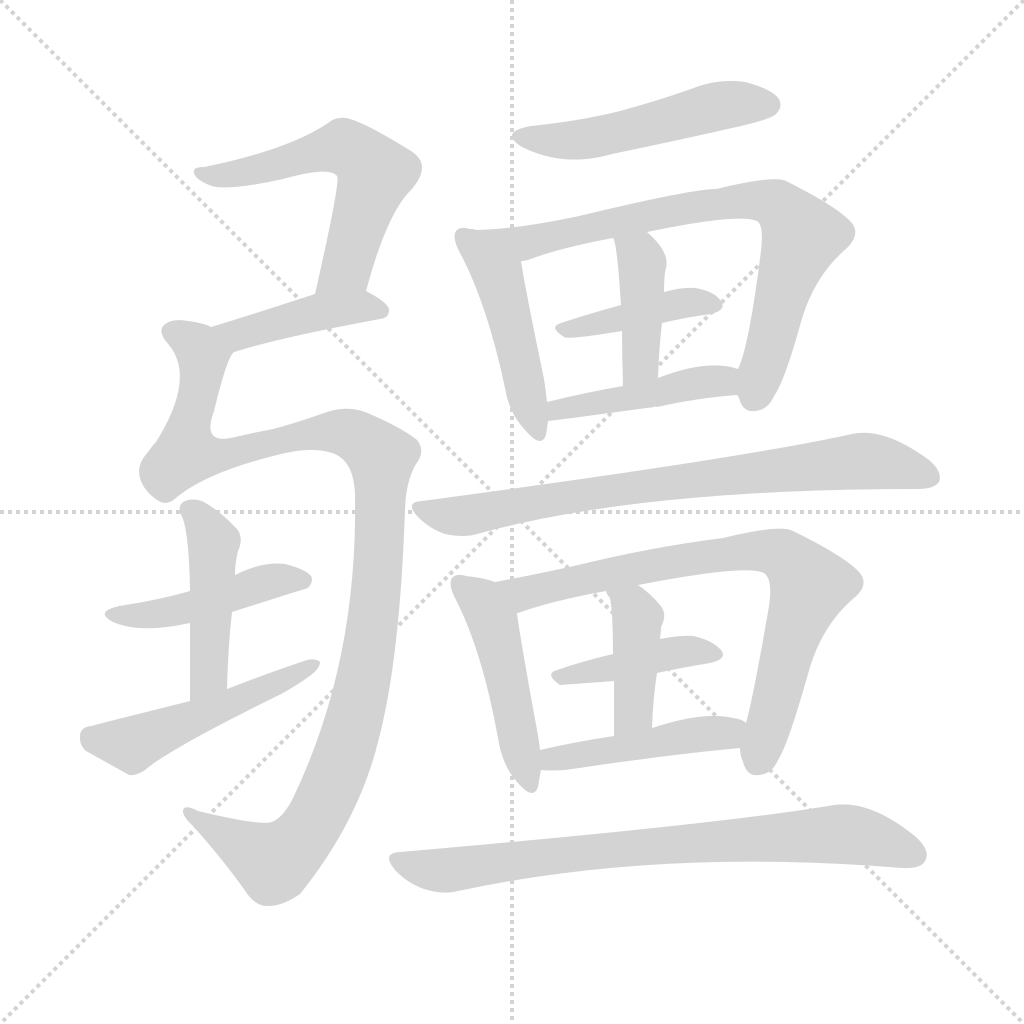
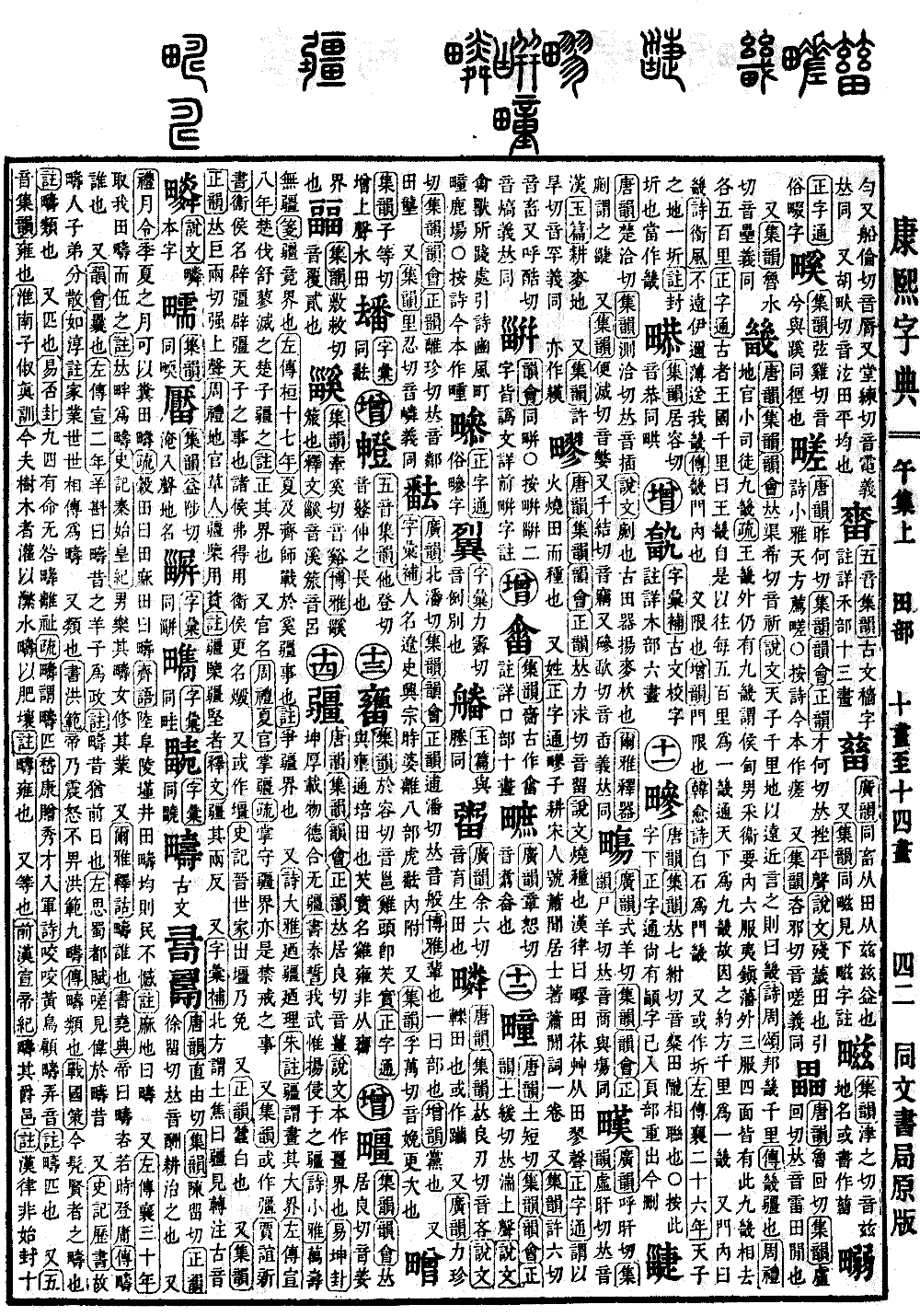
Jiang
Kangxi strokes: 19
Page 766, Entry 33
Pronounced jiang.
According to the Explanation of Simple and Compound Characters (Shuowen Jiezi), it was originally written as a character meaning boundary.
In the Book of Changes (Yijing), Kun hexagram: The earth is thick and carries all things, its virtue is boundless.
In the Book of Documents (Shujing), Great Oath (Taishi): My military power is displayed, invading its territory.
In the Book of Odes (Shijing), Minor Odes (Xiaoya): Ten thousand years of life without limit.
Commentary: Jiang means boundary or limit.
In the Zuo Tradition (Zuo Zhuan), 17th year of Duke Huan: In summer, we fought against the Qi army at Xi, which was a border dispute.
Annotation: A struggle over borders.
Also, in the Book of Odes (Shijing), Greater Odes (Daya): Then he demarcated the land and brought it under order.
Zhu Xi commentary: Jiang means to draw its main boundaries.
In the Zuo Tradition (Zuo Zhuan), 8th year of Duke Xuan: Chu attacked and destroyed Shu Liao, and the Viscount of Chu established boundaries there.
Annotation: Defining its borders.
Also an official title.
In the Rites of Zhou (Zhou Li), Summer Offices: One who oversees borders.
Sub-commentary: One who manages the guarding of borders, also a matter of prohibitions and regulations.
Also, according to the Collected Rhymes (Jiyun), sometimes written as a variant form (qiáng).
In Jia Yi's New Book (Xinshu): Duke Wei of Wey was named Piqiang. Piqiang is a term reserved for the Son of Heaven; feudal lords may not use it, so the Duke of Wey changed his name to Hui.
Also sometimes written as a variant form (jiāng).
In the Records of the Grand Historian (Shiji), House of Jin: Only after crossing the border was he safe.
Also, according to the Correct Rhymes (Zhengyun), it refers to the white color of a silkworm.
Also, according to the Collected Rhymes (Jiyun) and Correct Rhymes (Zhengyun), pronounced jiang (rising tone).
In the Rites of Zhou (Zhou Li), Earth Offices, Grass Official: The疆 (jiǎng) used hemp seeds.
Annotation: Jiang refers to the hard and firm ones.
Explanation of Terms: Jiang is pronounced jiǎng.
Also, according to the Supplement to the Dictionary (Zihuibu), in the north, scorched earth is called jiang. Referenced in the Ancient Sounds of Zhuanzhu.