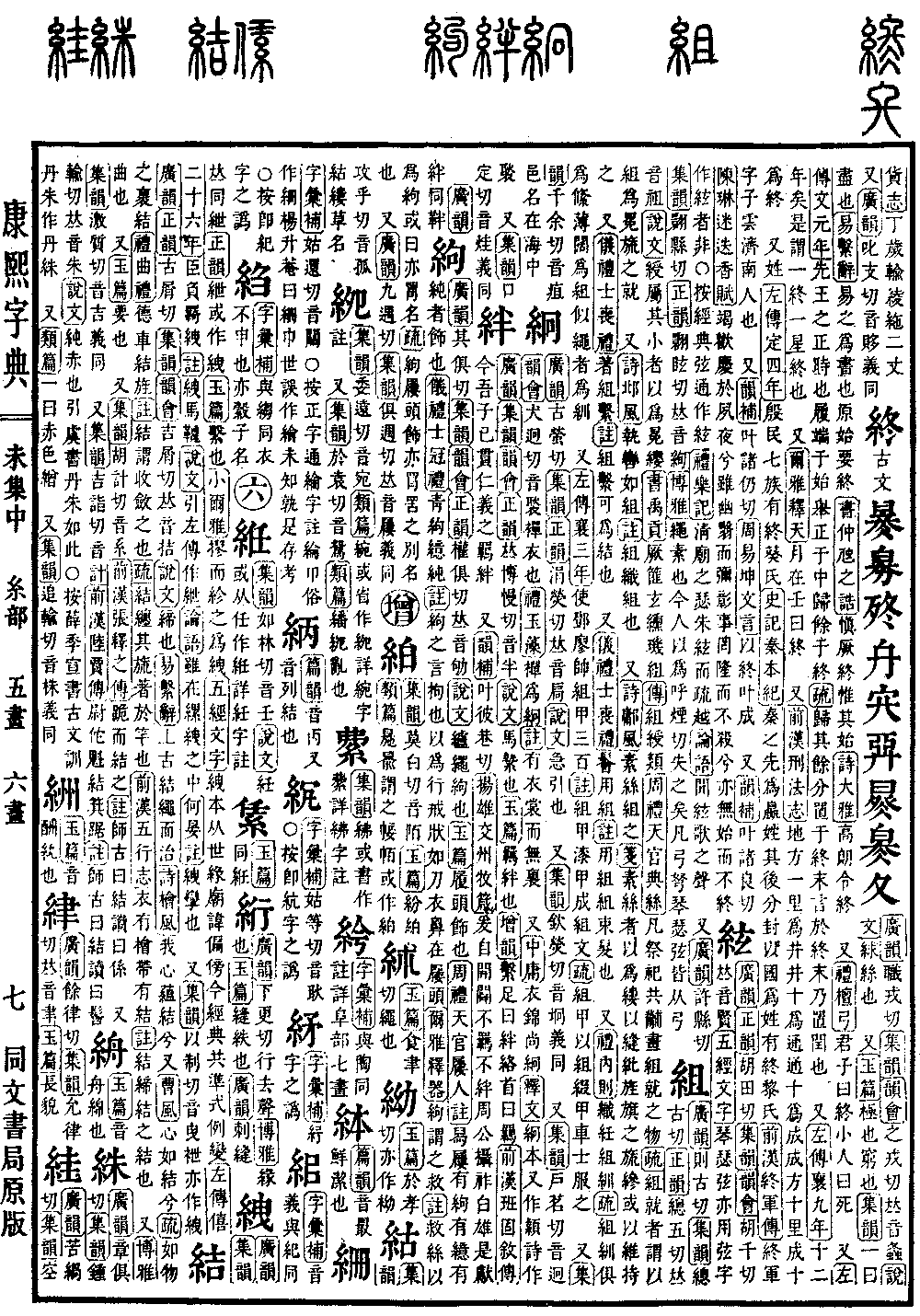
Wei Collection, Lower Volume
Radical: Silk (mì)
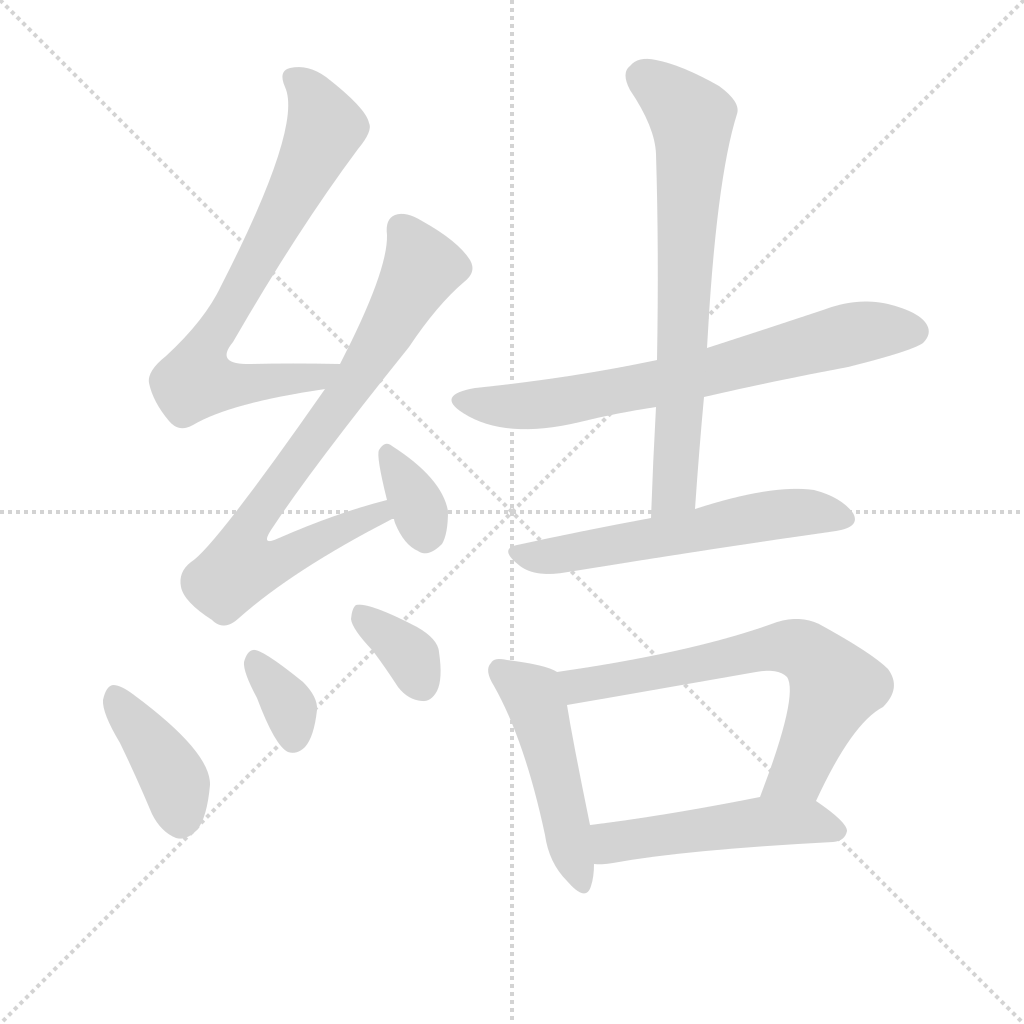
結
Kangxi Strokes: 12
Page 921, Entry 34
Pronounced jié.
As defined in the Shuowen Jiezi (Shuowen), it means to fasten or tie.
According to the Book of Changes (Yijing), in ancient times people used knotted ropes to manage affairs.
In the Book of Odes (Shijing), in the section regarding the Airs of Kuai, it is written: My heart is bound in knots.
Also in the section regarding the Airs of Cao: The heart is like a knot.
The commentary explains this as the state of being wrapped and knotted.
In the Book of Rites (Liji), it is written: A virtuous carriage has knotted banners.
The commentary explains that knotting refers to gathering them together.
The commentary further explains that knotting refers to wrapping the streamers around the pole.
According to the Book of Han (Hanshu), in the Record of the Five Elements, it is written: Clothing has seams, and belts have knots.
The commentary notes that the knot here refers to the act of tying.
Also, according to the Guangya, it means to be bent or crooked.
Also, according to the Yupian, it means to be essential or the waist.
Also, pronounced xì.
According to the Book of Han (Hanshu), in the Biography of Zhang Shizhi, it is written: Kneeling and tying it.
The commentary by Shigu says: Read as xì (to fasten).
Also, pronounced jí. The meaning is the same.
Also, pronounced jì.
According to the Book of Han (Hanshu), in the Biography of Lu Jia, it is written: Zhao Tuo had a topknot and sat with legs spread.
The commentary by Shigu says: Read as jì (a hair bun).