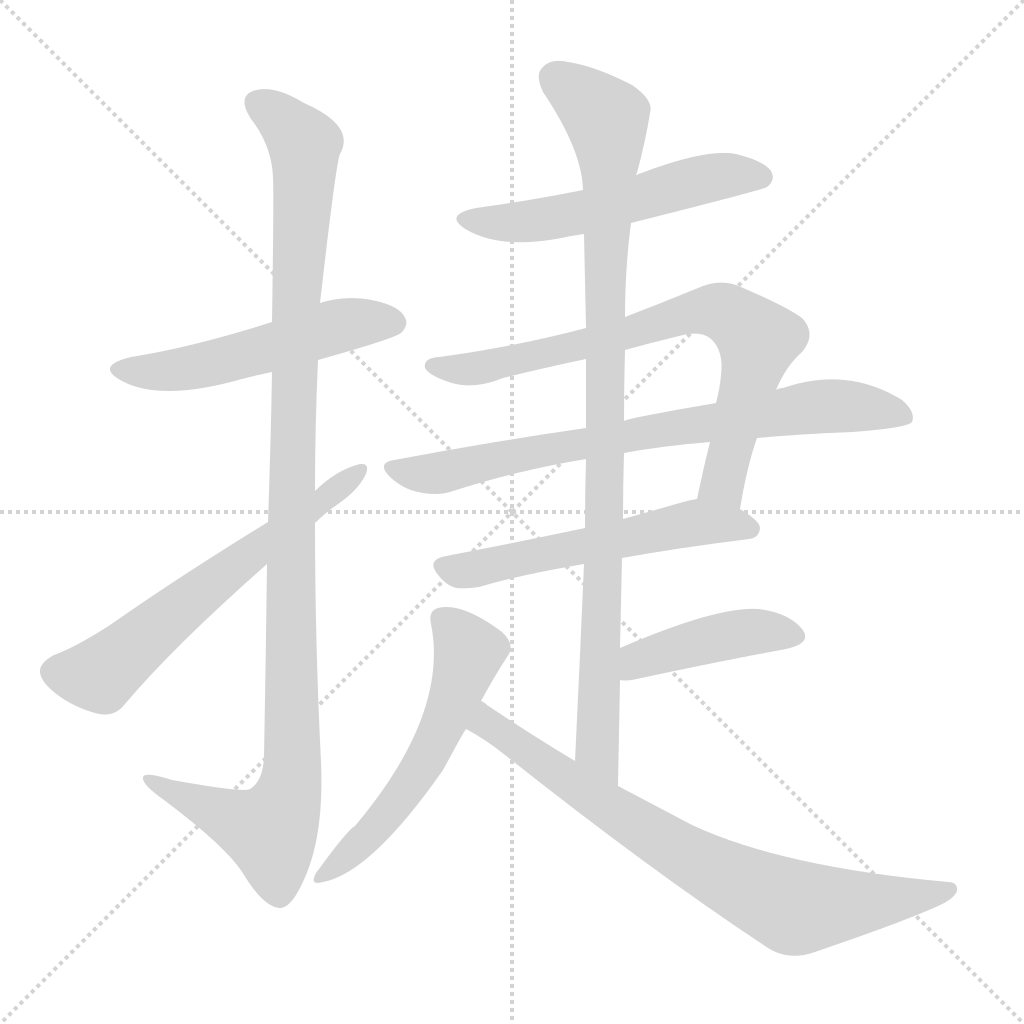
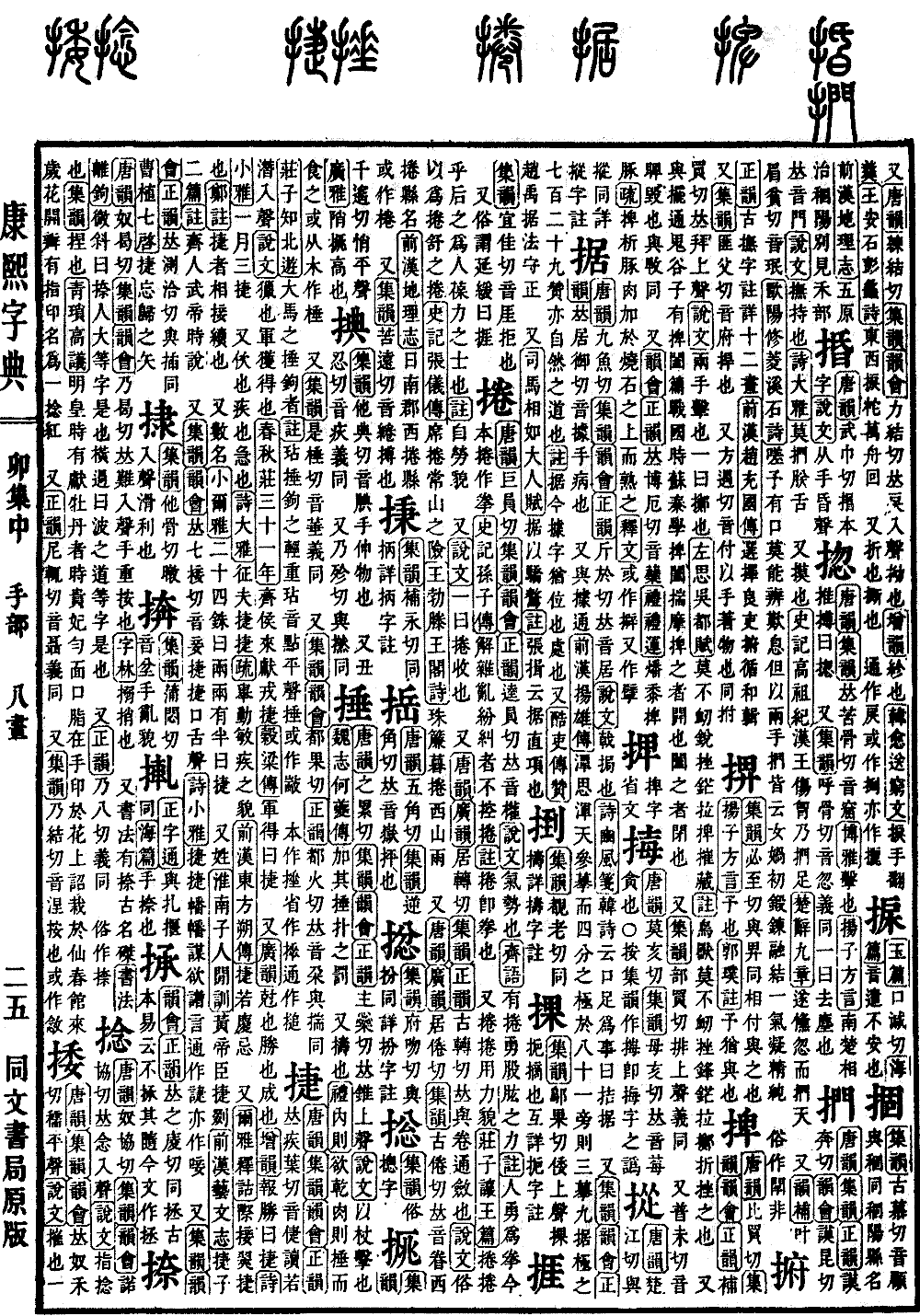
Mao Collection, Middle Volume. Radical: Hand (shǒu). Kangxi strokes: 12. Page 435, Entry 24.
Pronounced jie (entering tone). Read like qian (entering tone).
Shuowen Jiezi (Shuowen): To hunt; in military terms, to obtain a victory.
Spring and Autumn Annals (Chunqiu): In the thirty-first year of Duke Zhuang, the Marquis of Qi came to present the spoils of war.
Gongyang Commentary (Gongyang Zhuan): Military acquisitions are called jie.
Guangyun (Rhyme Dictionary): To overcome, to be victorious, to complete.
Zengyun (Additional Rhymes): To report a victory is called jie.
Book of Odes (Shijing): Thrice victorious in a single month.
Also: to assist, to be swift, to be urgent.
Book of Odes (Shijing): The soldiers are swift and hasty.
Commentary (Shu): The appearance of movements that are agile and rapid.
History of the Former Han (Qian Hanshu): As swift as Qingji.
Erya (Approaching Elegance): To border, to connect, to overlap, are all meanings of jie.
Zheng Commentary (Zheng Zhu): Jie means to connect or follow one another in succession.
Also a unit of weight.
Xiao Erya (Small Erya): Twenty-four zhu make a liang, and one and a half liang make a jie.
Also a surname.
Huainanzi (Huainanzi): The Yellow Emperor had a minister named Jieduo.
History of the Former Han (Qian Hanshu): Jiezi, two volumes.
Commentary (Zhu): A man from Qi who spoke during the reign of Emperor Wu.
Pronounced qie. Jie-jie refers to the sound of chatter.
Book of Odes (Shijing): Chattering and fluttering, planning to bring about slanderous words. Often written as jie (variant form). Also written as sha (variant form).
Pronounced qia. Same as cha (to insert).
Cao Zhi (Seven Exhortations): To insert the arrow of forgetting to return.