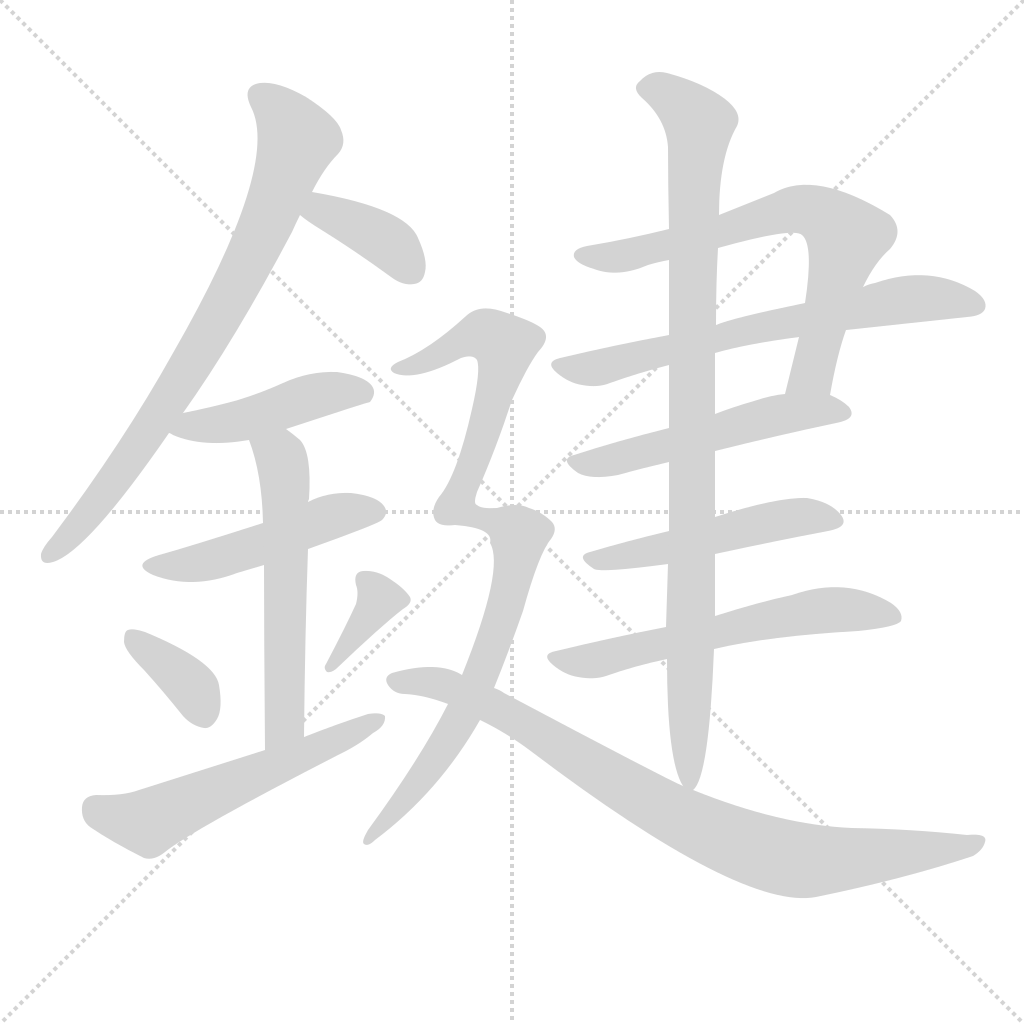
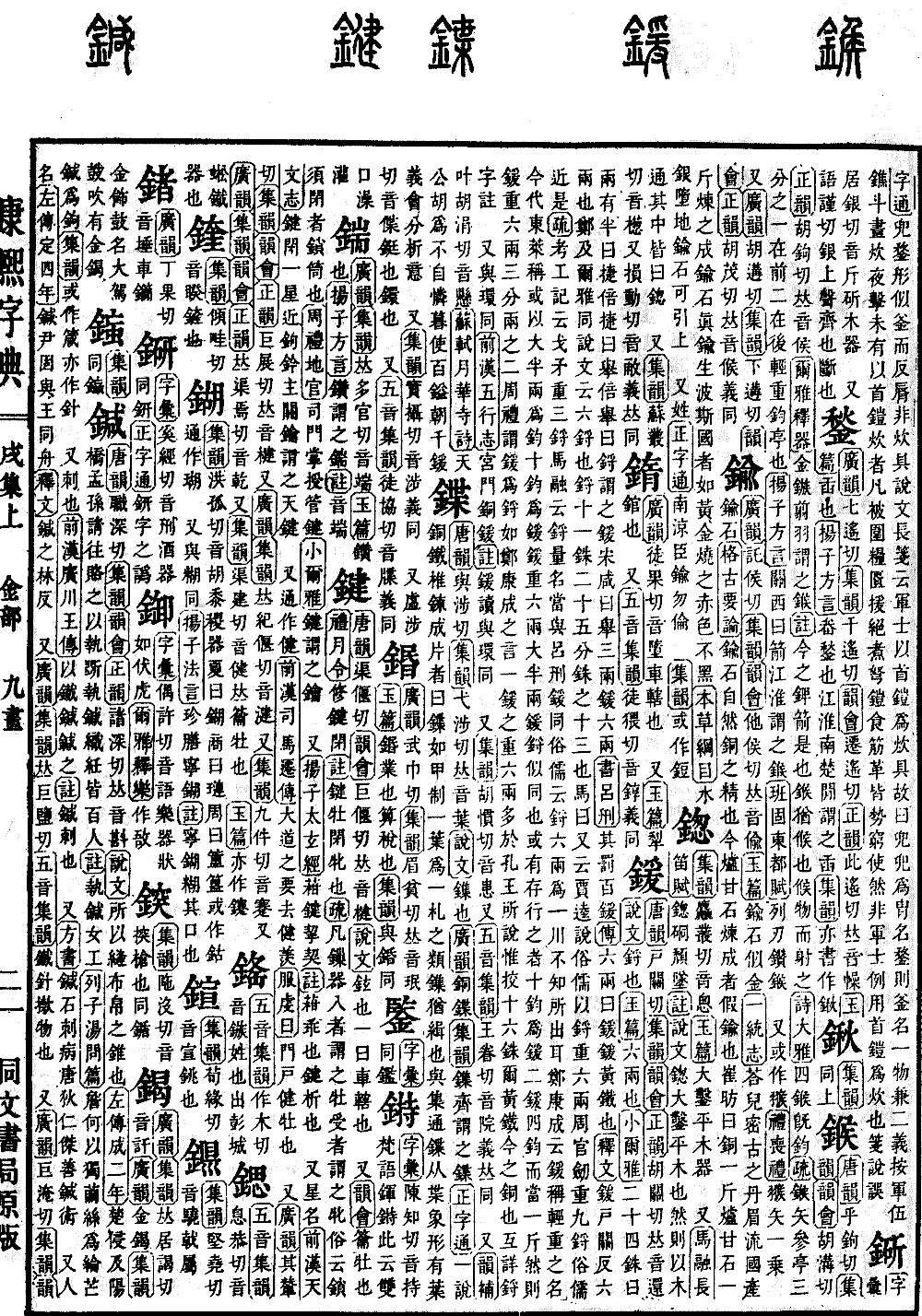
Xu Collection, Upper Volume
Radical: Metal (jīn)
Key
Kangxi stroke count: 17
Page 1315, Entry 14
Pronounced jian (falling tone).
According to the Shuowen Jiezi (Dictionary of Explanations of Characters), it refers to a linchpin. It also refers to a carriage axle pin.
According to the Collection of Rhymes (Yunhui), it refers to the bolt of a lock.
Book of Rites (Liji), Monthly Ordinances (Yueling): Repair the bolts and locks. Commentary: The bolt is the male part, the lock is the female part. Sub-commentary: Generally, for locking devices, the part that enters is called the male, and the part that receives is the female. Commonly referred to as the lock cylinder.
Rites of Zhou (Zhouli), Office of the Earth: The gatekeeper is in charge of issuing keys and bolts.
Little Erya (Xiao Erya): A bolt is also called a key.
Also, in the Taixuanjing by Yang Xiong: The bolt separates the tally. Commentary: To separate. The bolt means to split.
Also a star name. Records of the Grand Historian (Hanshu), Treatise on Astronomy: The star Jianbi is near the Gouqian, governing locks and keys; it is called the Heavenly Bolt.
Also used interchangeably with the character meaning robust. Records of the Grand Historian (Hanshu), Biography of Sima Qian: The essential path to avoiding greed and envy. Commentary by Fu Qian: This refers to the bolt of a door.
Also pronounced jian (falling tone).
Also pronounced jian (rising tone).
Also pronounced jian (third tone).
Also pronounced gan (even tone).
Also pronounced jian (falling tone).
It refers to the bolt of a lock. According to the Yupian dictionary, it is also written in a variant form.