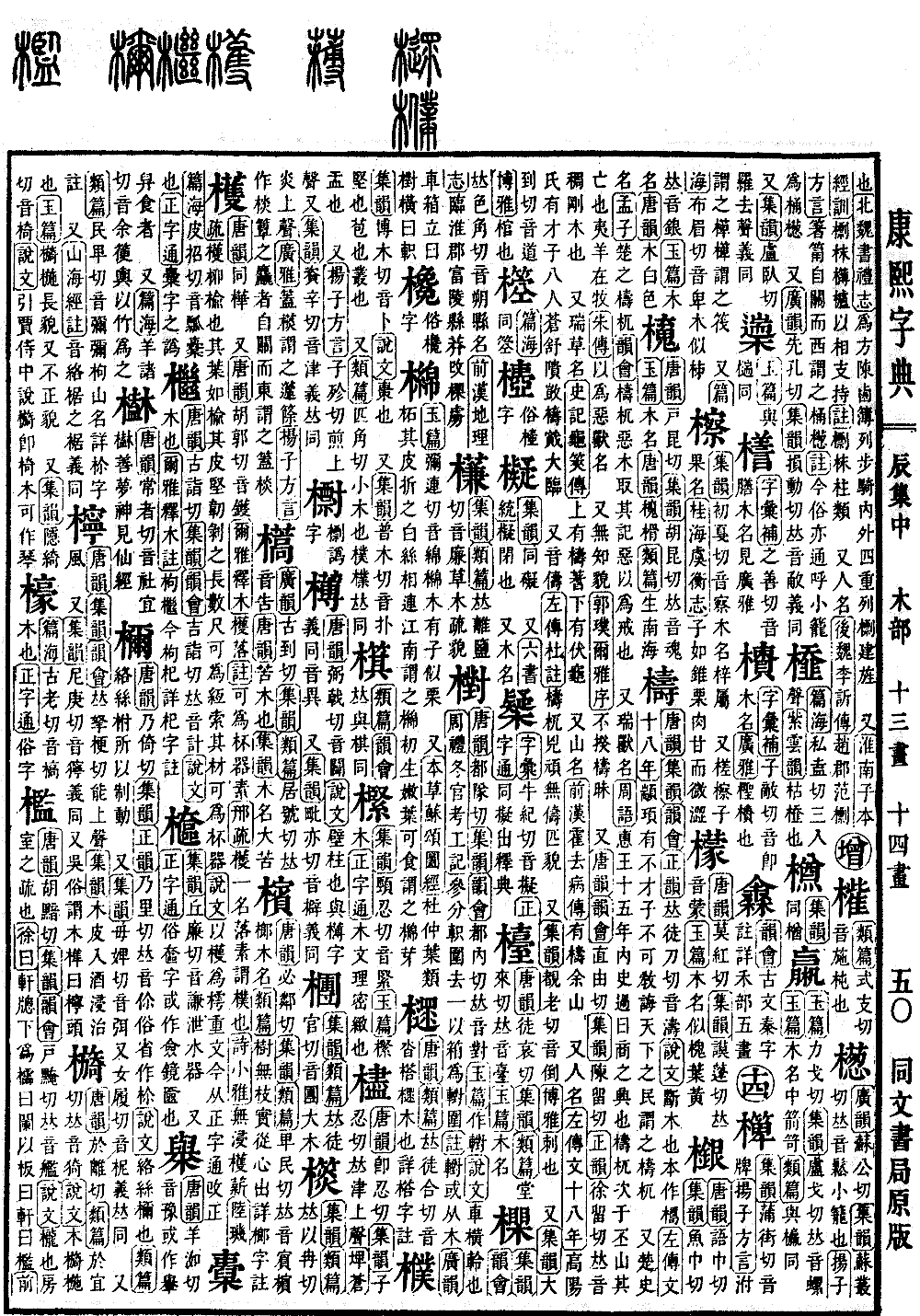
Chen Collection, Middle Volume
Radical: Wood (mù)
檻
Kangxi strokes: 18
Page 558, Entry 47
Pronounced jiàn.
According to the Explaining Graphs and Analyzing Characters (Shuowen Jiezi), it refers to a cage or the openwork lattice of a room. Xu states that for a porch window, the lower part is called a lattice (lán), and if made of boards, it is called a balcony (xuān) or a railing (kǎn). In the Biography of Zhu Yun in the History of the Former Han (Qianhan Shu), it is noted that he grabbed the palace railing and the railing broke. In Ban Gu’s Western Capital Rhapsody (Xidu Fu), it is written that one leans back against the lattice railings.
According to the Jade Chapters (Yupian), it also refers to a protective barrier. In the Elegies of Chu (Chuci), specifically the Invocation of the Soul (Zhao), it mentions high halls and deep chambers with storied railings and pavilions. The commentary explains that vertical pieces are called railings (kǎn) and horizontal pieces are called balustrades (shǔn).
It also refers to a cage on a carriage. In the Biography of Chen Yu in the History of the Former Han, it is recorded that Guan Gao was taken in a cage carriage to Chang’an.
It also refers to an enclosure for keeping wild animals, hence the term enclosure (quànkǎn). In the Huainanzi, section on Principles of Sovereignty (Zhushu Xun), it states that for those who raise tigers, leopards, rhinoceroses, and elephants, one must build enclosures for them.
Also, the sound of a carriage moving is described as kǎn-kǎn. In the Book of Odes (Shijing), Kingdom of Wang section, it states that the great carriage rumbles (kǎn-kǎn).
A spring that gushes straight out is called a kǎn spring. In the Book of Odes, section on Greater Odes (Daya), it mentions the bubbling kǎn spring.
It is also interchangeable with the character for a bathing vessel (làn). In the Zhuangzi, section on Zeyang, it mentions bathing in the same basin. The commentary notes it is sometimes written as a variant (làn).
According to the Correct Rhymes (Zhengyun), it has two pronunciations in the upper and departing tones. The meaning of railing uses the departing tone, pronounced jiàn. The meanings of carriage movement and kǎn spring use the upper tone, pronounced lǎn.
It also rhymes with the sound xiàn. In Ouyang Xiu’s Poem on the New Frost, it states: The plantains and water chestnuts are not worth counting, their scattered remains only serve to soil the pool railings. The seasons are turning to harvest and the year is nearing its end, frost and snow intensify from this point on.