Xu Collection, Middle Volume
Radical: Leather (gé)
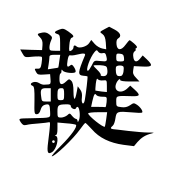
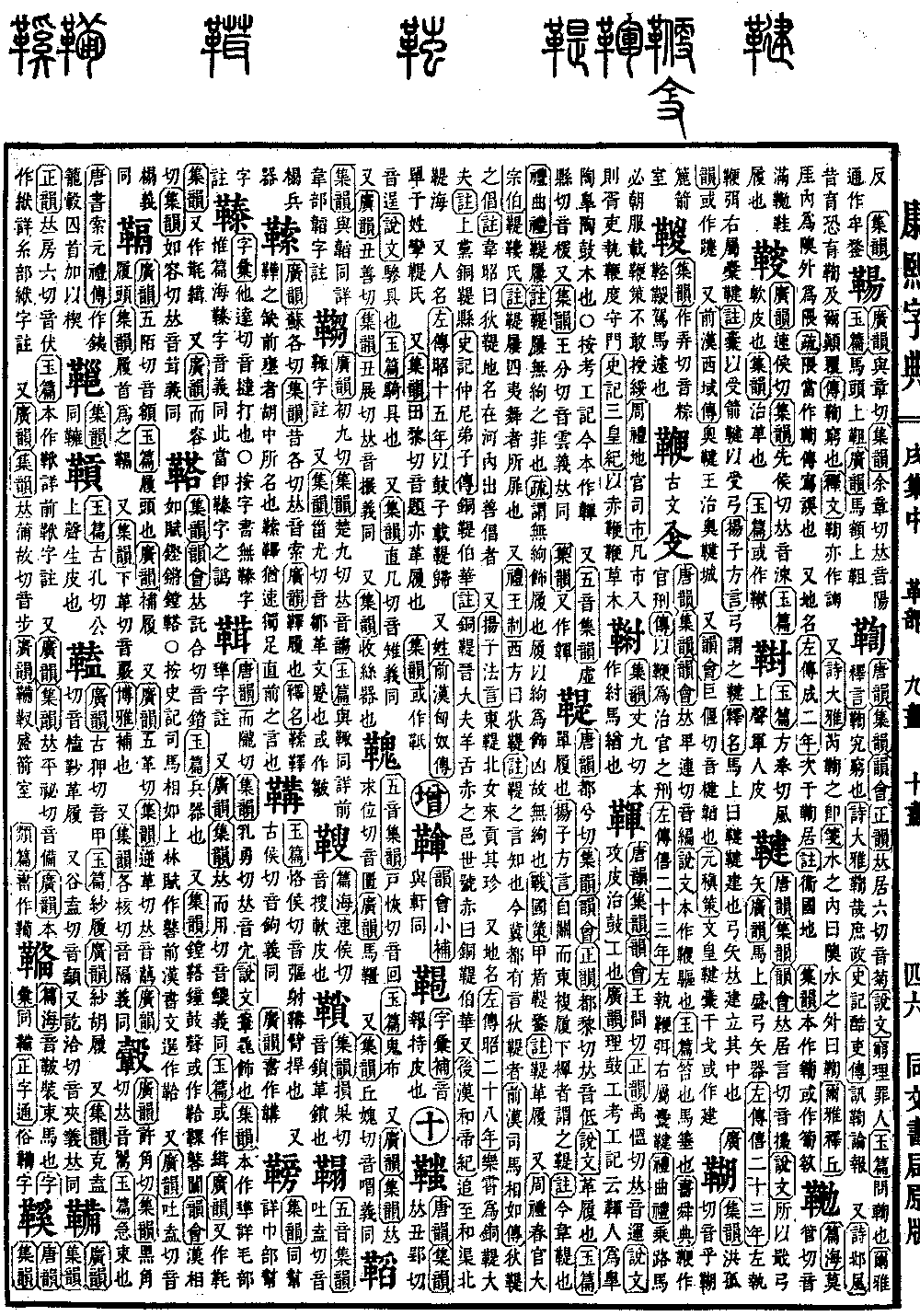
Jian; Kangxi stroke count: 18; Page 1390, Entry 06
According to the Tang Rhymes (Tangyun), the Collected Rhymes (Jiyun), and the Rhyme Compendium (Yunhui), it is pronounced jian.
According to the Explaining Graphs and Analyzing Characters (Shuowen), it is an instrument used to contain a bow and arrows.
According to the Broad Rhymes (Guangyun), it is a container used to hold a bow and arrows while riding a horse.
According to the Zuo Commentary (Zuozhuan) on the twenty-third year of Duke Xi, the left hand holds the horse whip and the bow, and the right hand secures the arrow bag and the bow bag.
The commentary notes that the arrow bag is for holding arrows, and the bow bag is for holding the bow.
According to the Dialect (Fangyan) by Yang Xiong (Yangzi), a bow is referred to as jian.
According to the Explanation of Names (Shiming), when one is on horseback, it is called jian. Jian implies to establish; it means the bow and arrows are established and placed within it.
According to the Broad Rhymes (Guangyun), it is sometimes written in a variant form.
Additionally, according to the History of the Former Han (Qianhan Shu), Western Regions section, the King of Aojian rules the city of Aojian.
Also, according to the Rhyme Compendium (Yunhui), it is pronounced jian. It signifies to contain or store.
According to the Policies (Ce) of Yuan Zhen, the Civil Emperor stored away the weapons. It is sometimes written as jian.