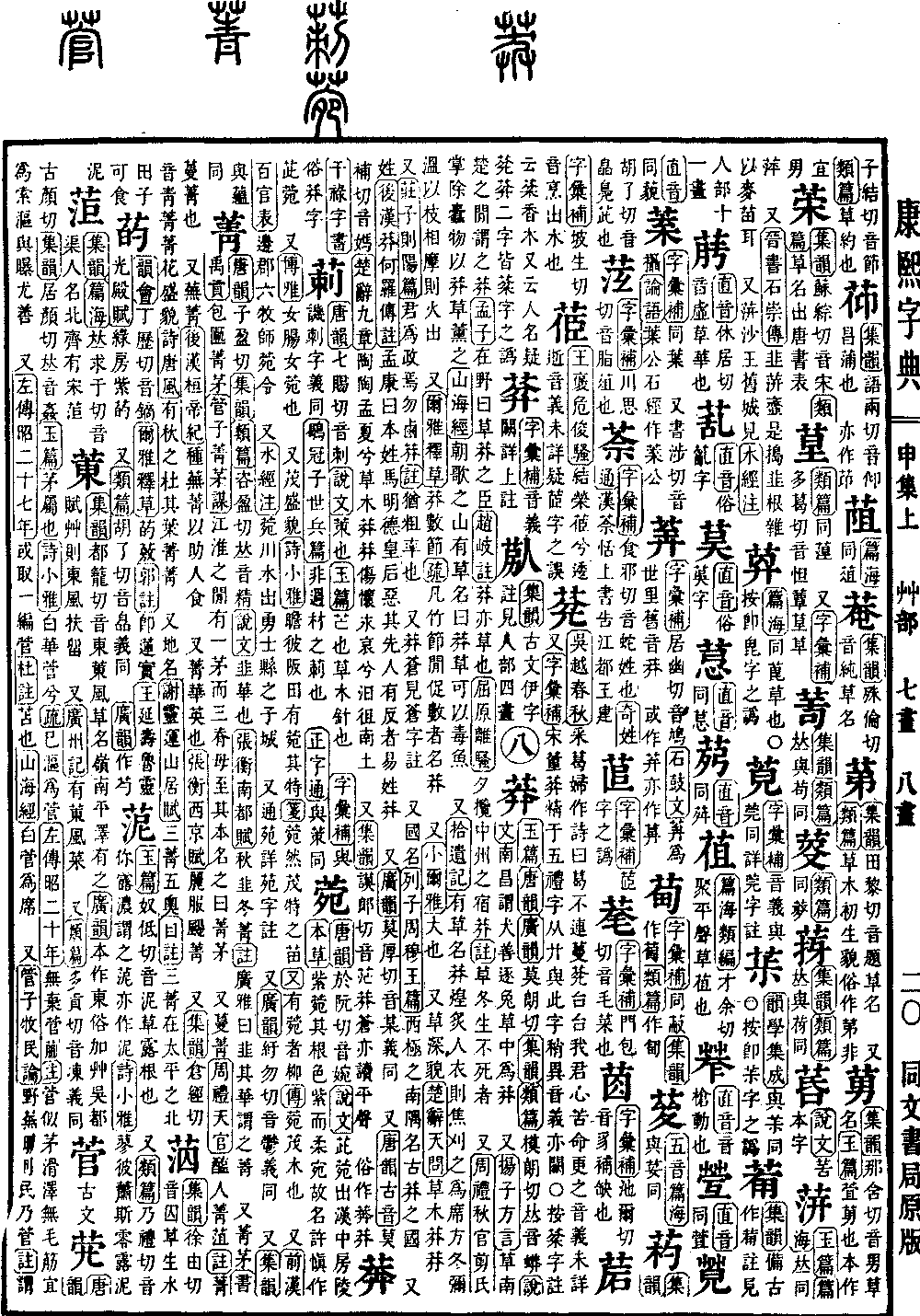
Shen Collection, Upper Volume
Radical: Grass (cǎo)
Kangxi strokes: 14
Page 1036, Entry 51
Ancient form. Tang Rhymes (Tangyun): Pronounced jian. Collected Rhymes (Jiyun): Pronounced jian. Jade Anthology (Yupian): A type of thatch grass. Book of Odes (Shijing), Lesser Odes: White blossoms of the jian grass. Commentary: When already soaked, it is called jian. Zuo Commentary (Zuozhuan), 20th year of Duke Zhao: Do not discard the jian and kuai grasses. Note: Jian grass resembles thatch; it is smooth and without hair, and its fibers are suitable for making ropes, especially when soaked and exposed to the sun. Also, Zuo Commentary (Zuozhuan), 27th year of Duke Zhao: Someone carried a bundle of jian grass. Du Commentary: Refers to a grass mat. Classic of Mountains and Seas (Shanhaijing): Use white jian grass to make mats. Also, Guanzi, Pastoral Governance (Mumin Pian): If the fields are desolate and empty, the people will commit crimes (jian). Note: Jian should be read as the word for crime (jian). Also a surname. Zhengzitong: In the Han dynasty, there was Jian Yu; in the Tang dynasty, there was Jian Chongsi. Also pronounced guan. Spring and Autumn Annals (Chunqiu), 10th year of Duke Yin: The Duke of Lu defeated the Song army at the location of Jian. Note: Jian is a place name in the State of Song. Also, Rhyme Supplement (Yunbu): Pronounced juan. Book of Odes (Shijing), Odes of Chen: At the pond outside the east gate, one can soak jian grass. This rhymes with the following phrase, "wuyan." Textual research: In Guanzi, Pastoral Governance, it says if the fields are desolate and empty, the people will be jian. The note previously said this referred to the color of the grass. Following the original text, Pastoral Governance Treatise has been corrected to Pastoral Governance Chapter. The note stating "refers to the color of the sprouts" has been corrected to "jian should be interpreted as the word for crime."