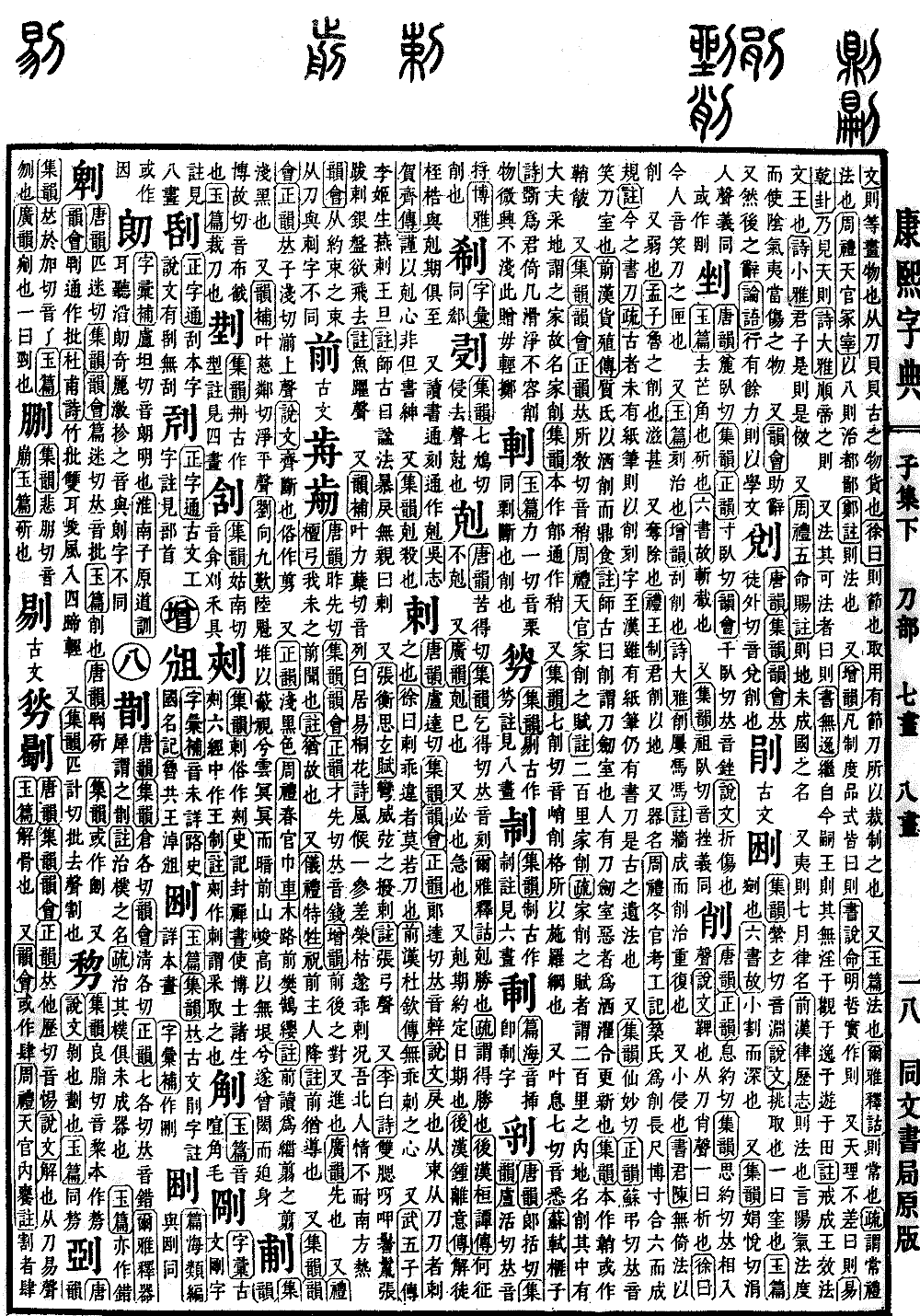
Zi Collection, Page Position: Lower, Radical: Knife (dāo)
Previous; Kangxi stroke count: 9; Page: Page 140, Entry 15
In ancient texts, it is written as "歬".
In "Tang Yun", the pronunciation is zuó xiān qiē. In "Ji Yun", "Yun Hui", and "Zheng Yun", the pronunciation is cái xiān qiē, with the same pronunciation as "qián".
"Zeng Yun" explains it as: previous, the opposite of "later".
It also has the meaning of "advance". "Guang Yun" explains it as "first".
Also seen in "Book of Rites (Liji) - Tan Gong": "I have not heard of this before", with the annotation that "previous" here means "former" (past).
Also seen in "Yi Li - Te Sheng": "The祝前主人降", with the annotation that "previous" means "to lead" (guide).
Also in "Ji Yun", "Yun Hui", "Zheng Yun", the pronunciation is zǐ qiǎn qiē, pronounced like the rising tone of "jiǎn".
"Shuowen Jiezi" explains it as "to cut neatly". The common character is written as "剪".
Also in "Zheng Yun", it is explained as shallow black.
Seen in "Zhou Li - Chun Guan - Jin Che": "The wooden chariot had a front fence and a white tassel", with the annotation that "previous" here is read as "jiǎn" from "zǐ jiǎn", meaning shallow black.
Also in "Yun Bu", it rhymes with cí lín qiē, pronounced like the level tone of "jìng".
Seen in "Liu Xiang - Jiu Tan": "The mounds were piled high, obscuring the view, the clouds were dark and obscured the front. The mountains were steep and boundless, so the towering buildings pressed upon the body." (Here "front" rhymes with "body").