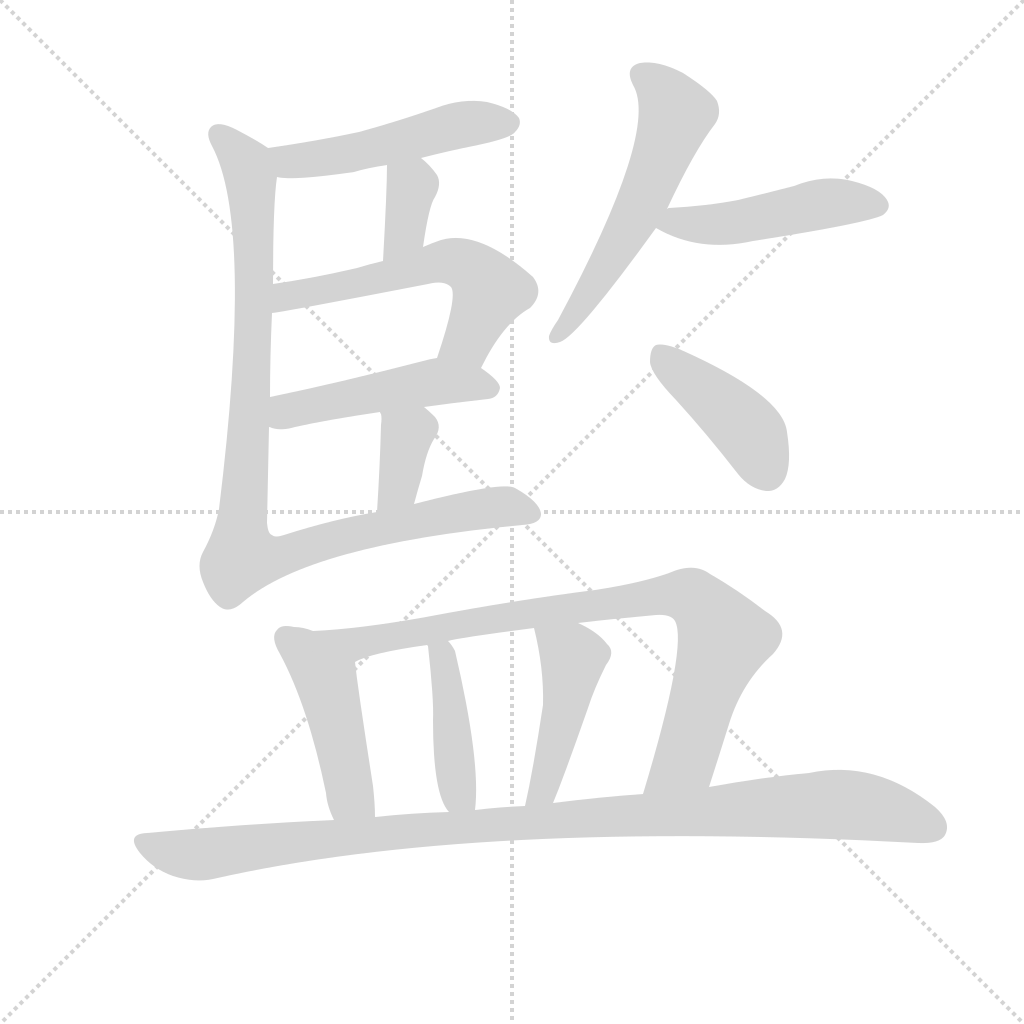
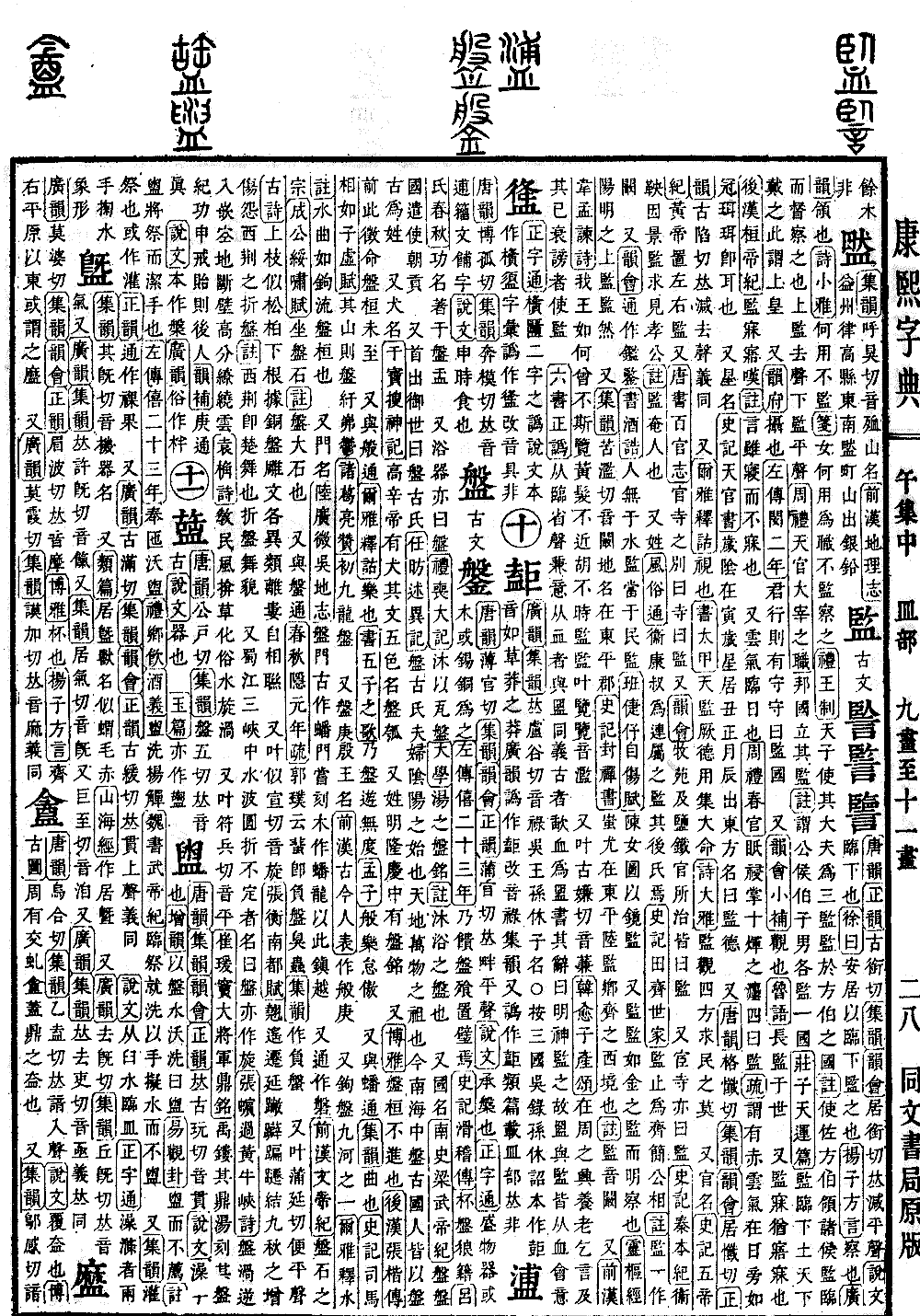
Wu Collection, Middle Volume. Radical: Dish (mǐn). Kangxi Strokes: 14. Page 796, Entry 02. Ancient form is written as shown in text.
Pronounced jian (level tone).
Explaining Graphs (Shuowen): To look downward from a high position.
Xu says: To reside in a high place to overlook the area below is the meaning of jian.
Yang Xiong’s Dialects (Fangyan): To inspect.
Broad Rhymes (Guangyun): To govern or lead.
Book of Odes (Shijing): Why do you not inspect?
Commentary (Jian): Why do you hold this office yet fail to inspect it?
Book of Rites (Liji): The Son of Heaven sends his ministers to serve as the Three Inspectors (san jian). To inspect the vassal states.
Annotation: To assist the regional lords, govern the feudal lords, and supervise them. The upper jian is pronounced in the departing tone; the lower jian is pronounced in the level tone.
Rites of Zhou (Zhouli): The states establish their supervisory officials.
Annotation: Refers to the titles of duke, marquis, earl, viscount, and baron, each supervising a state.
Zhuangzi: To supervise the lower lands; the world supports him, which is called the Supreme Emperor.
Rhyme Repository (Yunfu): Acting or deputy.
Zuo Tradition (Zuo Zhuan): When the ruler travels, there is a remaining guardian; the guardian is called the inspecting ruler (jianguo).
Compendium of Rhymes (Yunhui): To observe.
Discourses of Lu (Luyu): To observe worldly affairs for a long time.
Also jianmei, which is like being awake or asleep.
Book of the Later Han (Hou Hanshu): Monitoring sleep while awake and sighing.
Annotation: It means one is lying down but not yet asleep.
Also refers to cloud formations near the sun.
Rites of Zhou (Zhouli): The officer of omens manages the ten types of solar halos, the fourth is called jian.
Sub-commentary: It refers to red clouds beside the sun, resembling caps and ear ornaments. The term er refers to ear ornaments.
Also the name of a star.
Records of the Grand Historian (Shiji): When the year is in the Yin position and the Jupiter is in the Ugly position, appearing in the east in the morning of the first month, it is called jiande.
Pronounced jian (departing tone). Same meaning as above.
Classic of Rites (Erya): To look.
Book of Documents (Shangshu): Heaven inspected his virtues, thus bestowing a great mission.
Book of Odes (Shijing): To observe the four quarters, seeking the hardships of the people.
Also the name of an office.
Records of the Grand Historian (Shiji): The Yellow Emperor established left and right inspectors.
Book of Tang (Tangshu): Government offices are called temple (si) or inspectorate (jian).
Compendium of Rhymes (Yunhui): Pasture lands and salt/iron administrative offices are all called jian.
Also, eunuchs are called jian.
Records of the Grand Historian (Shiji): Wei Yang requested an audience with Duke Xiao through Jing Jian.
Annotation: Jian refers to a eunuch.
Also a surname.
Customs and Traditions (Fengsu Tong): Wei Kangshu served as an inspecting official, and his descendants used this as their clan name.
Records of the Grand Historian (Shiji): Jian Zhi served as the chancellor of Qi.
Annotation: In some versions, jian is written as kan.
Compendium of Rhymes (Yunhui): Used interchangeably with the characters for mirror (jian) and mirror (jian).
Book of Documents (Shangshu): One should not use water as a mirror, but should use the people as a mirror.
Ban Jieyu: Women use pictures and mirrors as an object lesson.
Jianjian, describing clarity like a metal mirror.
Spiritual Pivot (Lingshu Jing): The upper part of the Yangming meridian has an appearance of clarity.
Pronounced kan (level tone).
Place name in Dongping Commandery.
Records of the Grand Historian (Shiji): The shrine of Chiyou is in Lujian Township, Dongping Commandery, on the western border of the State of Qi.
Annotation: Jian is pronounced like kan.
Also pronounced jian (level tone).
Poetry of Wei Meng: How is my King, why does he not inspect? The elders are not near, why not inspect at all times? Jian rhymes with lan, which is pronounced like lan.
Also pronounced jian (level tone).
Han Yu: During the flourishing of the Zhou Dynasty, they provided for the elderly and sought their advice. When it had already declined, they allowed slanderers to inspect it.
Six Writings and Correct Errors (Liushu Zhenge): Derived from lin (to overlook) with a shortened phonetic; it also carries meaning. Included with blood (xue) because it shares the same meaning as alliance (meng). In ancient times, people would smear blood on their lips during an alliance and write an oath saying: The bright spirits inspect this. Therefore, both alliance and inspect include blood, forming an associative compound character.