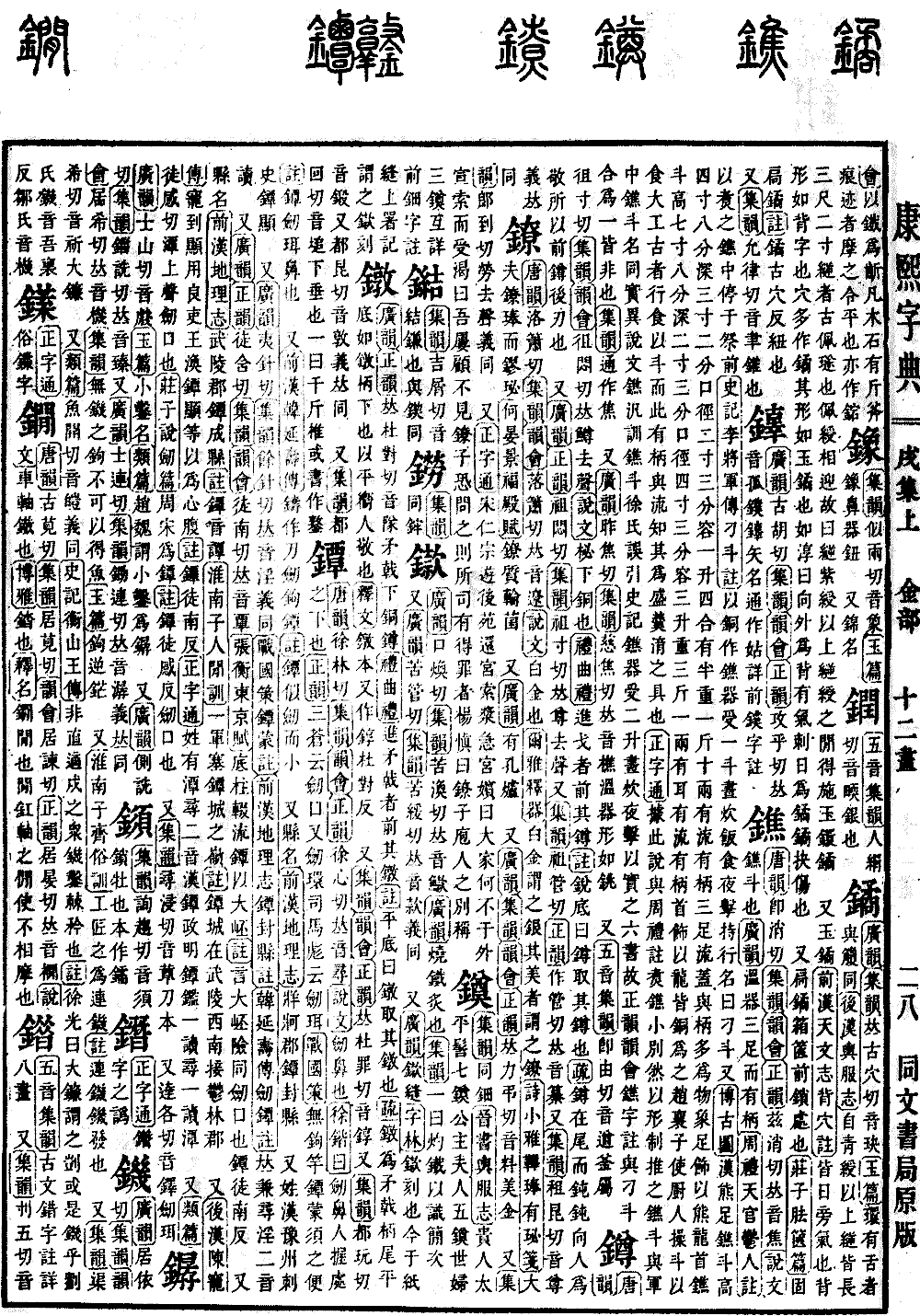
Xu Collection, Upper Volume
Radical: Metal (jīn)
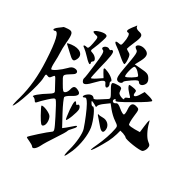
Character: jī
Kangxi Stroke Count: 20
Page 1322, Entry 17
According to the Extensive Dictionary of Rhymes (Guangyun), it is pronounced jī. According to the Collected Rhymes (Jiyun) and the Compendium of Rhymes (Yunhui), it is pronounced jī, with the same sound as jī (machine/trigger).
According to the Collected Rhymes (Jiyun), a hook without a barb cannot catch fish. According to the Jade Compendium (Yupian), it refers to the reverse-facing barb on a hook.
Also, according to the Huainanzi: Explanations of Qi Customs (Huainanzi: Qisu Xun), craftsmen create repeating crossbows. The commentary states that the repeating trigger refers to the firing mechanism of the crossbow.
Also, according to the Collected Rhymes (Jiyun), it is pronounced qí, with the same sound as qí (to pray). It refers to a large sickle.
Also, according to the Classified Dictionary (Leipian), it is pronounced ái, with the same sound as ái (white/bright). The meaning is the same.
According to the Records of the Grand Historian: Biography of the King of Hengshan (Shiji: Hengshanwang Zhuan), these are not merely ordinary soldiers guarding the frontiers, but those wielding sickles, chisels, and thorn-wood spear shafts. The commentary states that Xu Guang noted that a large sickle is called a kǎi, which perhaps is what this character refers to. The Liu family considers the pronunciation of this character to be wǔ, while the Zou family considers it to be jī.