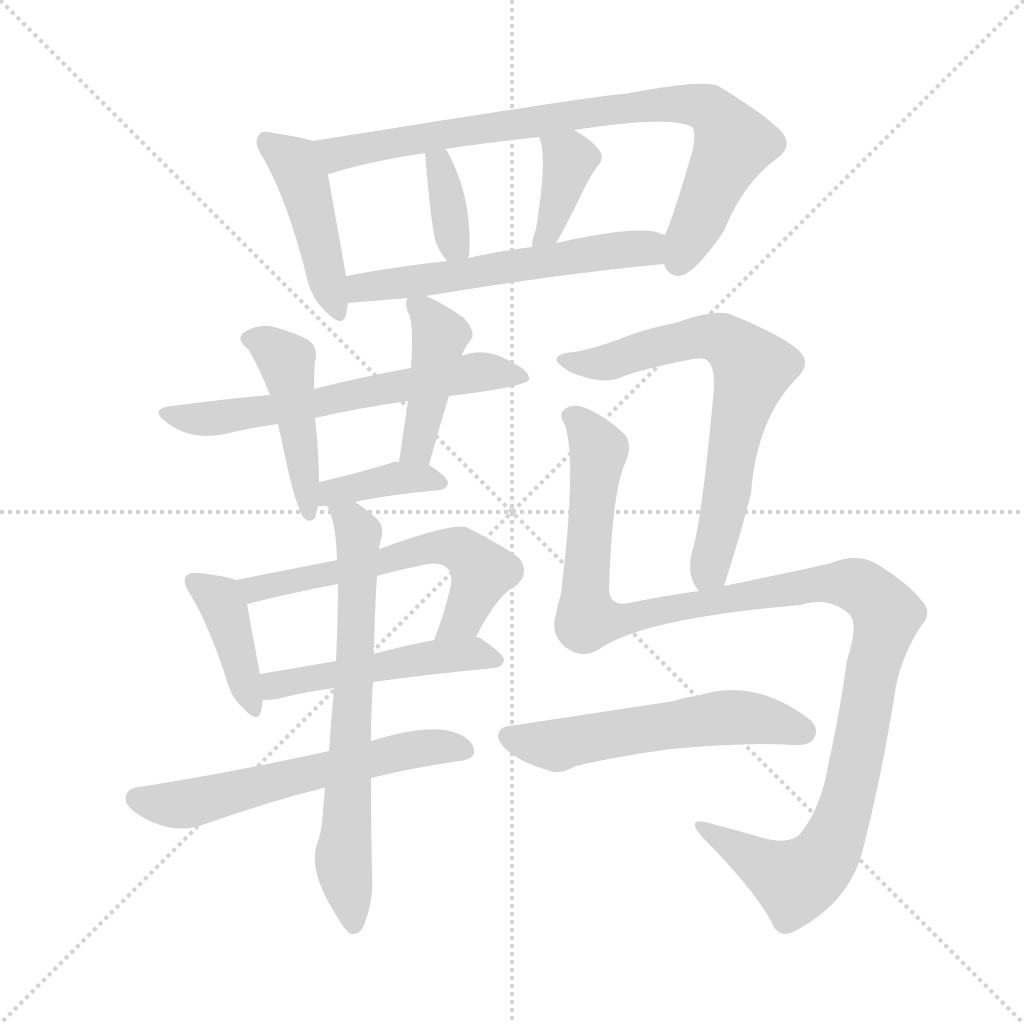
Wei Collection, Middle Volume
Radical: Net (wǎng)
Kangxi stroke count: 25
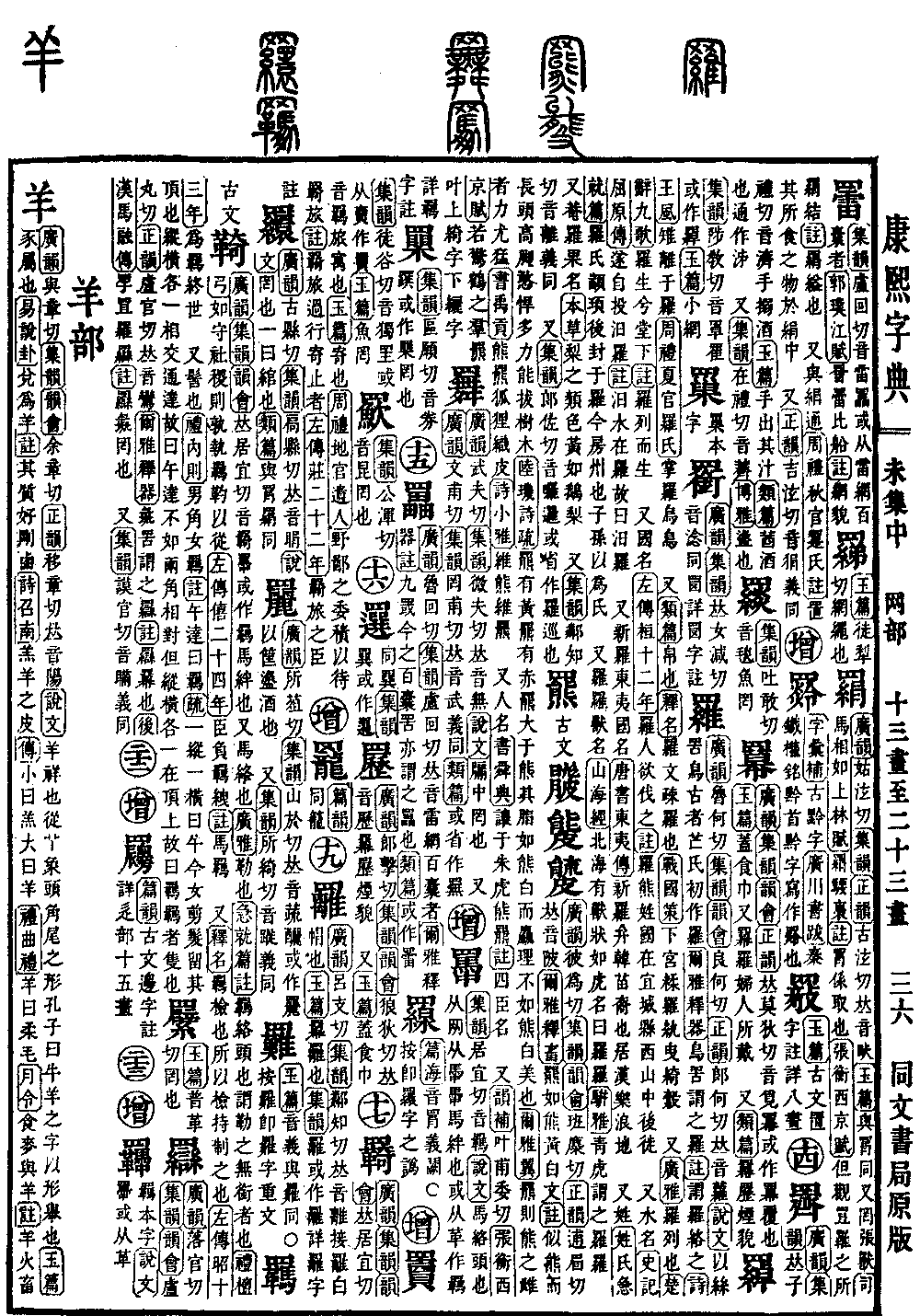
Page 950, Entry 01
Ancient character. According to the Extensive Dictionary (Guangyun), Collection of Rhymes (Jiyun), and Dictionary of Rhymes (Yunhui), the pronunciation is ji. Sometimes written in a variant form. A tether for horses. Also, a horse halter. According to the Refinement of Usage (Guangya), it means a bridle. According to the Commentary on the Rapid Accomplishment (Jijiupian zhu), a ji is a headstall, referring to a horse bridle without a bit. In the Book of Rites (Liji), record of Tan Gong: If all remain to guard the altars of the soil and grain, who will hold the horse tether to follow. In the Zuo Tradition (Zuozhuan), twenty-fourth year of Duke Xi: Your servant will carry the horse halter and reins. Commentary: This refers to a horse tether. Also, according to the Explanation of Names (Shiming), ji means to restrain or control, used to supervise and manage. In the Zuo Tradition (Zuozhuan), thirteenth year of Duke Zhao: To spend a lifetime as a traveler in a foreign land. Also refers to a hair bun. In the Book of Rites (Liji), record of Internal Regulations (Neize): A young boy wears horn-shaped buns, a young girl wears a ji bun. Commentary: If the parts connect across, it is called a ji. Explanation: One vertical and one horizontal is called intersection. Now, girls cut their hair, leaving the hair on the crown of the head, with one tuft left vertically and one horizontally, crossing and connecting to each other, thus called intersection. Unlike two horns facing each other, it is merely one tuft vertical and one horizontal on the crown, hence called a ji. Ji means single.
Textual Research: In the Book of Rites (Liji), record of Tan Gong: If all remain to guard the altars of the soil and grain, who will hold the horse tether and bridle to follow. The word all has been added according to the original text. In the Book of Rites (Liji), record of Internal Regulations (Neize): Boys have horn buns, girls have ji buns. Commentary: Now girls cut their hair, leaving the hair on the crown of the head, and it has been corrected to the crown of the head according to the original text.