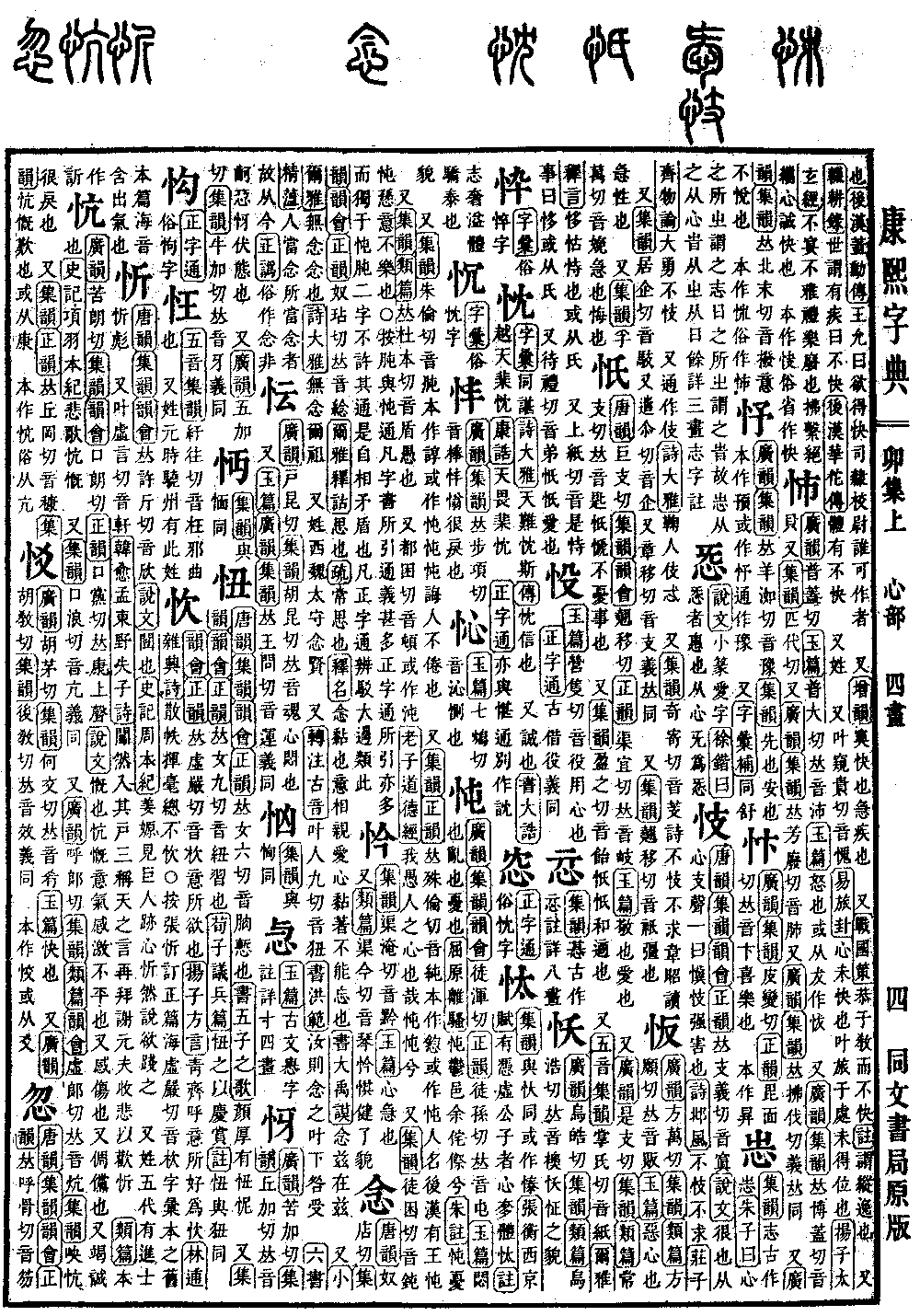
Mao Collection, Upper Volume
Radical: Heart (xīn)
Page 378, Entry 34
Tang Rhyme (Tangyun), Collected Rhymes (Jiyun), Rhyme Meetings (Yunhui), and Rectified Rhymes (Zhengyun) all give the fanqie as hu-gu; pronounced hu.
Shuowen Jiezi (Shuowen): To forget. To be dazed and confused, unaware of reason.
Yanzi Chunqiu (Yanzi Chunqiu): In the song of the Qi laborer, it says, dazed and confused, what can be done.
Guangyun: Sudden, rapid.
Erya (Erya): Exhausted. Commentary: The appearance of suddenly disappearing.
Zuo Zhuan (Zuo Zhuan): Gao Yao and Ting Jian suddenly had no one to offer them sacrifices.
Extinguished or cut off.
Book of Odes (Shijing): Thus it is broken off, thus it is extinguished. Commentary: Hu means extinguished.
Jiyun: Slight. The weight of one silkworm is called one hu; ten hu make one si. Liu De said: Hu refers to a spider web.
Negligent or careless.
Book of the Later Han (Hou Hanshu): You love Ban Gu but are negligent toward Cui Yin.
Hu huang, empty and adrift.
Jia Yi's Rhapsody on the Owl (Fu): Vast and boundless, soaring together with the Dao.
A surname. In the Ming dynasty, there were Hu Zhong and Hu Ming.
Also written as a variant form (hu).
Book of the Former Han (Qian Hanshu): At that time, people all slighted him. Commentary: Same as hu.
Zhong Hu, a person's name.
Book of the Former Han (Qian Hanshu): Written as Zhong Hu.
Also used as a variant for (hu, an official tablet).
Book of Etiquette and Ceremonial (Yili): A bamboo tablet. Commentary: In the modern text, the character for tablet is written as hu.
Also used as a variant for (wu).
Xunzi (Xunzi): Dazed and crude. Commentary: Same as hu. The appearance of having no foundation.
Also rhyming with huo; pronounced xi.
Book of the Former Han (Qian Hanshu): Investigating the roots, the arts and numbers begin from one, producing the qi of the Yellow Bell, with measurements as minute as one hu.
Also rhyming with xu-yue; pronounced xue.
Lu Ji's Rhapsody on Clouds (Fu): Filling the eight directions with lingering energy, though covering the sky, it has not yet dispersed. How could one rely on the passage of time to vanish quickly in a single morning?
Shuowen Jiezi (Shuowen): Composed of the radical for heart and the phonetic element wu.
Changjian: Also written as the variant form. According to current characters, they all evolved from the small seal script; one can only interpret and explain them according to Shuowen. For instance, the character hu has many borrowed and common meanings. If one wishes to investigate the subtle and correct errors, one must cite the ancient great seal script to judge the modern script; then the numerous meanings can be discarded. To explain the characters of the modern text, one should rely only on the modern text and refute the places where it is borrowed in the classics and histories; then the meaning of the characters is clear, and there is no need for overly pedantic discussion or subjective judgment. For all characters in each radical, those that do not cite the Jingyun Zheng'e for identification and refutation follow this example.