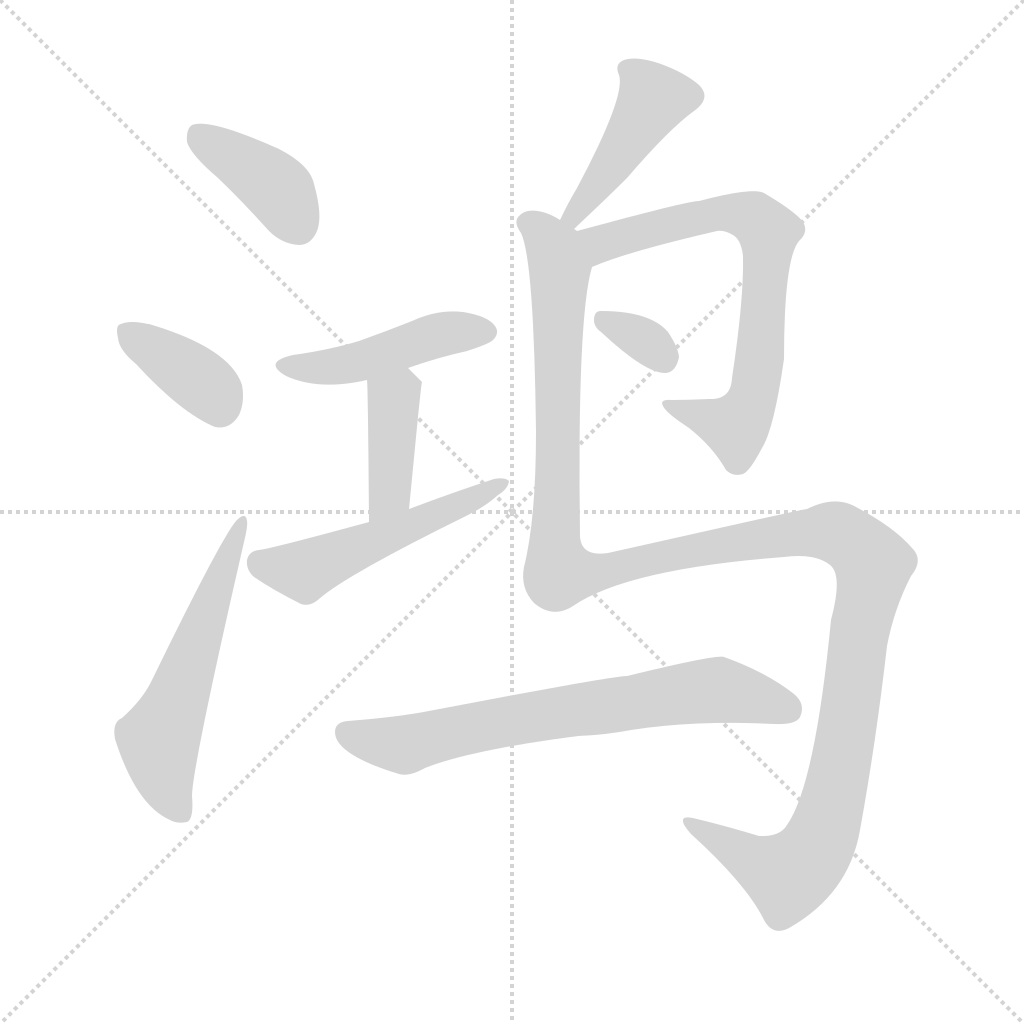
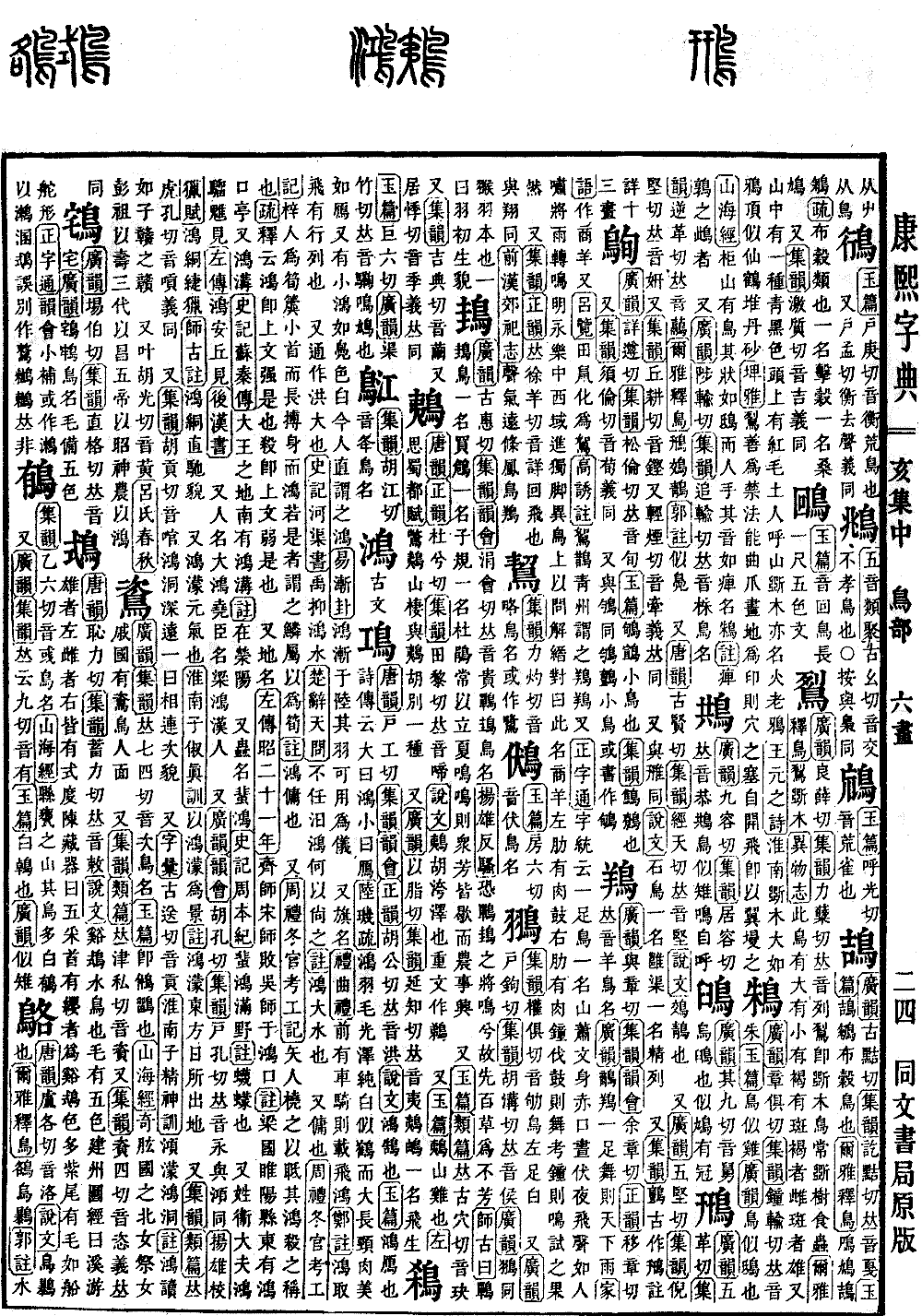
Hai Collection, Lower Volume
Radical: Bird (niǎo)
Kangxi Strokes: 17
Page 1488, Entry 01
Ancient form. Pronounced hóng.
According to the Shuowen Jiezi (Explanation of Characters and Analysis of Compound Characters): Hóng is a swan.
According to the Yupian (Jade Compendium): Hóng is a wild goose. The Book of Odes (Shijing) commentary states: The large ones are called hóng, the small ones are called yàn.
Lu Ji commentary: The feathers of the hóng are glossy and pure white; it resembles a crane but is larger, with a long neck, and its meat is as delicious as that of a hawk. There is also a small hóng that resembles a wild duck and is white in color; people today simply call it hóng.
Book of Changes (Yijing), Hexagram Jian: The wild goose advances to the high land, its feathers can be used for rituals.
Also a type of flag. Book of Rites (Liji), Qu Li: When there are chariots and cavalry in front, then bear the flying hóng flag.
Zheng commentary: The hóng is chosen because its flight has a row-like formation.
Also commonly used as hóng, meaning large. Records of the Grand Historian (Shiji), Treatise on Rivers and Canals: Yu suppressed the great floods.
Chu Ci, Questions of Heaven: If one cannot manage the vast, how can one exalt it?
Commentary: Hóng means large water.
Also means sturdy or thick. The Rites of Zhou (Zhouli), Winter Official, Artificer's Record: The woodworkers make the uprights for bell chimes, with small heads and long bodies, sturdy in the middle and thick, those that are like this are called scale-like, and are used for chimes.
Commentary: Hóng means sturdy or thick.
Also, the Rites of Zhou (Zhouli), Winter Official, Artificer's Record: The arrow-makers bend them to observe the balance between their thickness and thinness.
Sub-commentary: The explanation says that hóng is the strength mentioned above. The shā is the weakness mentioned above.
Also a place name. Zuo Tradition (Zuo Zhuan), 21st Year of Duke Zhao: The Qi army and Song army defeated the Wu army at Hóngkǒu.
Commentary: There is a Hóngkǒu Pavilion east of Suiyang County in the State of Liang.
Also Hónggōu (a canal). Records of the Grand Historian (Shiji), Biography of Su Qin: Your Majesty's land has the Hónggōu Canal to the south.
Commentary: Located in Xingyang.
Also an insect name. Fēihóng. Records of the Grand Historian (Shiji), Annals of Zhou: Fēihóng filled the fields.
Commentary: This refers to tiny insects (mièmēng).
Also a surname. The Wei official Hóng Liúchuài, see Zuo Tradition (Zuo Zhuan). Hóng Ānqiū, see History of the Later Han (Hou Hanshu).
Also a personal name. Dàhóng, a minister of Emperor Yao. Liáng Hóng, a man of the Han dynasty.
Also pronounced hǒng. Same as hòng.
Yang Xiong, Rhapsody on Hunting (Yǔliè Fù): Hóngtóng (a description of swift movement).
Shigu commentary: Hóngtóng means the appearance of galloping straight ahead.
Also hóngméng, the primal vapor. Huainanzi, Treatise on Truth (Chǔzhēn Xùn): Using hóngméng as the pillar of light.
Commentary: The wilderness of the east where the sun rises.
Also pronounced hòng. Meaning same as above.
Also pronounced hòng. Hóngdòng, deep and remote. One meaning is the appearance of things connected in sequence.
Also pronounced gòng.
Huainanzi, Treatise on Spirit (Jīngshén Xùn): Hòngméng hóngdòng.
Commentary: Hóng is pronounced like the Gòng in Zǐ Gòng.
Also rhyming as huáng.
Lüshi Chunqiu: Peng Zu was known for his longevity, the three dynasties were known for their prosperity. The five emperors were known for their clarity, and Shennong was known for his vastness.