Si Collection, Upper Volume
Radical: Water (shuǐ)
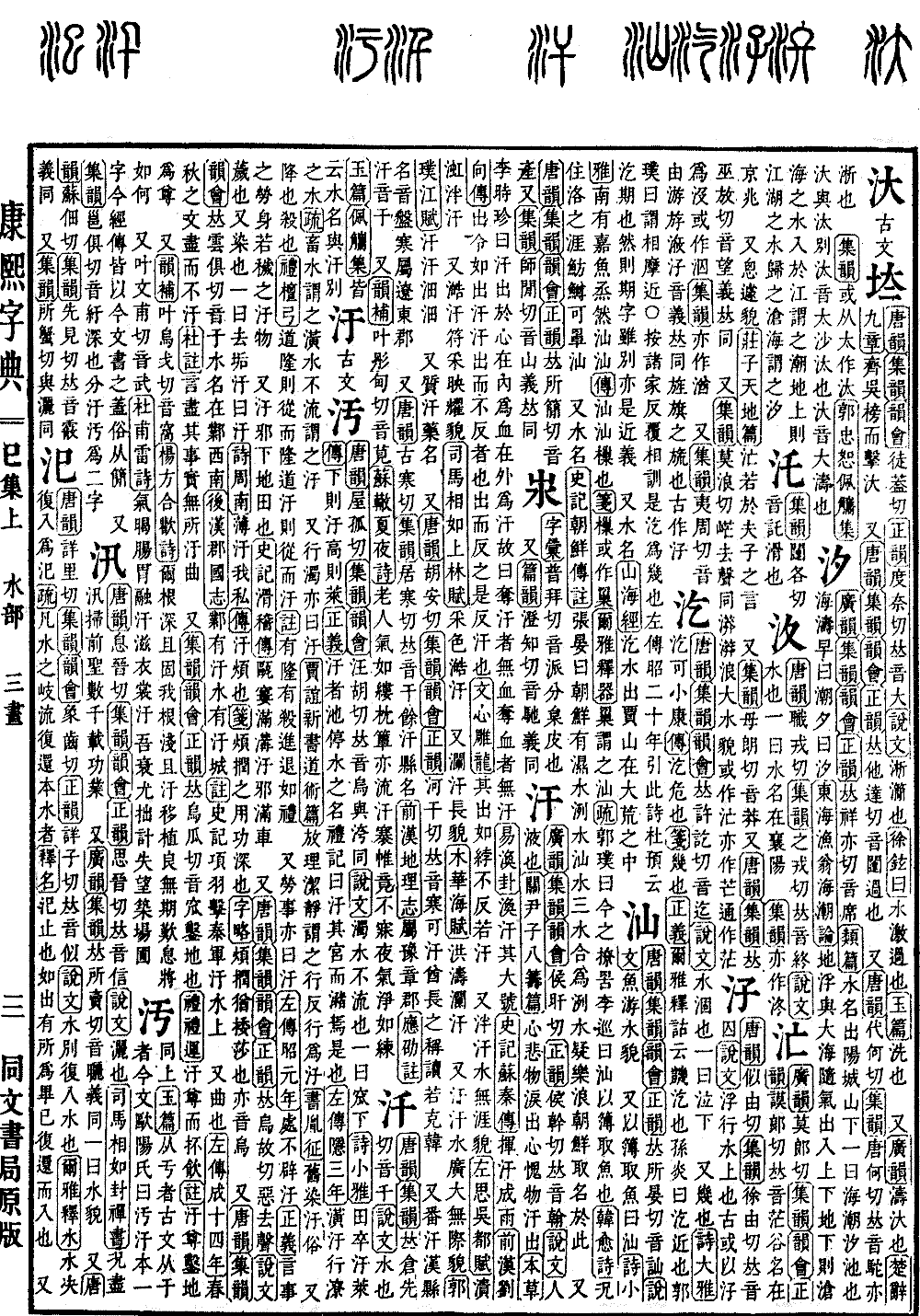
汗
Kangxi strokes: 7
Page 605, Entry 11
According to the Guangyun (Guǎngyùn), Jiyun (Jíyùn), and Yunhui (Yùnhuì), it is pronounced han. According to the Zhengyun (Zhèngyùn), it is pronounced han; the pronunciation is the same as han.
The Shuowen Jiezi (Shuōwén Jiězì) defines it as the liquid secreted by the human body.
The Guanyinzi (Guānyǐnzǐ), Eight Categories Chapter, records: When the heart is sad, tears flow from the eyes; when the heart is ashamed, sweat flows from the body.
In the Compendium of Materia Medica (Běncǎo Gāngmù), Li Shizhen says: Sweat is governed by the heart; it is blood within the body, and it becomes sweat when discharged outside. Thus it is said that excessive sweating damages the blood, and if one loses too much blood, there is no sweat left to discharge.
The Book of Changes (Yijing), Huan Hexagram, contains the phrase: The great mandate is like dissipating sweat.
The Records of the Grand Historian (Shǐjì), Biography of Su Qin, describes people sweating so profusely that it is like rain.
The Book of Han (Qiánhànshū), Biography of Liu Xiang, says that issuing a political decree is like sweating. Once sweat flows out, it cannot be taken back. If a decree is issued and then retracted, it is like trying to make sweat flow back into the body.
The Literary Mind and the Carving of Dragons (Wénxīn Diāolóng) describes such an issuance as being like the heavy rope pulling a coffin, which cannot be retracted just as sweat cannot flow back.
Also, panhan, describes the appearance of water as vast and boundless.
The Zuo Si, Ode to the Capital of Wu (Wúdū Fù), contains the phrase: Overflowing and vast.
Also, haohan, describes the appearance of literary talent as brilliant and shining.
The Sima Xiangru, Rhapsody on the Shanglin Park (Shànglín Fù), contains the phrase: Colors are brilliant and shining.
Also, lanhan, describes an appearance that is long and vast.
The Mu Hua, Rhapsody on the Sea (Hǎi Fù), contains the phrase: Great waves are vast and long.
Also, hanhan, describes the appearance of a water surface as broad and boundless.
The Guo Pu, Rhapsody on the Yangtze River (Jiāng Fù), contains the phrase: Vast and broad.
There is also zhihan, which is the name of a medicinal substance.
Also, according to the Tangyun (Tángyùn), it is pronounced han; according to the Jiyun (Jíyùn), Yunhui (Yùnhuì), and Zhengyun (Zhèngyùn), it is pronounced han; the pronunciation is the same as han.
Kehan is a title for the leaders of ethnic minorities. The pronunciation is the same as kehan.
There is also Fanhan, which was the name of a county in the Han Dynasty. It is pronounced panhan and was under the jurisdiction of Liaodong Commandery.
Also, according to the Tangyun (Tángyùn), it is pronounced gan; according to the Jiyun (Jíyùn), it is pronounced gan; the pronunciation is the same as gan.
Yuhan is the name of a county.
The Book of Han (Qiánhànshū), Treatise on Geography, records that it belonged to Yuzhang Commandery.
The commentary by Ying Shao says that here, han is pronounced gan.
Also, according to the Yunbu (Yùnbǔ), it is rhymed and pronounced xian.
Su Zhe, Summer Night Poem, writes: The old man’s breath is as faint as a thread, and sweat flows onto the pillow and mat. Lifting the curtain, he is unable to sleep, as the night air is as clear as white silk.