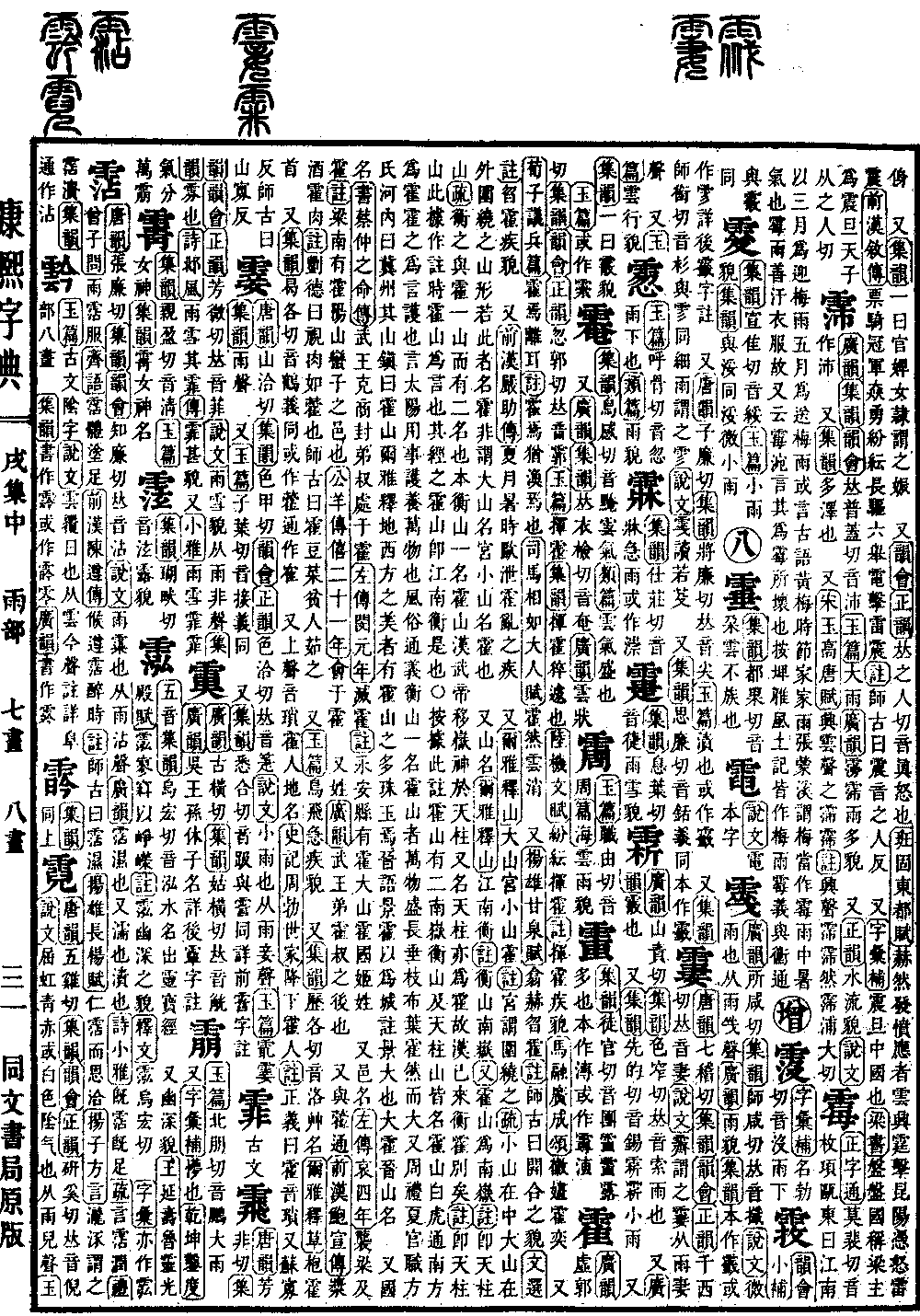
Xu Collection, Middle Volume
Radical: Rain (yǔ)
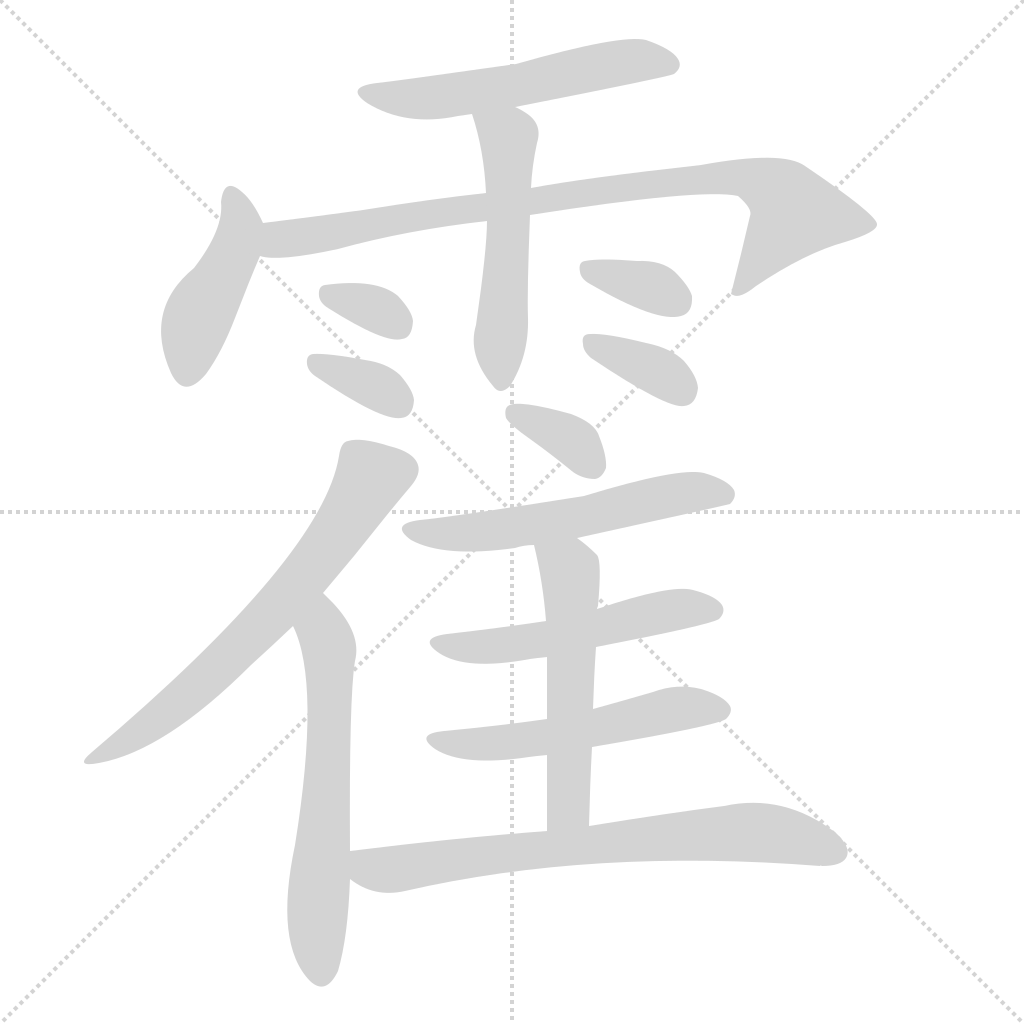
Huo; Kangxi stroke count: 16; Page 1375, Entry 17
Pronounced huo.
Jade Chapter (Yupian): Huihuo (rapid movement).
Collected Rhymes (Jiyun): Huihuo, meaning sudden or hurried.
Lu Ji, Rhapsody on Literature (Wenfu): In a flurry of rapid movement.
Commentary: Huihuo describes something fast.
Ma Rong, Eulogy on Guangcheng (Guangcheng Song): Radiant and shimmering.
Also, Xunzi, Discussion on Military Affairs (Yibing Pian): Suddenly dispersed.
Commentary: Huo means as if scattered.
Sima Xiangru, Rhapsody on the Great Man (Daren Fu): Suddenly, the clouds dispersed.
Also, Yang Xiong, Rhapsody on Ganquan (Ganquan Fu): Rapidly opening and closing.
Commentary: Shigu states it describes the appearance of opening and closing.
Selections of Refined Literature (Wenxuan) Commentary: Xu-huo describes speed.
Also, History of the Former Han (Qianhan), Biography of Yan Zhu: In the hot summer months, one suffers from cholera and diarrhea.
Also, Erya, Explaining Mountains: A large mountain is called Gong, a small mountain is called Huo.
Commentary: Gong means to surround.
Exegesis: A small mountain is in the center, a large mountain is outside, surrounding it. A mountain shape such as this is called Huo. It does not mean the large mountain is named Gong and the small mountain is named Huo.
Also, the name of a mountain.
Erya, Explaining Mountains: In the south of the Yangtze River is Heng.
Commentary: Mount Heng is the Southern Peak.
Also: Mount Huo is the Southern Peak.
Commentary: This refers to Mount Tianzhu.
Exegesis: Heng and Huo are two names for the same mountain. Originally Mount Heng, it was also called Mount Huo. Emperor Wu of Han transferred the mountain deity to Mount Tianzhu, which was also called Huo, so since the Han Dynasty, Heng and Huo have been separate.
Commentary: This refers to Mount Tianzhu. This is based on the situation of Mount Huo at the time the commentary was written. The Mount Huo in the classic text refers to the Heng mountain south of the Yangtze. According to this commentary, there are two Mount Huos; Mount Heng, the Southern Peak, and Mount Tianzhu, both called Mount Huo. White Tiger Hall (Baihu Tong): The south is called Huo. Huo refers to protection, meaning the solar energy acts to protect and nourish all things. Comprehensive Meaning of Customs and Traditions (Fengsu Tongyi): Mount Heng is also called Mount Huo because all things grow vigorously, hanging their branches and spreading their leaves, suddenly becoming large.
Also, Rites of Zhou (Zhouli), Ministry of Summer, Office of the Regional Commissioner: The land within the Yellow River is called Jizhou; its mountain sentinel is Mount Huo. Erya, Explaining Earth: Among the beauties of the west is Mount Huo, with its many pearls and jade. Discourses of the States (Jinyu): Using Jinghuo as a city wall. Commentary: Jing means large. Large Huo is a mountain name in the state of Jin.
Also, the name of a state.
Book of Documents (Shujing), Commentary on the Mandate to Cai Zhong: After King Wu conquered the Shang, he enfeoffed his younger brother Shu Chu in Huo.
Zuo Commentary (Zuozhuan), First Year of Duke Min: Destroyed Huo.
Commentary: Yong'an County contains the Great Mount Huo. The State of Huo was of the Ji clan.
Also, the name of a settlement.
Zuo Commentary (Zuozhuan), Fourth Year of Duke Ai: Attacked Liang and Huo.
Commentary: South of Liang is Mount Huoyang, a settlement of the Man people.
Gongyang Commentary (Gongyangzhuan), Twenty-first Year of Duke Xi: Met at Huo.
Also, a surname.
Collected Rhymes (Guangyün): Descendants of Huo Shu, the younger brother of King Wu.
Also, used interchangeably with huo (bean leaves).
History of the Former Han (Qianhan), Biography of Bao Xuan: Serving wine and bean leaves as meat.
Commentary: Liu De states: This means looking at meat as if it were bean leaves. Shigu states: Huo refers to bean sprouts, eaten by the poor.
Also, Jade Chapter (Yupian): The appearance of a bird flying rapidly.
Also, Collected Rhymes (Jiyun): Pronounced luo. A type of plant.
Erya, Explaining Plants: Fu-huo (a type of herb).
Also, Collected Rhymes (Jiyun): Pronounced he. Meaning is the same. Sometimes written as huo. Commonly written as huo.
Also, rising tone, pronounced suo. Huoren, a place name.
Records of the Grand Historian (Shiji), Biography of Zhou Bo: Subjugated the people of Huo.
Commentary: The Zhengji states: Huo is pronounced suo, or according to the fanqie (su-gua). Shigu states: According to the fanqie (shan-gua).