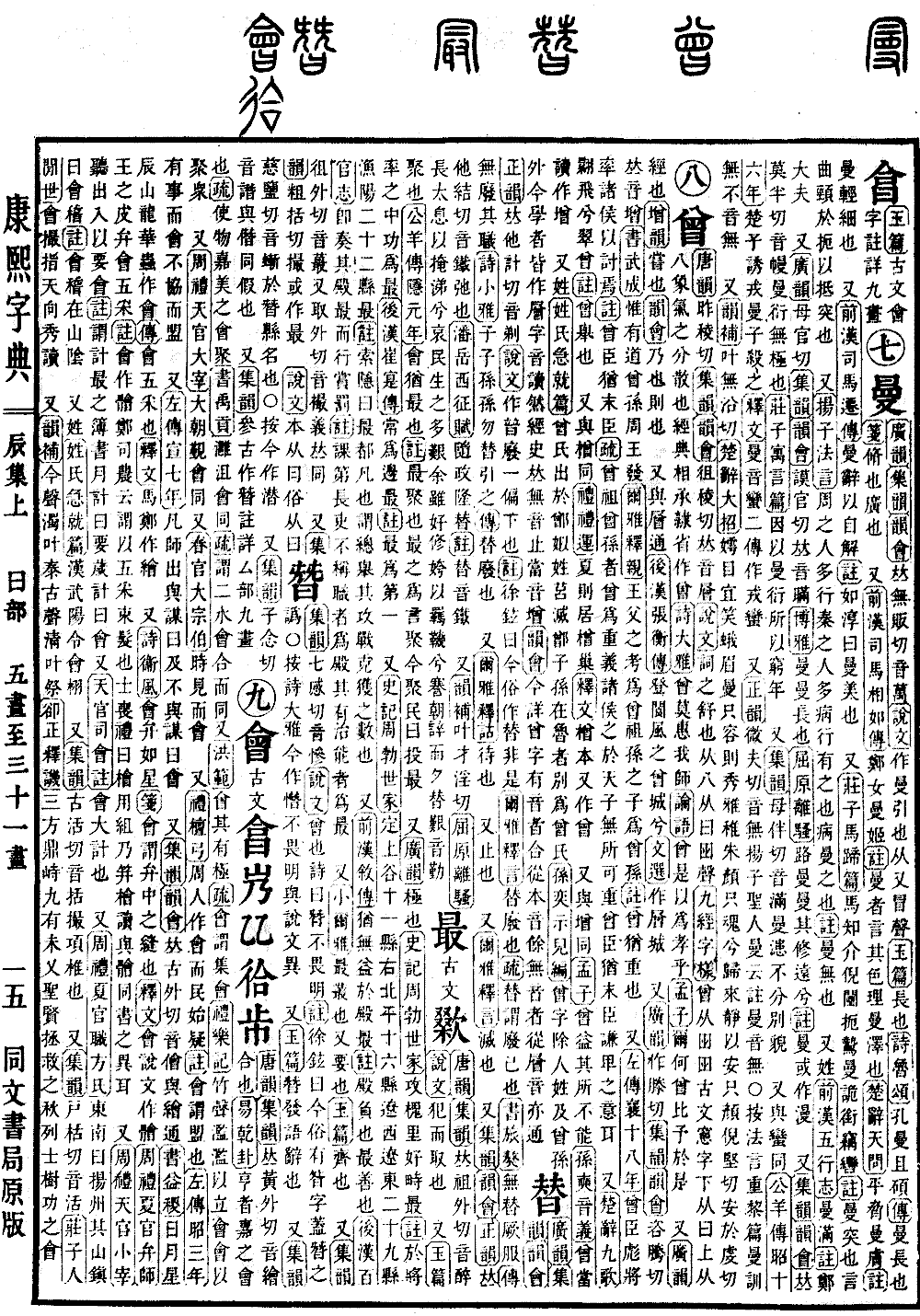
Chen Collection, Upper Volume
Radical: Say (yuē)
Kangxi Strokes: 13
Page 503, Entry 08
Ancient text. Pronounced hui. Means to combine or assemble.
Book of Changes (Yijing), Qian Hexagram: Success is the gathering of excellence. Commentary: To cause things to gather in a beautiful manner.
Book of Documents (Shangshu), Tribute of Yu: The Yong and Ju rivers meet and flow together. Commentary: Refers to two rivers joining and flowing away together.
Also, Grand Plan (Hongfan): To gather those who have standards. Commentary: To gather means to assemble.
Book of Rites (Liji), Record of Music (Yueji): The sound of bamboo is pervasive; it is used to establish gatherings, and gatherings are used to assemble the masses.
Also, Rites of Zhou (Zhouli), Offices of Heaven, Grand Administrator: Large court audiences and joint meetings.
Also, Spring Offices, Grand Minister of Rites: When feudal lords hold an audience with the Son of Heaven without a fixed schedule, it is called a gathering.
Also, Book of Rites (Liji), Tan Gong: The people of Zhou initiated the gathering, and the people began to have doubts. Commentary: Gathering refers to a covenant meeting.
Zuo Commentary (Zuozhuan), Third Year of Duke Zhao: When there are affairs, one gathers; when opinions do not align, one swears a covenant.
Also, Zuo Commentary (Zuozhuan), Seventh Year of Duke Xuan: Whenever troops are sent to participate in planning, it is called ji; when not participating in planning, it is called hui.
Also, Rhyme Collection (Jiyun), Rhyme Compendium (Yunhui): Pronounced kuai. Interchangeable with the character for embroidery (hui).
Book of Documents (Shangshu), Yiji: The sun, moon, stars, mountains, dragons, and variegated animals are used for ornamentation. Commentary: The term used here refers to five-colored embroidery or painting. Explanatory Text: The editions of Ma Rong and Zheng Xuan use the character for embroidery.
Also, Book of Odes (Shijing), Odes of Wei: The ornaments on the leather cap are like stars. Commentary: Refers to the seams of a leather cap. Explanatory Text: The character here is written with a variant form (kui).
Rites of Zhou (Zhouli), Summer Offices, Cap Master: The King's leather cap is decorated with five-colored jade at the seams. Commentary: The term here is written as a variant form (kui). Zheng Sinong states: This refers to binding the hair with five-colored silk ribbons. The Rites for the Funeral of a Scholar states: Bind the hair with silk ribbons and then insert a hairpin. The character (kuai) is pronounced the same as the variant form (kui), only the writing is different.
Also, Rites of Zhou (Zhouli), Offices of Heaven, Lesser Administrator: Listen to reports of financial income and expenditure based on accounting records. Commentary: Refers to ledger books that record summaries; monthly statistics are called yao, and annual statistics are called hui.
Also, Offices of Heaven, Commentary on the Administrator of Statistics: Hui refers to grand statistics.
Also, Rites of Zhou (Zhouli), Summer Offices, Office of Regional Government: The southeast is called Yangzhou, and its guardian mountain is called Kuaiji. Commentary: Kuaiji is located in Shanyin.
Also a surname. Book of Surnames (Xingshi Jijue Pian): During the Han dynasty, there was a magistrate of Wuyang County named Hui Xu.
Also, Rhyme Collection (Jiyun): Pronounced kuo. Refers to the nape of the neck, that is, the cervical vertebrae.
Also, Rhyme Collection (Jiyun): Pronounced huo. Zhuangzi, In the World of Men: The cervical vertebrae pointing to the sky. This is the pronunciation by Xiang Xiu.
Also, Supplement to Rhymes (Yunbu): The modern pronunciation is voiced, rhyming with tai. The ancient pronunciation is unvoiced, rhyming with ji.
Que Zheng, Explanation of Satire (Shiji): Three directions stand in opposition, and the world is not yet settled. This is an era for sages to save the world from danger, and an opportunity for ambitious men to establish achievements.