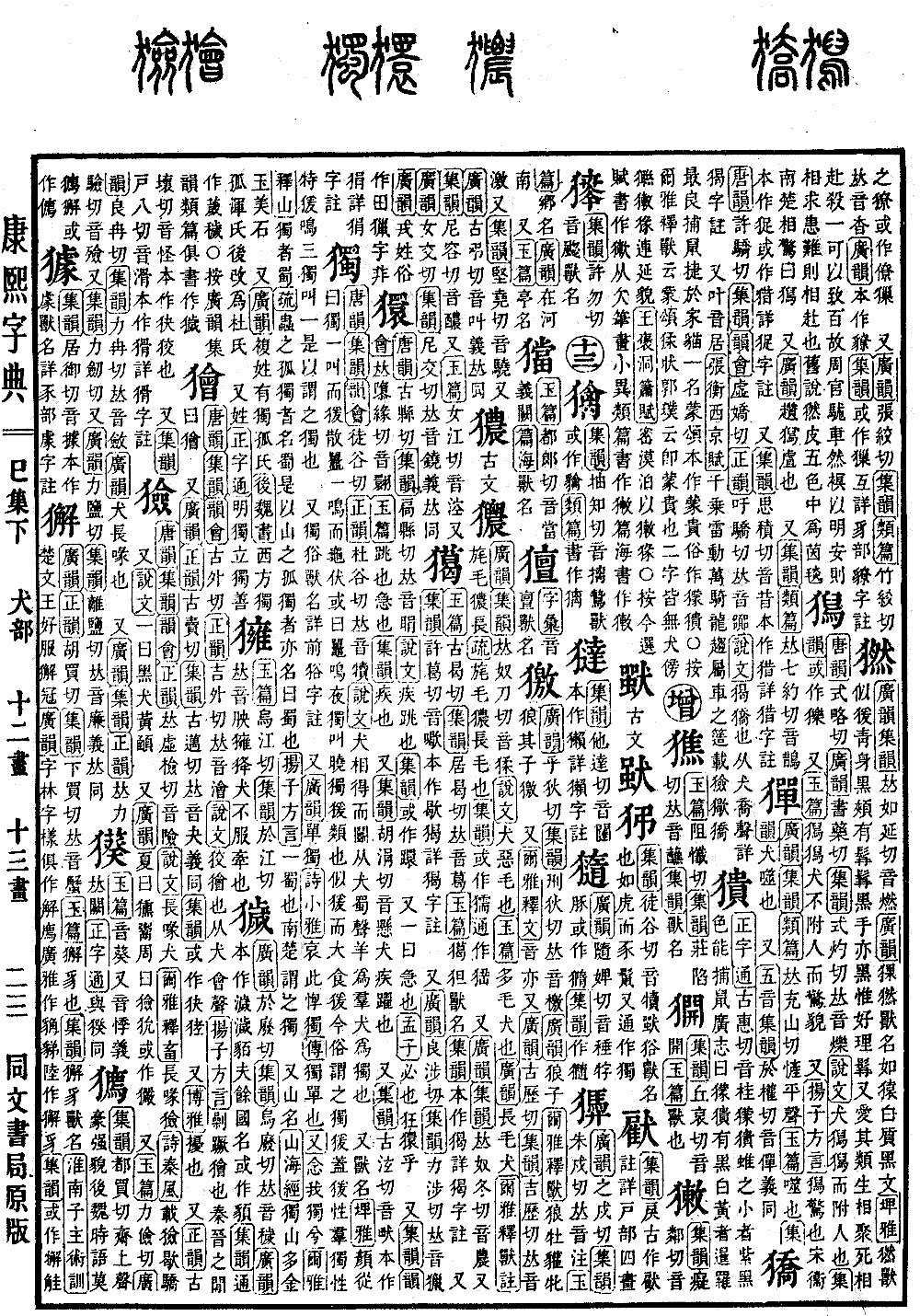
Si Collection, Lower Volume
Radical: Dog (quǎn)
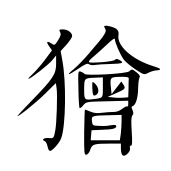
獪
Kangxi Stroke Count: 17
Page 719, Entry 28
Pronounced hui (falling tone) according to Tang Rhyme (Tangyun), Collection Rhyme (Jiyun), and Rhyme Meeting (Yunhui), as well as Correct Rhymes (Zhengyun). According to Explaining Graphs and Analyzing Characters (Shuowen), it means crafty and cunning. Composed of the radical for dog and a phonetic element indicating sound. According to Master Yang's Regional Dialects (Fangyan), it is equivalent to the term jiaojue. In the regions of Qin and Jin, it is called kuai.
Pronounced guai (falling tone) according to Extensive Rhymes (Guangyun) and Correct Rhymes (Zhengyun), and pronounced guai (falling tone) according to Collection Rhyme (Jiyun). The meaning is the same. According to Collection Rhyme (Jiyun), it is sometimes written in a variant form (jie).
Also, according to Er Ya's supplementary text (Boya), it means to disturb.
Also, according to Correct Rhymes (Zhengyun), pronounced guai (falling tone). The original form is written differently. It means cunning.
Also, according to Collection Rhyme (Jiyun), pronounced hua (entering tone). The original form is written as the word for cunning (hua). Refer to the detailed notes under the entry for the character for cunning (hua).
The character (lang) was originally composed of the radical for dog and the character (zuo).
Textual research: According to Collection Rhyme (Jiyun), it is sometimes written as (jie). I have carefully corrected the original text from (lang) to (jie).