Mao Collection, Upper Volume
Radical: Heart (xīn)
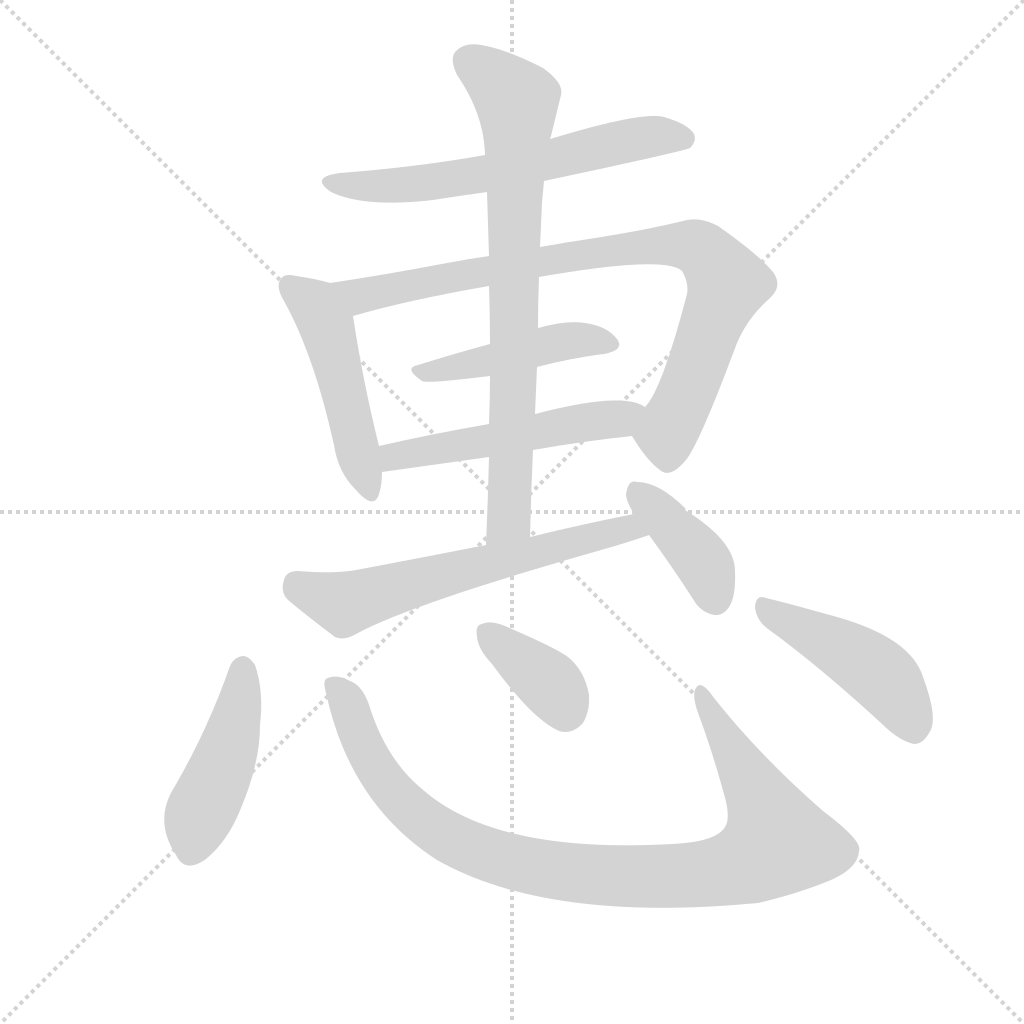
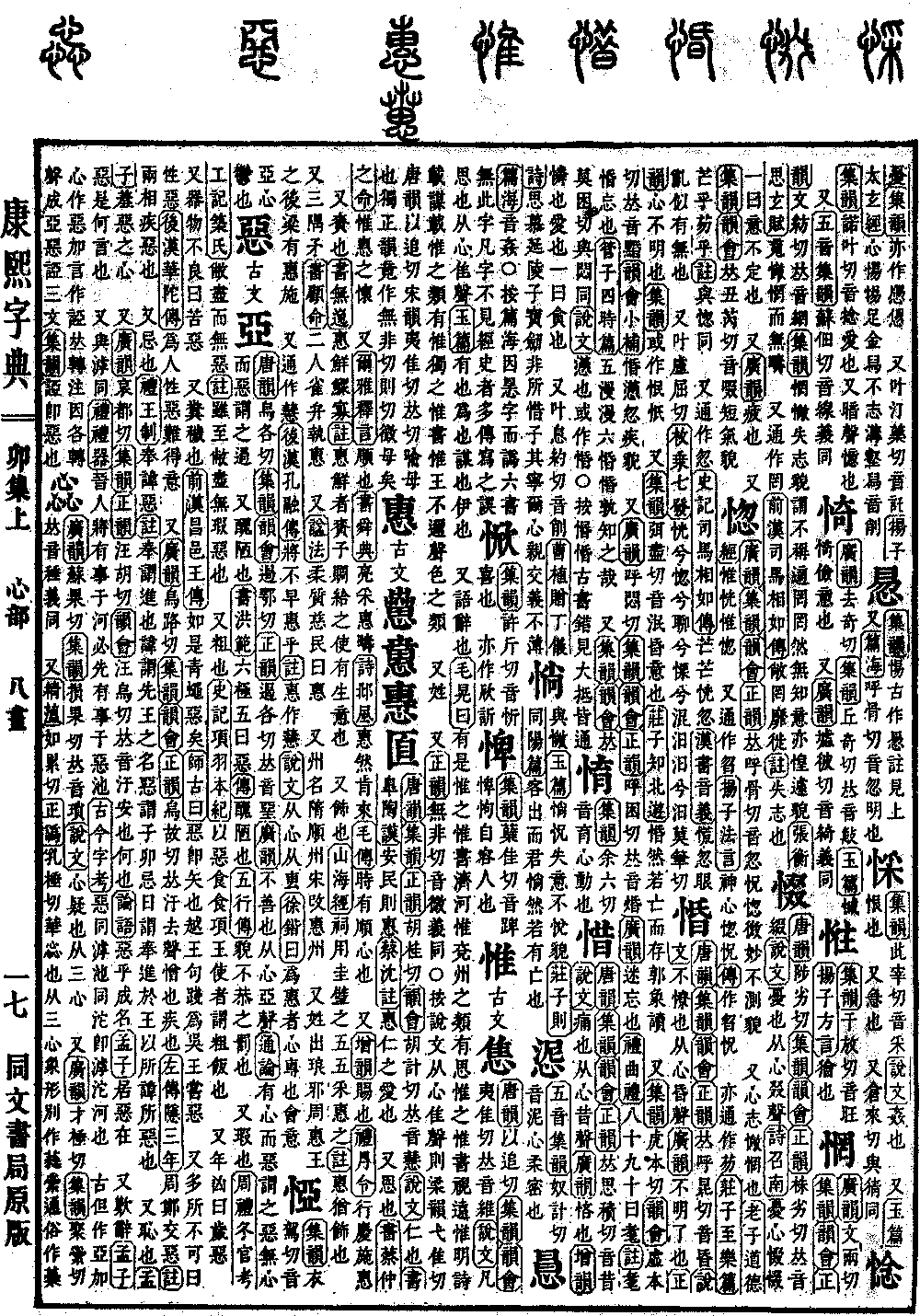
Hui
Kangxi Strokes: 12
Page 391, Entry 19
Ancient script. According to Tang Rhymes (Tangyun), Collection of Rhymes (Jiyun), and Correct Rhymes (Zhengyun), it is pronounced hui (falling tone). According to Collection of Rhymes (Yunhui), it is pronounced hui (falling tone). Shuowen Jiezi states it means benevolence. In the Book of Documents (Shangshu), chapter Gao Yao Mo, it says: To bring peace to the people is to practice benevolence. Cai Shen comments: Hui means benevolent love. It also means grace. In the Book of Documents, chapter Cai Zhong Zhi Ming, it says: Only cherishing grace. It also means to follow or comply, as stated in the Erya, chapter Shiyan. In the Book of Documents, chapter Shun Dian, it says: Brightly conduct yourself and follow the fields. In the Book of Odes (Shijing), chapter Bei Feng, it says: You kindly agreed to come. The Mao Commentary states: This refers to having a compliant heart. It also means to bestow, as stated in the Additional Rhymes (Zengyun). In the Book of Rites (Liji), chapter Yue Ling, it says: Carry out celebrations and bestow grace. It also means to provide, as in the Book of Documents, chapter Wu Yi: Provide for the widowed and solitary. The commentary states: Hui-xian means to bestow and provide relief to give them vitality. It also means to decorate. In the Classic of Mountains and Seas (Shanhaijing), it says: For sacrifices, use jade disks and adorn them with five colors. The commentary states: Hui means to decorate. It also refers to a three-cornered spear. In the Book of Documents, chapter Gu Ming, it says: Two men in sparrow-patterned caps held spears. According to the Rules of Posthumous Titles (Shifa), one who is gentle by nature and kind to the people is called Hui. It is also the name of a prefecture. In the Sui Dynasty, it was Shun Prefecture; the Song Dynasty changed it to Hui Prefecture. It is also a surname, originating from the descendants of King Hui of Zhou in Langya; during the Liang Dynasty, there was Hui Shi. It is also used interchangeably with the word for wisdom (hui). In the History of the Later Han (Hou Hanshu), biography of Kong Rong, it says: Would it not be wise to do so early? The commentary notes: Hui is used for wisdom. Shuowen Jiezi states: It is composed of heart and zhuan. Xu Kai states: One who practices benevolence has a focused heart. It is a compound ideograph, composed of the radical for receptacle and the character for self.