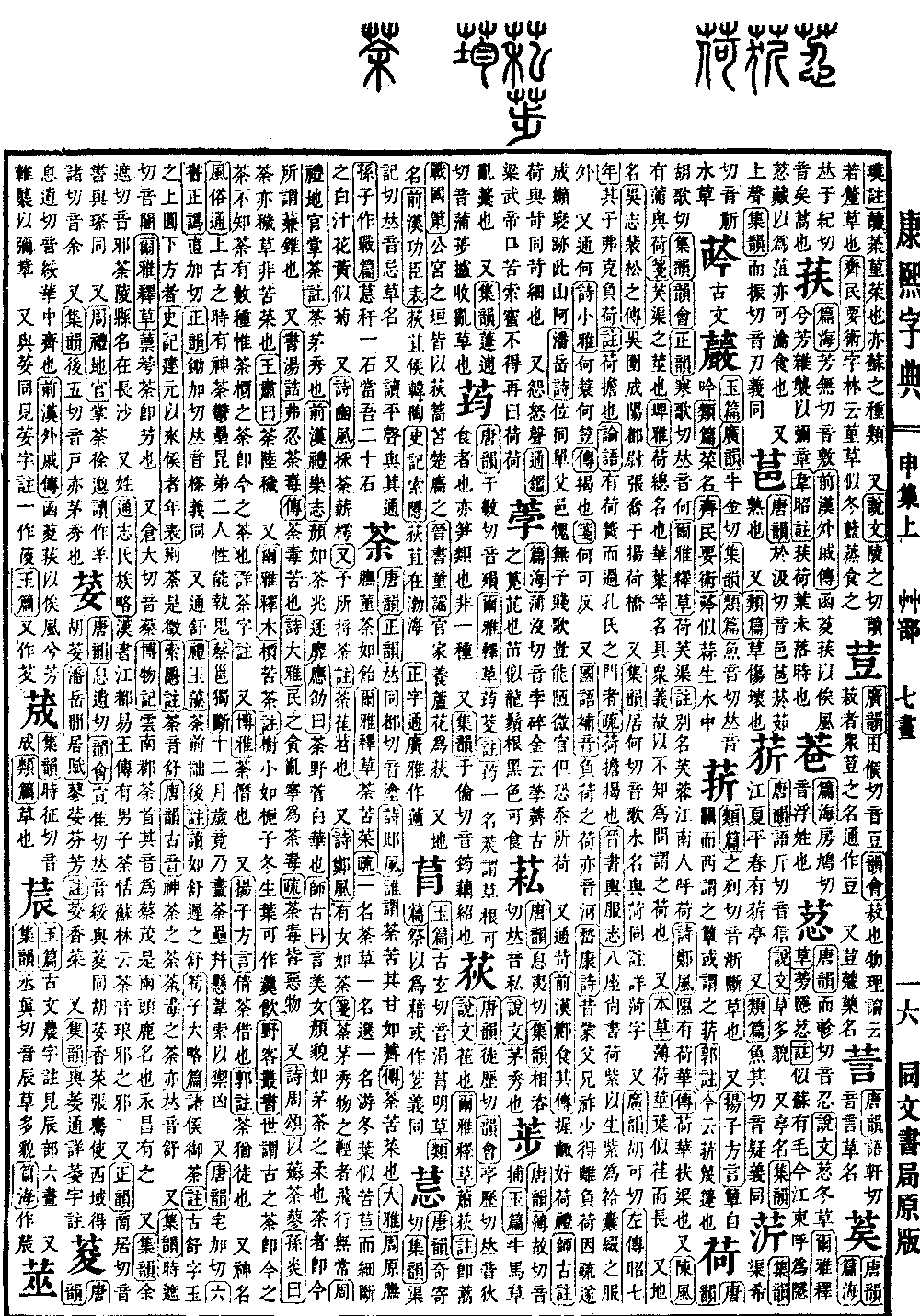
Shen Collection, Upper Volume
Radical: Grass (cǎo)
Kangxi Strokes: 13
Page 1032, Entry 13
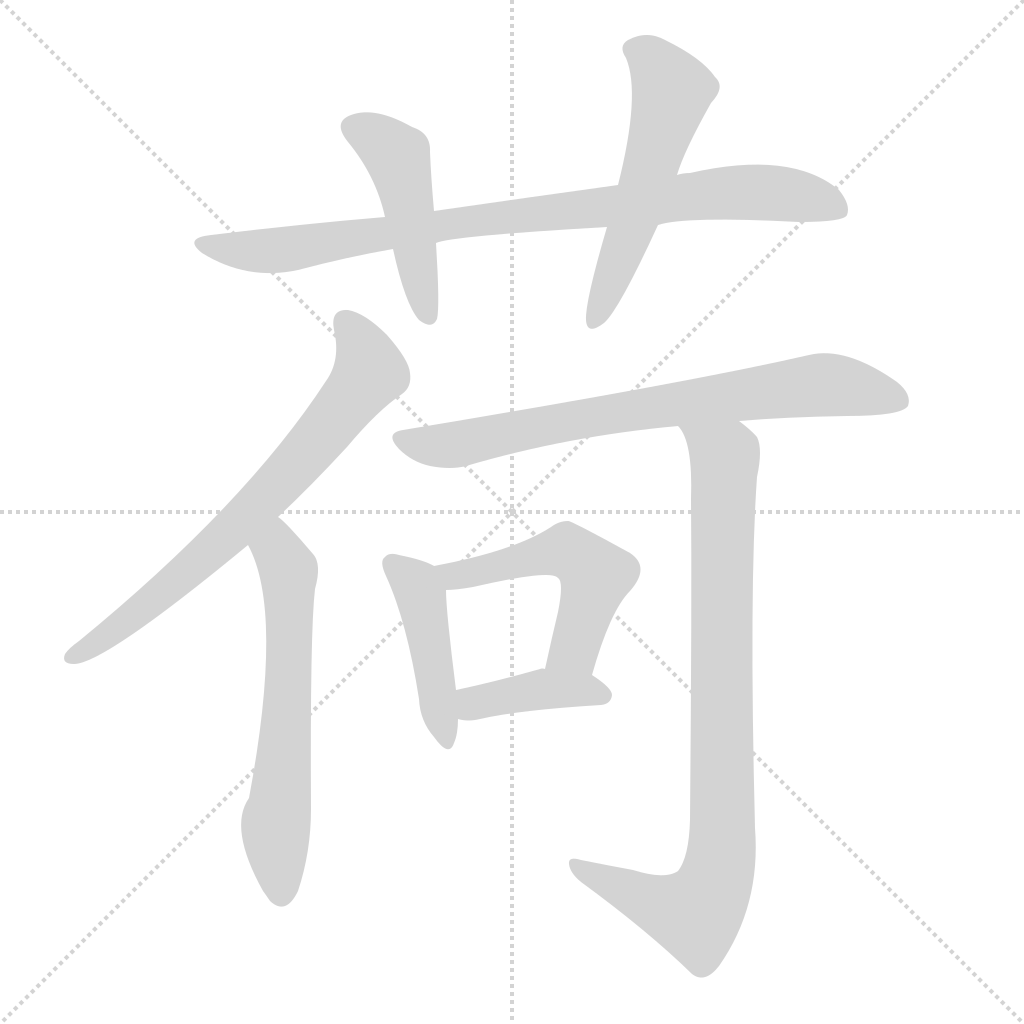
Pronounced he.
Book of Erya: Explaining Plants (Erya): He is fúqú.
Commentary: Another name is fúróng. People in Jiangdong call it he.
Book of Odes (Shijing), Zheng Feng: There are lotus flowers in the low-lying fields.
Commentary: Lotus flowers are fúqú.
Also in Chen Feng: There are rushes and lotus.
Annotation: The stalk of the fúqú.
Book of Piya: He is a general term. Because its flowers and leaves have various names and it is used for asking questions about what one does not know, it is called he.
Also, in the Materia Medica (Bencao): Bòhé, with stalks and leaves resembling perilla but longer.
Also, a place name. Records of the Three Kingdoms (Wuzhi): The Wu state surrounded the commandant Zhang Qiao of Chengyang at Yanghe Bridge.
Also, pronounced ge. A water name; the same as he. See the note under the character he.
Also, pronounced ke. Zuo Commentary (Zuo Zhuan), Seventh Year of Duke Zhao: His son could not bear the burden.
Commentary: He means to carry on the back or shoulder.
Analects (Lunyu): There was a man carrying a basket (kuì) who passed by the gate of the Kong family.
Sub-commentary: He means to carry or lift.
Book of Jin (Jinshu): The eight ministers wore purple, using raw purple silk for a lining bag, attached to the outside of the clothing.
Also used interchangeably with he (interrogative). Book of Odes (Shijing), Xiao Ya: Carrying the raincoat, carrying the hat.
Commentary: To carry or lift.
Commentary Explanation: Pronounced he.
Also, according to the supplement to the sound of the Discourses of the States (Guoyu Buyin), the he in the sense of to bear a burden is also pronounced he.
Poem by Xi Kang: Formerly blessed by the grace of my father and elder brother, I was able to leave my burdens behind at a young age. Because of my leisure, I became lazy, and now I dwell in the seclusion of these mountains.
Poem by Pan Yue: My position is the same as the magistrate of Shanfu, yet I am ashamed that I have no songs like those of Zijian. How could I despise this minor office? I only fear I am unworthy of the burdens I carry.
Also used interchangeably with ke. History of the Former Han (Qianhan), Biography of Li Yiji: Petty and fond of harsh rituals.
Commentary by Shigu: He is the same as ke; ke means petty or detailed.
Also, a sound of resentment or anger. Comprehensive Mirror for Aid in Government (Tongjian): Emperor Wu of Liang had a bitter taste in his mouth; he asked for honey but did not receive it, and said again, he he.