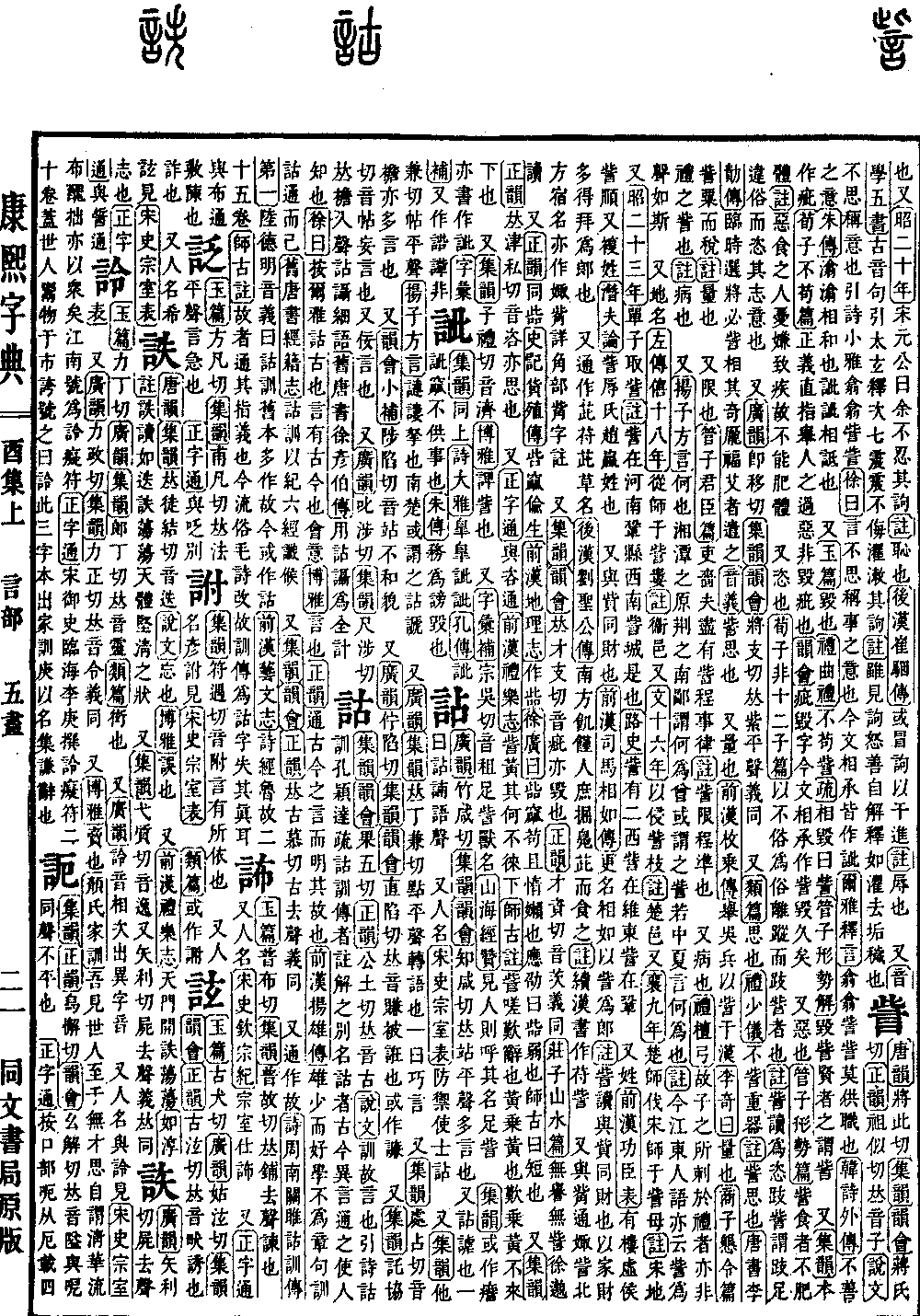
You Collection, Upper Volume
Radical: Speech (yán)
Gu
Kangxi stroke count: 12
Page 1153, Entry 01
Pronounced gu.
According to the Explaining Graphs and Analyzing Characters (Shuowen Jiezi), it means to interpret ancient language using contemporary language. It is cited in the Book of Odes (Shijing) as "gu xun." Kong Yingda's commentary states that the term "gu xun zhuan" is another way of referring to annotations. "Gu" means that since language changes from ancient to modern times, one provides explanations so that people of the present can understand the words of the past.
Xu Kai states that according to the Erya, "gu" means "ancient," referring to the distinction between ancient and modern language. It is a compound ideographic character.
The Boya defines it as "speech."
The Zhengyun defines it as language that bridges the gap between ancient and modern times and clarifies original meanings.
The History of the Former Han (Qian Hanshu), Biography of Yang Xiong, records that when Yang Xiong was young and fond of learning, he did not pursue the trivial study of phrases and glosses (xungu), but sought only to comprehend the profound meaning.
The Old History of the Tang (Jiu Tangshu), Treatise on Classics and Books, records the use of "gu xun" to record the subtle and profound meanings of the Six Classics.
Also, pronounced gu in the departing tone. The meaning is the same.
Also used as a phonetic loan for the character "gu" (meaning reason or ancient).
In the Book of Odes (Shijing), Zhou Nan, Guan Ju, Gu Xun Zhuan, Section 1, Lu Deming's Sound and Meaning (Yinyi) states that in older versions of "gu xun," it was often written as "gu," while some contemporary versions write it as "gu."
The History of the Former Han (Qian Hanshu), Treatise on Literature, records the Lu Gu (Lu's Explanations) of the Book of Odes in twenty-five volumes.
Shigu's commentary states that "gu" means to understand its intent and meaning. The currently popular version of the Mao Odes changes "gu xun zhuan" to "gu xun zhuan," which actually causes it to lose its original character.