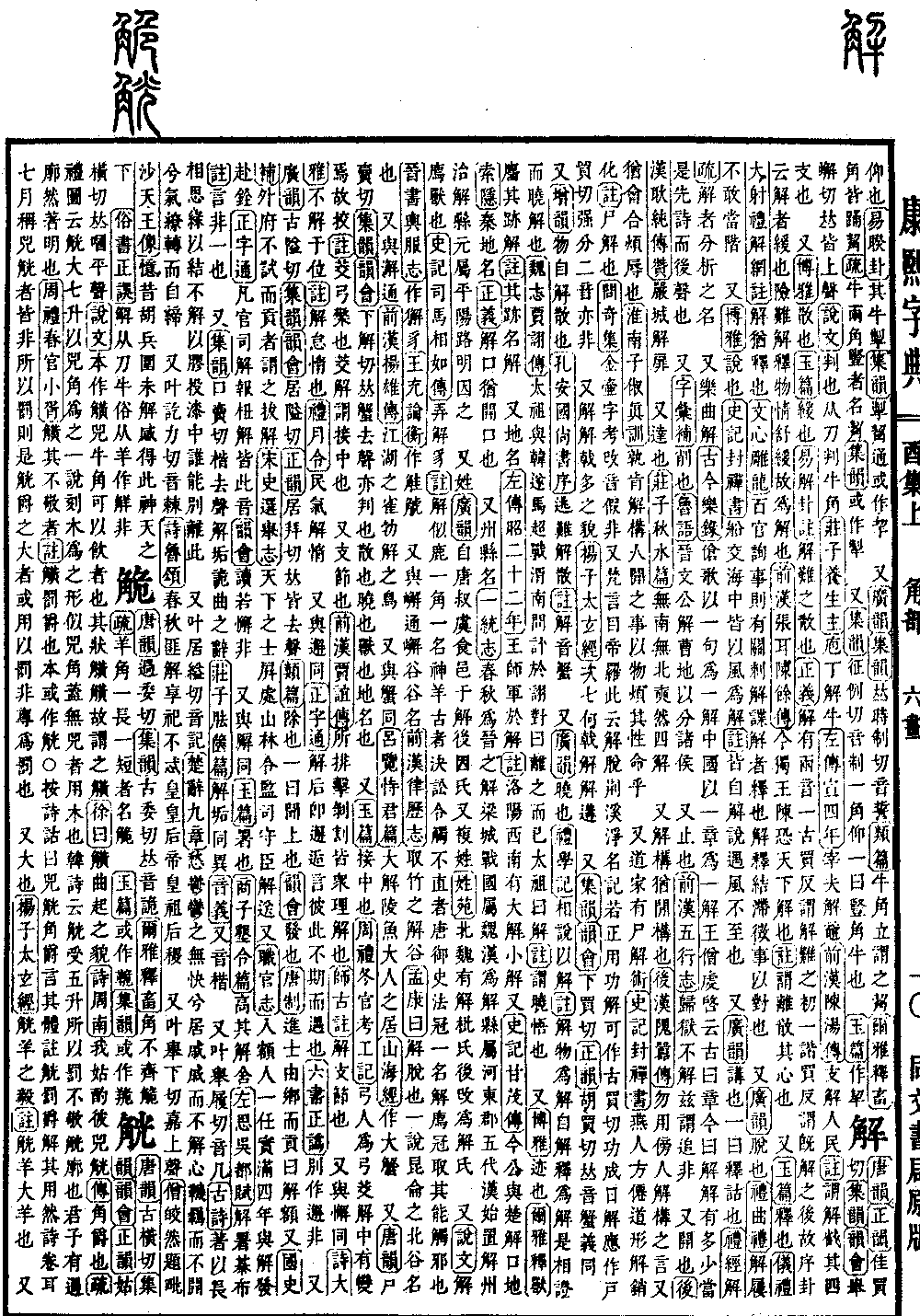
You Collection, Upper Volume
Radical: Horn (jiǎo)
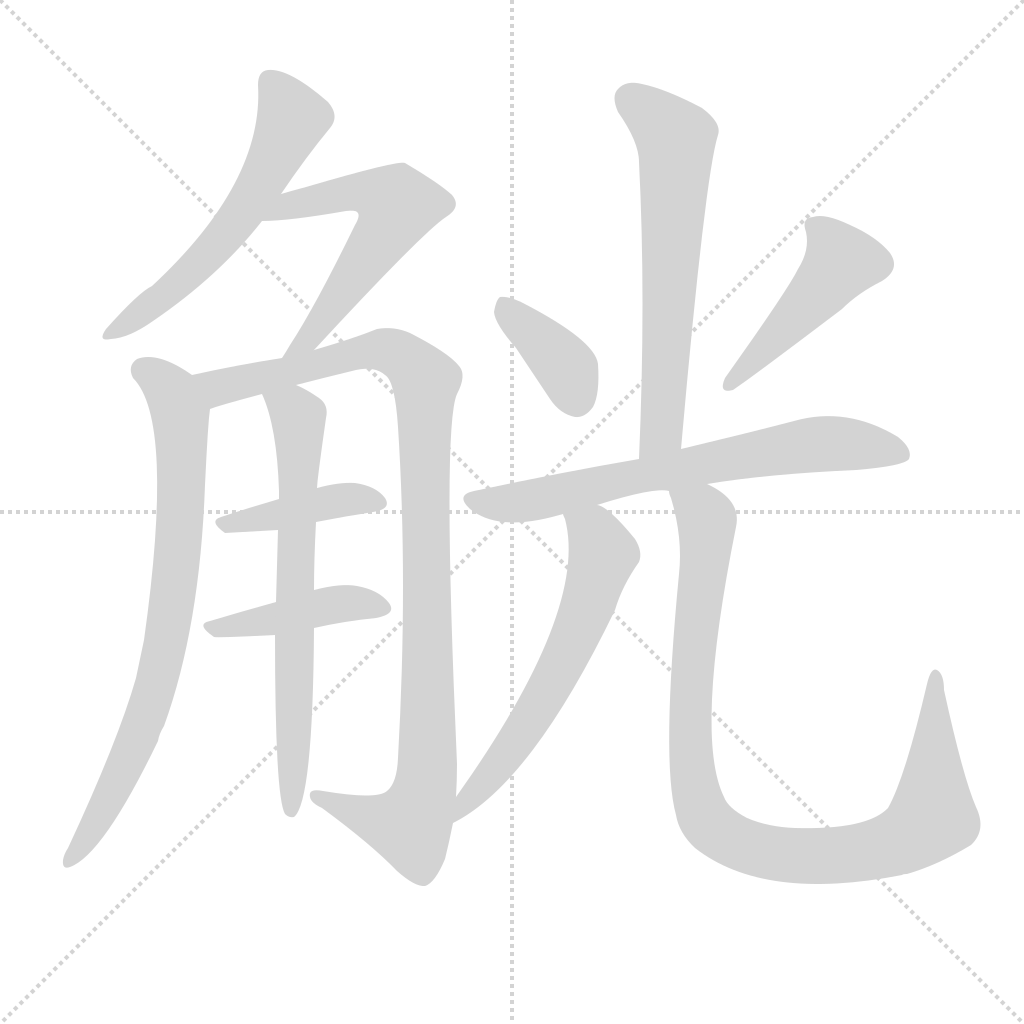
觥; Kangxi strokes: 13; Page 1142, Entry 03
Pronounced guō
Shuowen Jiezi (Explanation of Writing and Analysis of Characters) states that it was originally written as a variant form (guǎng), referring to a drinking vessel made of rhinoceros horn, so named for its curved shape. Xu Kai comments that the term refers to a curved and raised appearance.
Book of Odes (Shijing), Zhou Nan: I shall pour wine from that rhinoceros horn cup to drink.
Mao Commentary: It is a wine vessel made of horn.
Kong Yingda Subcommentary: The Illustrations of Rites (Litu) states: A gong has a capacity of seven sheng, made of rhinoceros horn. Another account says it is carved from wood in the shape of a rhinoceros horn, used when a horn is unavailable. Han Shi states: A gong holds five sheng and is used to impose a penalty for those who are disrespectful. Gong means to be broad or manifest. If a superior makes a mistake, it is as obvious as a gong.
Rites of Zhou (Zhouli), Spring Offices, Minor Overseer: Use a gong to penalize those who are disrespectful.
Zheng Xuan Commentary: The gong is a vessel used for penalty wine. Some versions write it as the current character. According to the Exegesis on the Book of Odes (Shigu): A rhinoceros-horn gong is a vessel made of horn, which describes its form. The annotations say a gong is a penalty cup, which explains its usage. However, the rhinoceros-horn gong mentioned in the Juan Er and Qi Yue chapters of the Book of Odes is not used for penalty wine, which shows that the gong is simply a large wine vessel, sometimes used for penalties but not exclusively for that purpose.
It also carries the meaning of large.
Yangzi, Tai Xuan Jing (Great Mystery): The determination of a large ram.
Commentary: A large ram is a big ram.
It also refers to the sound of jade bells.
Han Yu, Dream Poem: The walking stick strikes the jade slab, producing a resounding clatter.
Also, the reduplicated form gong gong describes a strong and upright appearance.
Book of the Later Han (Hou Hanshu), Biography of Guo Xian: Guo Ziheng of Guandong was strong and unyielding.
Also rhyming with guāng.
Book of Odes (Shijing), Bin Feng: Ascend that public hall, raise that rhinoceros horn cup, and wish for ten thousand years of longevity.
Liu Zhen, Lu Capital Rhapsody (Lu Du Fu): Holding the ritual vessel with its covering cloth, receiving the wine cup to present the wine vessel. Once filled, drain the cup, with the liquid dripping into the penalty vessel.
Five Books on Phonology (Yinxue Wushu): The ancient reading is guāng.