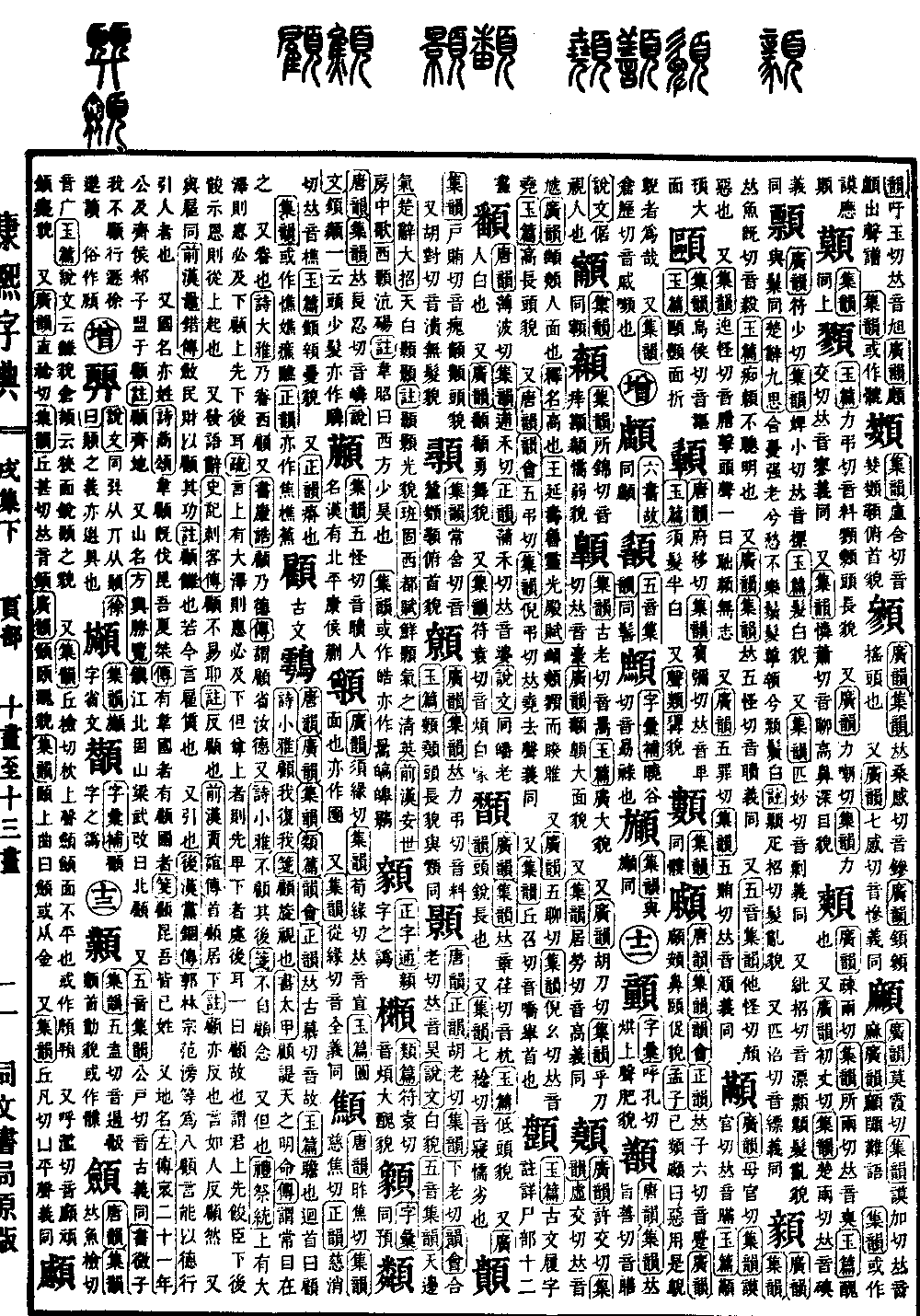
Xu Collection, Lower Volume
Radical: Page (yè)
Kangxi Strokes: 21
Page 1409, Entry 03
Ancient form. Tang Rhymes (Tangyun), Broad Rhymes (Guangyun), Collected Rhymes (Jiyun), Classified Chapters (Leipian), Rhyme Compendium (Yunhui), Correct Rhymes (Zhengyun). Pronounced gu.
Jade Chapters (Yupian): To gaze at. Turning one's head to look is called gu.
Book of Odes (Shijing), Lesser Odes: Looking at me, returning to me.
Annotation: Gu means to turn the head and look.
Book of Documents (Shujing), Taijia: Consider the bright decree of Heaven.
Commentary: The meaning is to constantly keep one's attention on this.
Also means to look back with affection.
Book of Odes (Shijing), Greater Odes: He looked back toward the west.
Book of Documents (Shujing), Kang Gao: Reflect on your virtue.
Commentary: The meaning is to reflect upon your moral conduct.
Book of Odes (Shijing), Lesser Odes: Not considering the consequences.
Annotation: Not caring about or reflecting upon the aftermath.
Also means only or however.
Book of Rites (Liji), Sacrificial System (Jitong): If the superior possesses great bounty, the kindness must reach the inferiors; it is merely that the superior comes first and the inferior later.
Sub-commentary: The meaning is that if the superior has great grace, the favor must surely be extended to those below. It is simply that the exalted are in front and the lowly are behind. Another interpretation states that gu means therefore, indicating that the ruler eats first and the ministers eat later, showing that grace originates from above.
Also an introductory particle.
Records of the Grand Historian (Shiji), Biographies of Assassins: Is it not difficult?
Note: Gu means conversely.
History of the Former Han (Qianhan), Biography of Jia Yi: First reflecting on being situated below.
Note: Gu also means to reverse, speaking of it like a person turning their head to look back.
Same as the character for employ (gù).
History of the Former Han (Qianhan), Biography of Chao Cuo: Collecting the people's wealth to pay for their labor.
Note: Gu means to reward or compensate, just like the term for employment remuneration used today.
Also means to guide.
History of the Later Han (Houhan), Biography of Partisan Prohibitions: Guo Linzong, Fan Pang, and others were the Eight Guides, meaning they were able to use their virtue to lead others.
Also a name of a state. Also a surname.
Book of Odes (Shijing), Eulogies of Shang: Wei and Gu were already attacked, as were Kunwu and Xia Jie.
Commentary: There was a State of Wei and a State of Gu.
Annotation: Gu and Kunwu were both of the Ji surname.
Also a place name.
Zuo Tradition (Zuo Zhuan), Twenty-first Year of Duke Ai: The Duke, the Marquis of Qi, and the Viscount of Zhu made a covenant at Gu.
Note: Gu is a location in the State of Qi.
Also a mountain name.
Comprehensive Geography (Fangyu Shenglan): Beigu Mountain in Zhenjiang was renamed Beigu by Emperor Wu of the Liang dynasty.
Five Tones Collected Rhymes (Wuyin Jiyun): Pronounced gu. The meaning is the same.
Book of Documents (Shujing), Weizi: I do not consider fleeing. Xu Miao reads it this way.
The vulgar form is written as a variant form (gù).
Textual Research:
Book of Rites (Liji), Sacrificial System (Jitong): Reflecting on the superior first and the inferior later.
Sub-commentary: It is only that the exalted are first, and the lower ones are in the rear. Based on the original text, changed to exist in the front.
Records of the Grand Historian (Shiji), Biographies of Assassins: Is it not difficult?
Note: To look back in reverse. Based on the original text, corrected to reverse of gu.