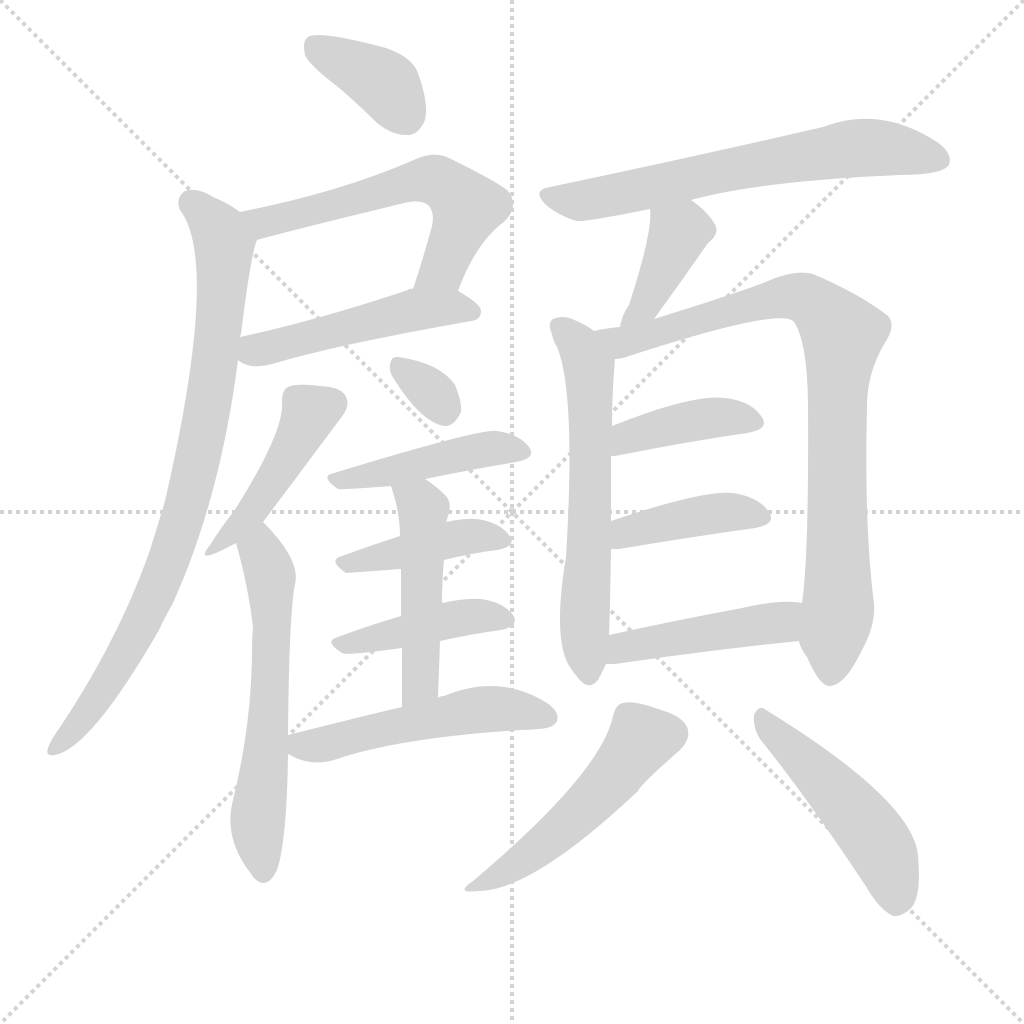
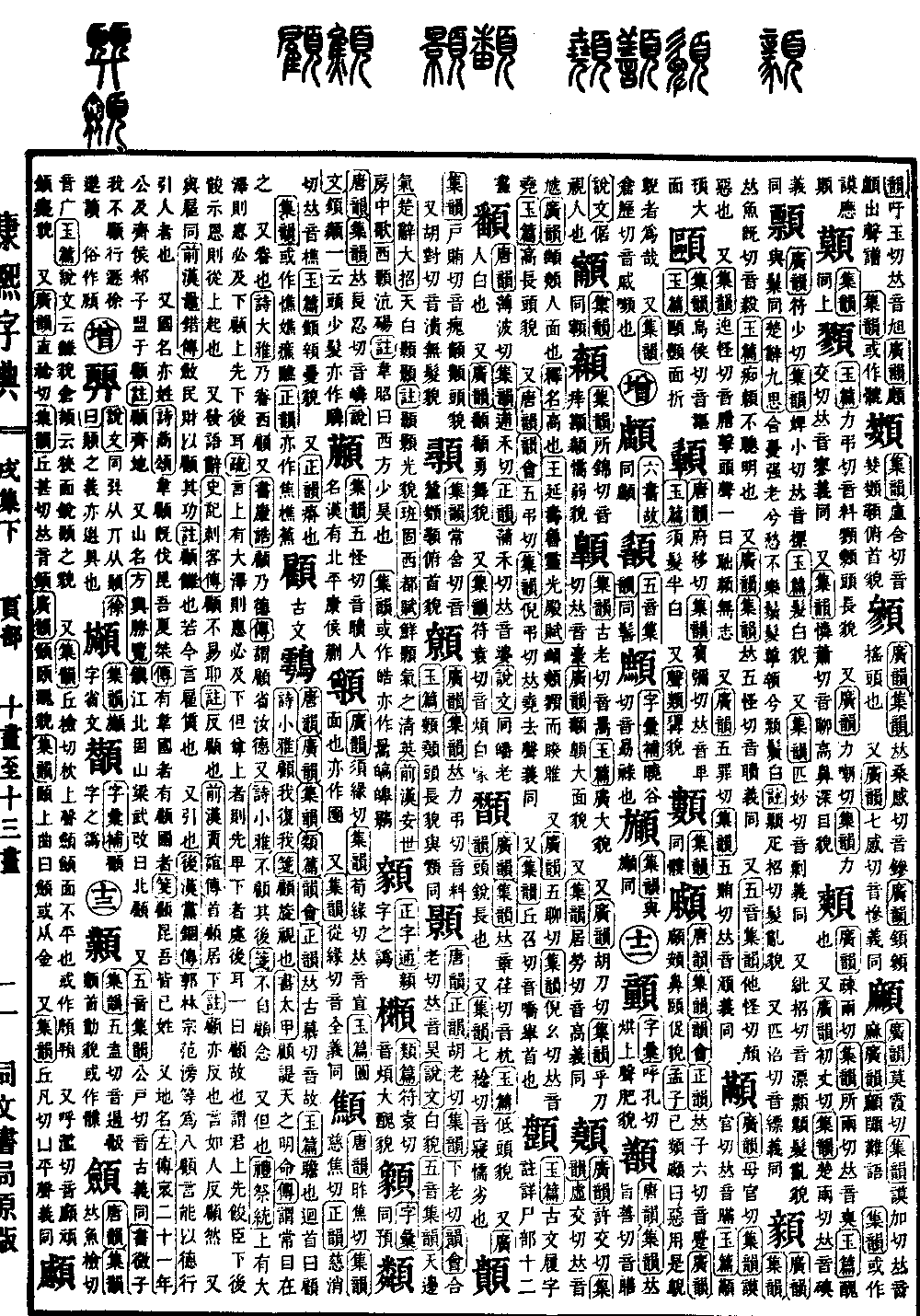
Xu Collection, Lower Volume
Radical: Page (yè)
Kangxi Strokes: 21
Page 1409, Entry 38
Ancient form. Pronounced gu.
Jade Chapter (Yupian): To look at. Turning the head is called gu.
Book of Odes (Shijing), Xiao Ya: Looking at me and returning to me.
Annotation (Jian): Gu means to turn and look.
Book of Documents (Shangshu), Tai Jia: To look upon the clear mandate of Heaven.
Commentary (Zhuan): This means to constantly keep one's eyes upon it.
Also, to show affection for.
Book of Odes (Shijing), Da Ya: Then with affection looking towards the west.
Also, Book of Documents (Shangshu), Kang Gao: To look into your virtue.
Commentary (Zhuan): This means to look and examine your virtue.
Also, Book of Odes (Shijing), Xiao Ya: Not looking back at what is behind.
Annotation (Jian): Not considering or reflecting upon oneself.
Also, a particle meaning but.
Book of Rites (Liji), Jiting: When those above have great abundance, their kindness must extend to those below; but the superiors are first and the inferiors are after.
Sub-commentary (Shu): This says when those above have great abundance, kindness must reach those below. However, the honorable ones are in the front, and the inferiors are behind. Another interpretation is that gu means therefore, implying the lord eats first and the ministers eat after, showing grace starting from the top.
Also, an opening particle.
Records of the Grand Historian (Shiji), Biography of Assassin-Retainers: Is it not difficult?
Annotation (Zhu): Gu means to turn back.
History of the Former Han (Qianhan Shu), Biography of Jia Yi: Turning back to reside in the lower position.
Annotation (Zhu): Gu also means to turn back, similar to a person turning their head to look.
Also, the same as gu (to hire).
History of the Former Han (Qianhan Shu), Biography of Chao Cuo: Collecting the wealth of the people in order to hire their labor.
Annotation (Zhu): Gu means to recompense, similar to saying to hire or employ today.
Also, to lead or attract.
History of the Later Han (Houhan Shu), Biography of Party Prohibitions: Guo Linzong and Fan Pang were among the Eight Gu, meaning those who can lead others through virtuous conduct.
Also, a state name. Also a surname.
Book of Odes (Shijing), Shang Song: Wei and Gu were already conquered, as were Kunwu and Xia Jie.
Commentary (Zhuan): There was a state of Wei and a state of Gu.
Annotation (Jian): Gu and Kunwu were both of the same surname.
Also, a place name.
Zuo Tradition (Zuozhuan), Twenty-first Year of Duke Ai: The Duke and the Marquis of Qi and the Viscount of Zhu made a pact at Gu.
Annotation (Zhu): Gu is a place in Qi.
Also, a mountain name.
Comprehensive Geography of the Empire (Fangyu Shenglan): Beigu Mountain in Zhenjiang was renamed Beigu by Emperor Wu of Liang.
Also, Five Sounds Collective Rhymes (Wuyin Jiyun): Pronounced gu. The meaning is the same.
Book of Documents (Shangshu), Weizi: I do not look back while escaping. (Read by Xu Miao).
Commonly written as the variant form (gù).