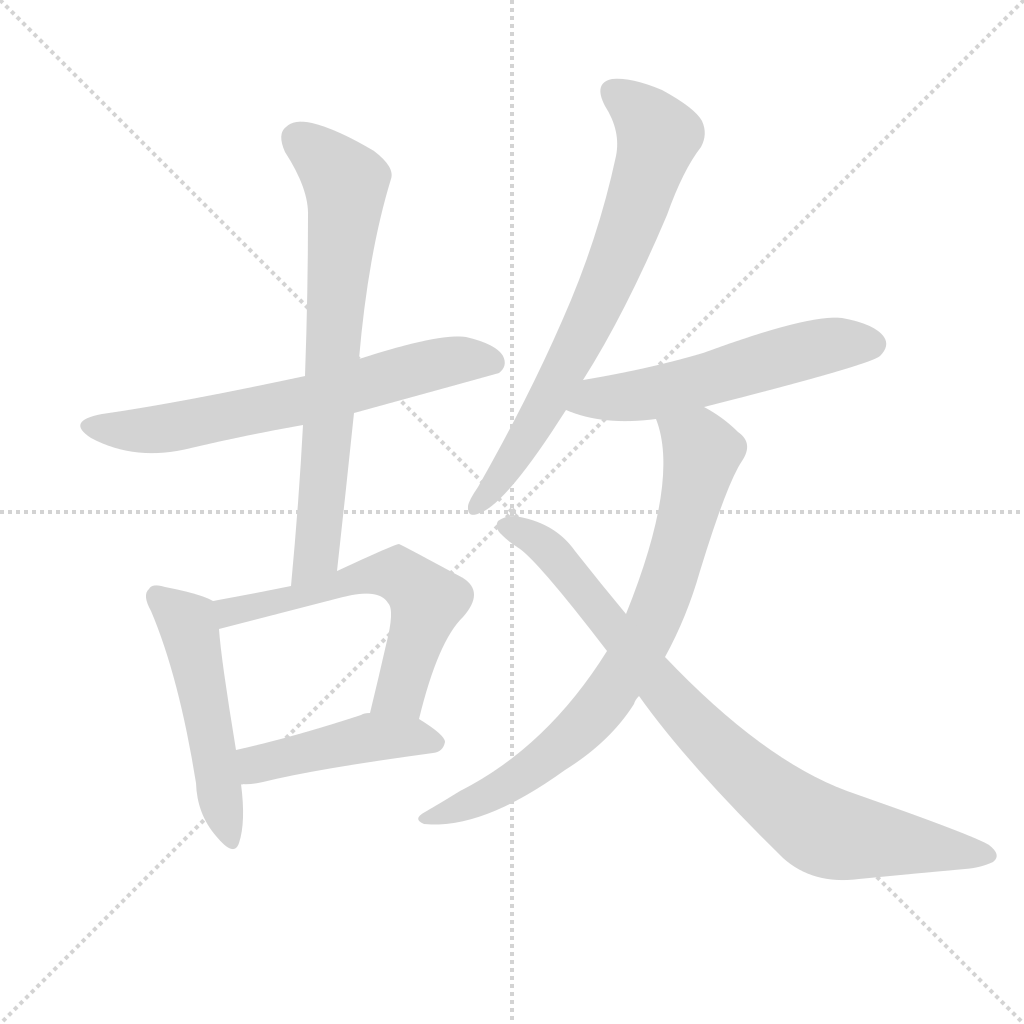
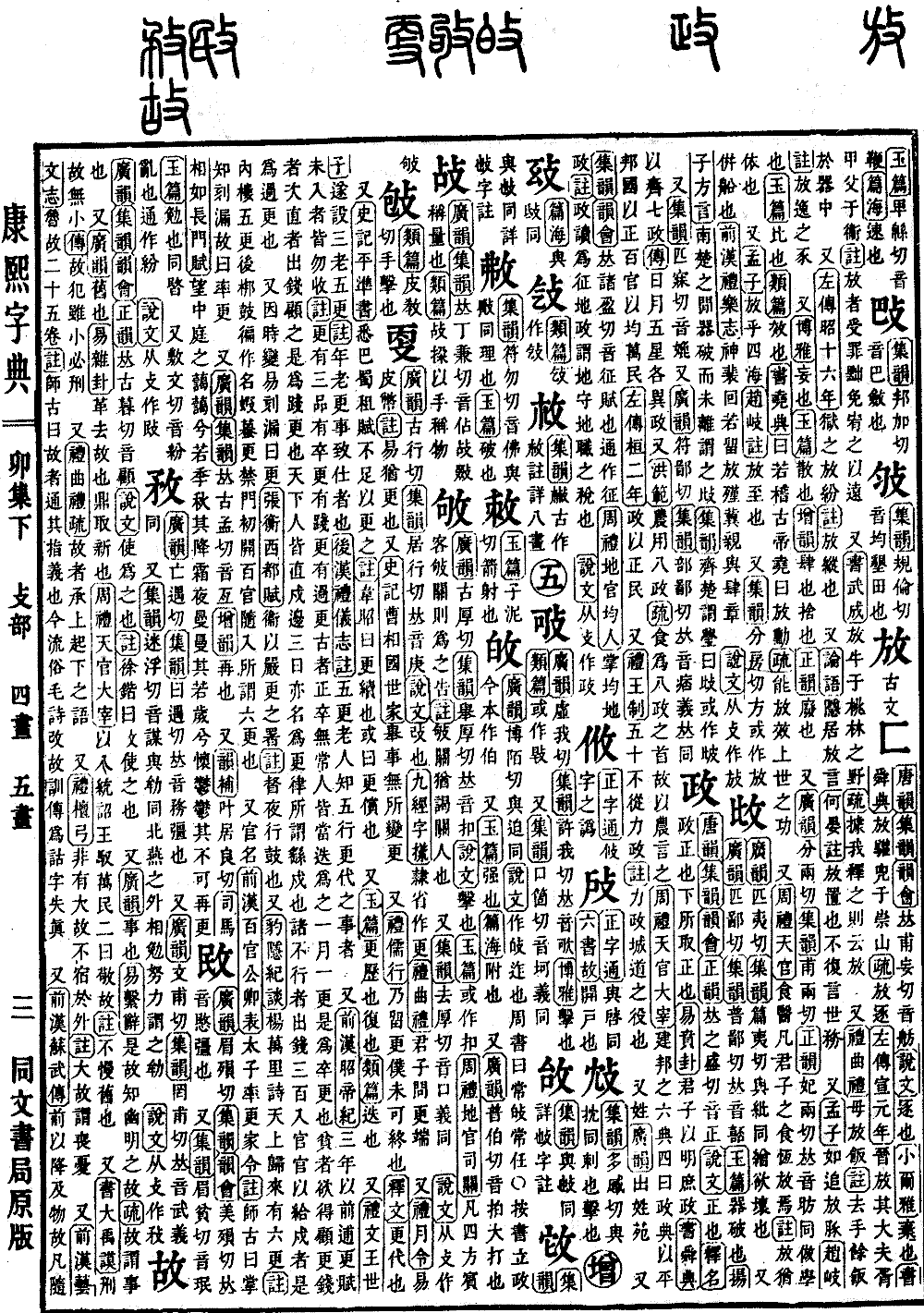
Mao Collection, Lower Volume
Radical: Tap (pū)
Kangxi Strokes: 9
Page 469, Entry 25
Pronounced gu (falling tone).
Shuowen Jiezi (Explanation of Simple and Compound Characters): To cause to do something.
Note: Xu Kai stated: It means to cause or induce.
Broad Rhymes (Guangyun): Matter or affair.
Book of Changes (Yijing): It is for this reason that one understands the reasons for both darkness and light.
Commentary: The term used here refers to matters or affairs.
Broad Rhymes: Old or former.
Book of Changes: Change means to discard the old. The cauldron means to adopt the new.
Rites of Zhou (Zhouli): By eight principles, the king governs the myriad people; the second is to respect the old.
Note: It means not to neglect established customs.
Book of Documents (Shangshu): Do not treat violations as insignificant.
Commentary: Even if the offense is small, one must punish.
Book of Rites (Liji): The term is used as a connective to link preceding and succeeding points.
Book of Rites: Unless there is a major exigency, one does not lodge overnight outside the home.
Note: Major exigency refers to funerals or times of grief.
History of the Former Han (Hanshu): Records of Lu, twenty-five volumes.
Note: Yan Shigu stated: The term refers to clarifying the meaning and intent. The current popular version of the Book of Odes (Shijing) has changed the character in the title of the ancient commentaries to a different character, which loses the original accuracy.
History of the Former Han: Of those who had surrendered previously and since passed away, only nine returned with Su Wu.
Note: Yan Shigu stated: To pass away, signifying that they have returned to the state of spirits.
Xunzi: To not elevate essential conduct, to not respect old laws, but to favor trickery and artifice.
Note: Here it means craftiness or artifice.
Rhyme Supplement (Yunbu): Rhymes with gu.
Jia Yi, Lament for Qu Yuan: Wandering aimlessly and suffering this blame, this is also due to your destiny. Having traveled through the nine provinces to serve the lords, why must you cling to this capital?
Note: In the Records of the Grand Historian (Shiji), this character is written as a variant form (gu).
Also rhymes with gu (rising tone).
Dongfang Shuo, Disputations of a Guest: Exhausting one's strength to admire it, yet troubled by clothing and food, or losing one's social status. If Su Qin and Zhang Yi were born in the present age, they would not even be able to hold a minor administrative post.
Shuowen Jiezi: Composed of the radical for Tap (pū). The original character was written with the radical for Tap (pū).