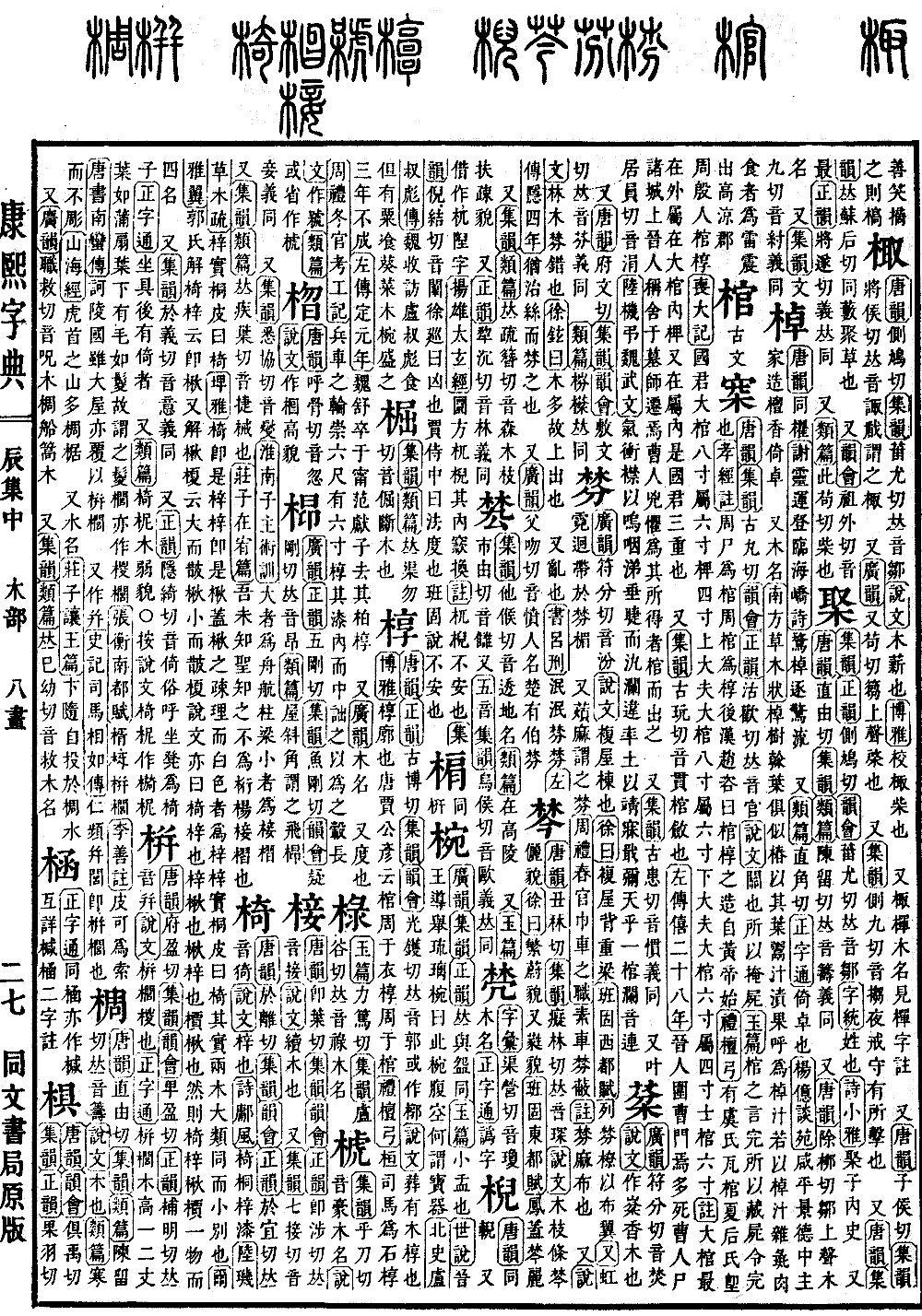
Chen Collection, Middle Volume
Radical: Tree (mù)
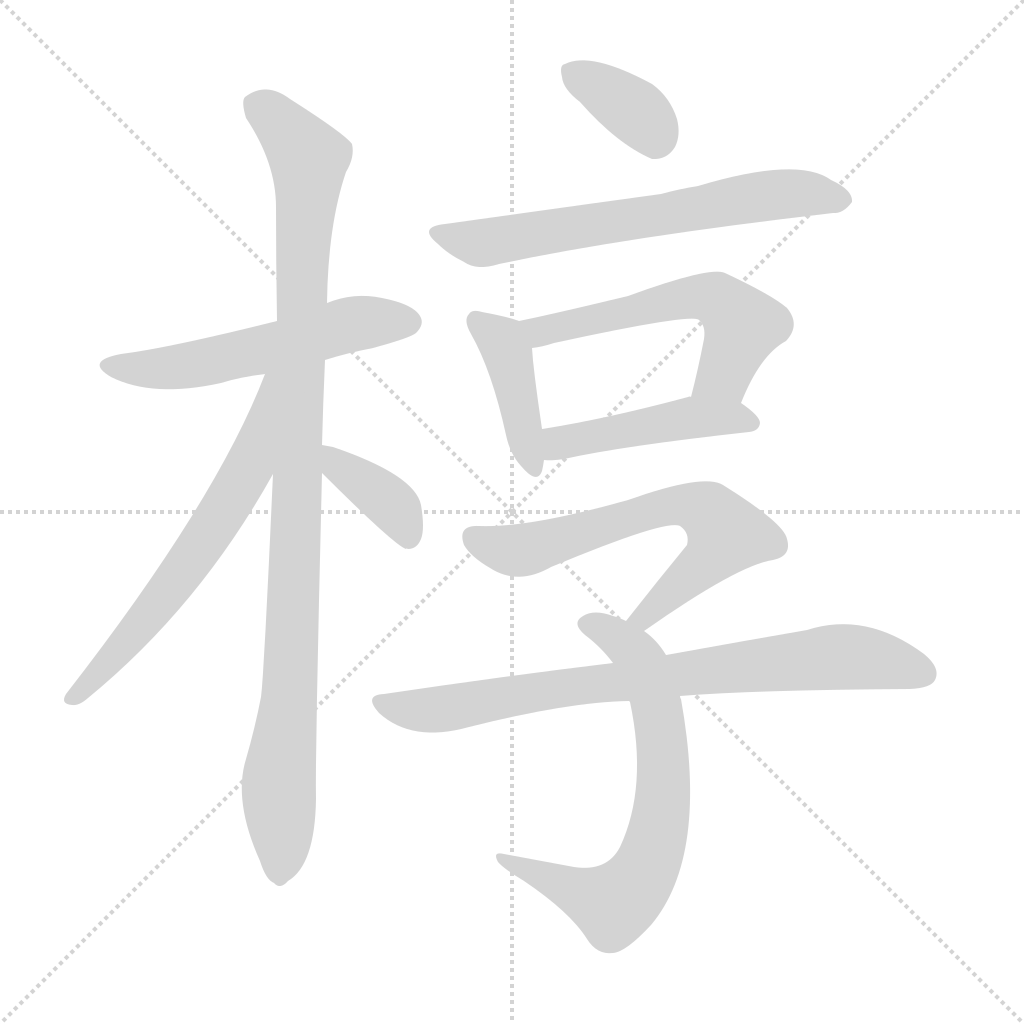
Entry: 椁
Kangxi strokes: 15
Page 535, Entry 15
Pronounced guo. Sometimes also written in a variant form (guǒ).
Shuowen Jiezi says: A wooden structure for burial.
Shiming says: A guo is an enclosure (kuo). Tang dynasty commentator Jia Gongyan says: The coffin wraps the body, and the guo wraps the coffin.
Book of Rites (Liji), Tan Gong section: The Sima of Huan built a stone outer coffin; it was not completed after three years.
Zuo Tradition (Zuozhuan), First Year of Duke Ding: Wei Shu died at Ning, and Fan Xianzi removed his cypress outer coffin.
Also, in Guangyun, it is the name of a tree.
Also means to measure.
Rites of Zhou (Zhouli), Winter Official, Artificer's Record: For the wheelwright, one-third of the felloe circumference is painted, and two-thirds of the inner lacquer is enclosed, with the center bent to form the length of the nave.
Textual verification:
Guangya defines guo as an enclosure. According to the original book, changed to Shiming.
Rites of Zhou (Zhouli), Winter Official, Artificer's Record: Regarding the wheels of a war chariot, they are six feet and six inches in height, with the inner lacquer enclosed, and the center bent to form the length of the nave.
Note: The following two sentences are from the Artificer's Record and should not be connected as they were. Following the original text, corrected to: Rites of Zhou (Zhouli), Winter Official, Artificer's Record: For the wheelwright, one-third of the felloe circumference is painted, and two-thirds of the inner lacquer is enclosed, with the center bent to form the length of the nave.