You Collection, Upper Volume
Radical: See (jiàn)
Kangxi Strokes: 11
Page 1133, Entry 11
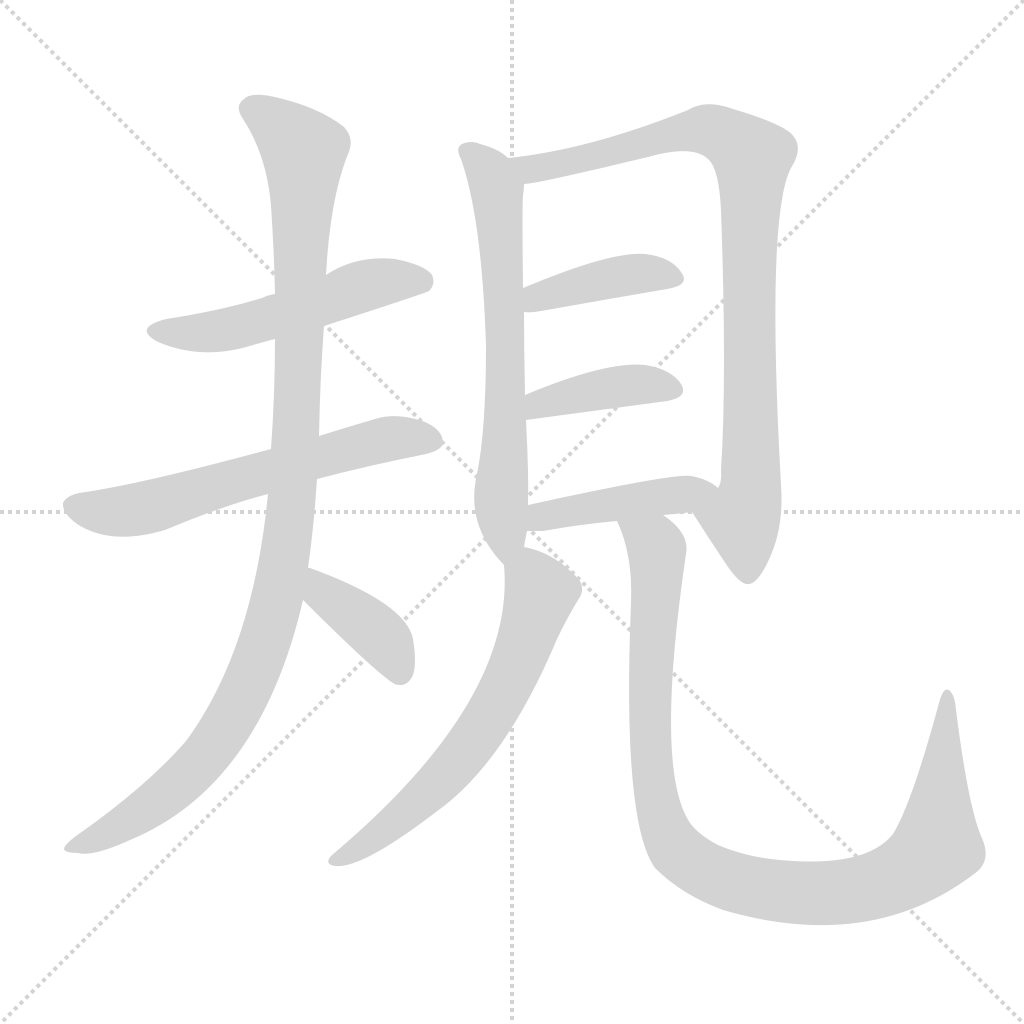
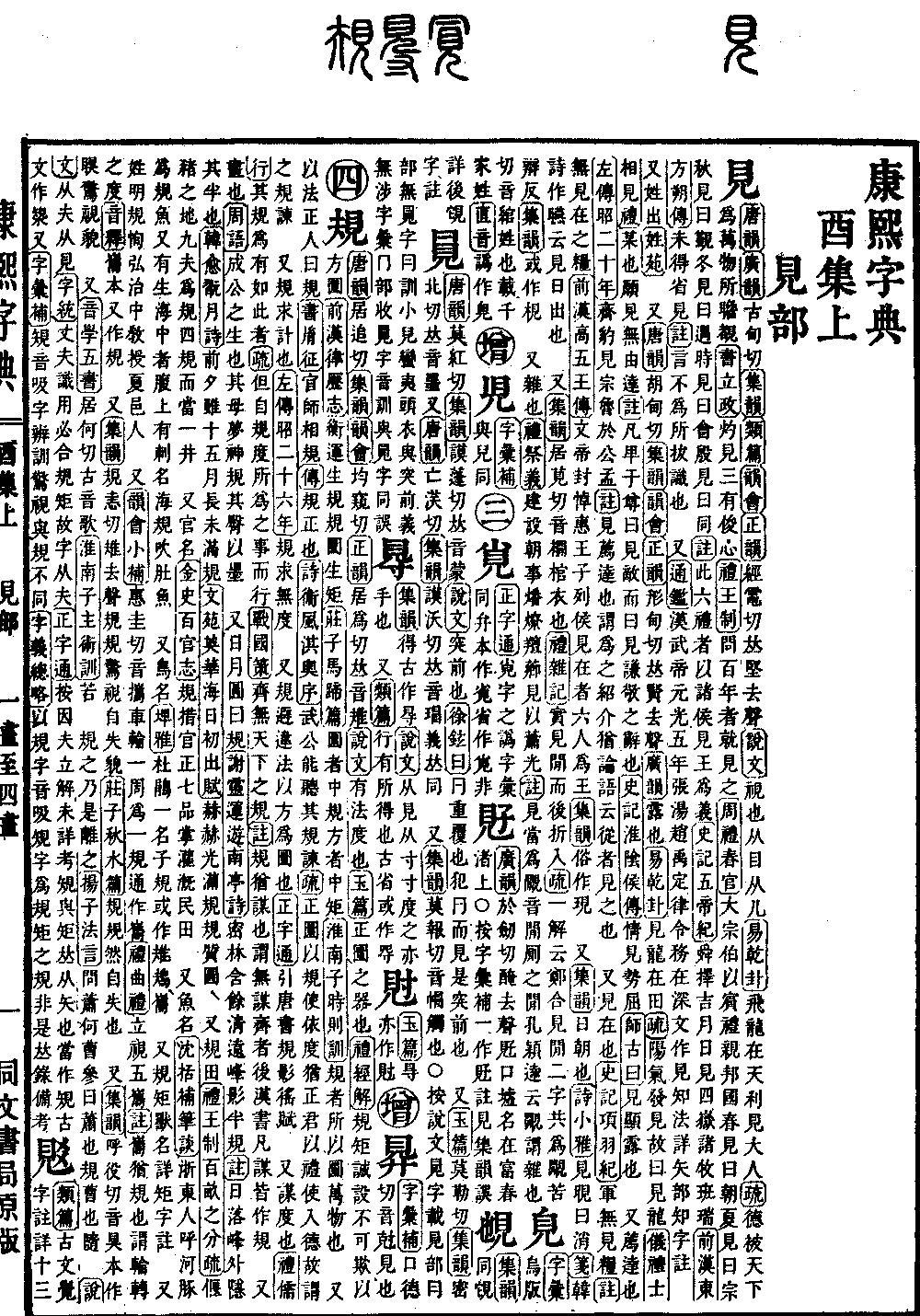
Pronounced gui. According to the Analytical Dictionary of Characters (Shuowen Jiezi), it refers to having standards and measures. According to the Jade Chapters (Yupian), it is an instrument for drawing perfect circles. In the Book of Rites (Liji), it is written: when the compass and square are correctly set, one cannot be deceived by square or round shapes. In the History of the Former Han (Qianhan Shu), it is stated: the balance of movement produces the compass, and the circularity of the compass produces the square. In the Zhuangzi, it is written: that which is round follows the compass, that which is square follows the square. In the Huainanzi, it is written: the compass is that by which one makes all things round.
Also, using methods to correct others is called gui (to admonish). In the Book of Documents (Shangshu), it is written: officials and teachers admonish one another. The commentary states: gui means to rectify. In the Book of Odes (Shijing), it is written: Duke Wu was able to listen to admonitions and advice. The sub-commentary states: just as one uses a compass to make a circle follow its measure, one uses ritual to correct a ruler and lead people toward virtue; thus, this is called admonition.
Also, gui means to seek or plan. In the Zuo Tradition (Zuozhuan), it is written: the quest for resources was without measure.
Also, gui means to evade or violate the law, turning the square into the round. The Correct Meaning of Characters (Zhengzitong) cites the Old Book of Tang (Tangshu): to evade taxes and levies.
Also, to plan or measure. In the Book of Rites (Liji), it is written: his plans and actions were like this. The sub-commentary states: he personally planned and measured the matters to be done and then carried them out. In the Strategies of the Warring States (Zhanguoce), it is written: Qi had no plans for the world. The commentary states: gui is like planning, referring to those who had no plans for the state of Qi. In the History of the Later Han (Houhan Shu), all mentions of planning are written as gui.
Also, to draw. In the Discourses of the States (Guoyu), it is written: when Duke Cheng was born, his mother dreamed that a deity drew a line on his buttocks with ink.
Also, the sun and moon being round is called gui. In a poem by Xie Lingyun, it is written: dense forests hold the lingering clarity, the distant peak shadows half the circle (gui). The commentary states: the sun sets beyond the peak, obscuring half of it. In a poem by Han Yu, it is written: although the eve before was the fifteenth, the moon never quite reached a full circle (gui). In the Collected Essays of Refined Literature (Wenyuan Yinghua), it is written: bright and full of light, round in substance like a circle.
Also, gui fields. In the Book of Rites (Liji), the sub-commentary regarding the division of one hundred mu of land states: in marshy lands, nine households constitute a gui, and four gui equal one well-field.
Also, a name for an official. In the History of the Jin Dynasty (Jinshi), it is written: an official for planning and water management, seventh rank, in charge of irrigating civilian fields.
Also, a name for a fish. In the Supplementary Brush Talks (Bu Bitan) by Shen Kuo, it is written: people in eastern Zhejiang call the pufferfish the gui fish. There are also those that live in the sea with thorns on their bellies, called sea-gui pufferfish.
Also, a name for a bird. In the Piya, it is written: the cuckoo is also called zigui. It is sometimes written as a variant form (ju).
Also, guiju, the name of a beast. See the entry for the character ju.
Also, a surname. Ming Dynasty scholar Gui Xun was a professor during the Hongzhi era, a native of Xiayi.
Also, pronounced xie. One full revolution of a carriage wheel is one gui. It is interchangeably written as a variant form (xi). In the Book of Rites (Liji), it is written: stand and look at the five rotations. The commentary states: xi is the same as gui, referring to the measurement of a wheel's rotation. The phonetic explanation notes that xi was originally written as gui.
Also, pronounced gui (falling tone). Gui-gui describes the appearance of being startled and losing one's composure. In the Zhuangzi, it is written: startled and lost, as if beside oneself.
Also, pronounced ju. Originally written as a variant form (ju). Describes the appearance of a startled look.
Also, according to the Five Books on Phonology (Yinxue Wushu), pronounced ge (ancient pronunciation). In the Huainanzi, it is written: if one lacks a single desire-character to regulate (gui) it, then one is separated from it. In the Fa Yan by Yang Xiong, when asked about Xiao He and Cao Can, it is said: Xiao regulated (gui), and Cao followed.
According to the Analytical Dictionary of Characters, it is composed of the characters for husband and see. According to the Principles of Characters (Zitong), a husband's knowledge and use must accord with the compass and square, hence the character is composed with the character for husband. The Correct Meaning of Characters states: the explanation based on the character for husband is not fully clear; upon examination, it is consistent with how the character for square is composed with the character for arrow. It should be written as a variant form (gui). The ancient form is written as a variant form (gui).
Also, pronounced xi. The Character Differentiation (Zibian) defines it as a startled look, which is different from the character for compass. The Comprehensive Collection of Characters (Zihui Zonglue) notes that using the character for compass to mean xi is incorrect; it is recorded for reference.