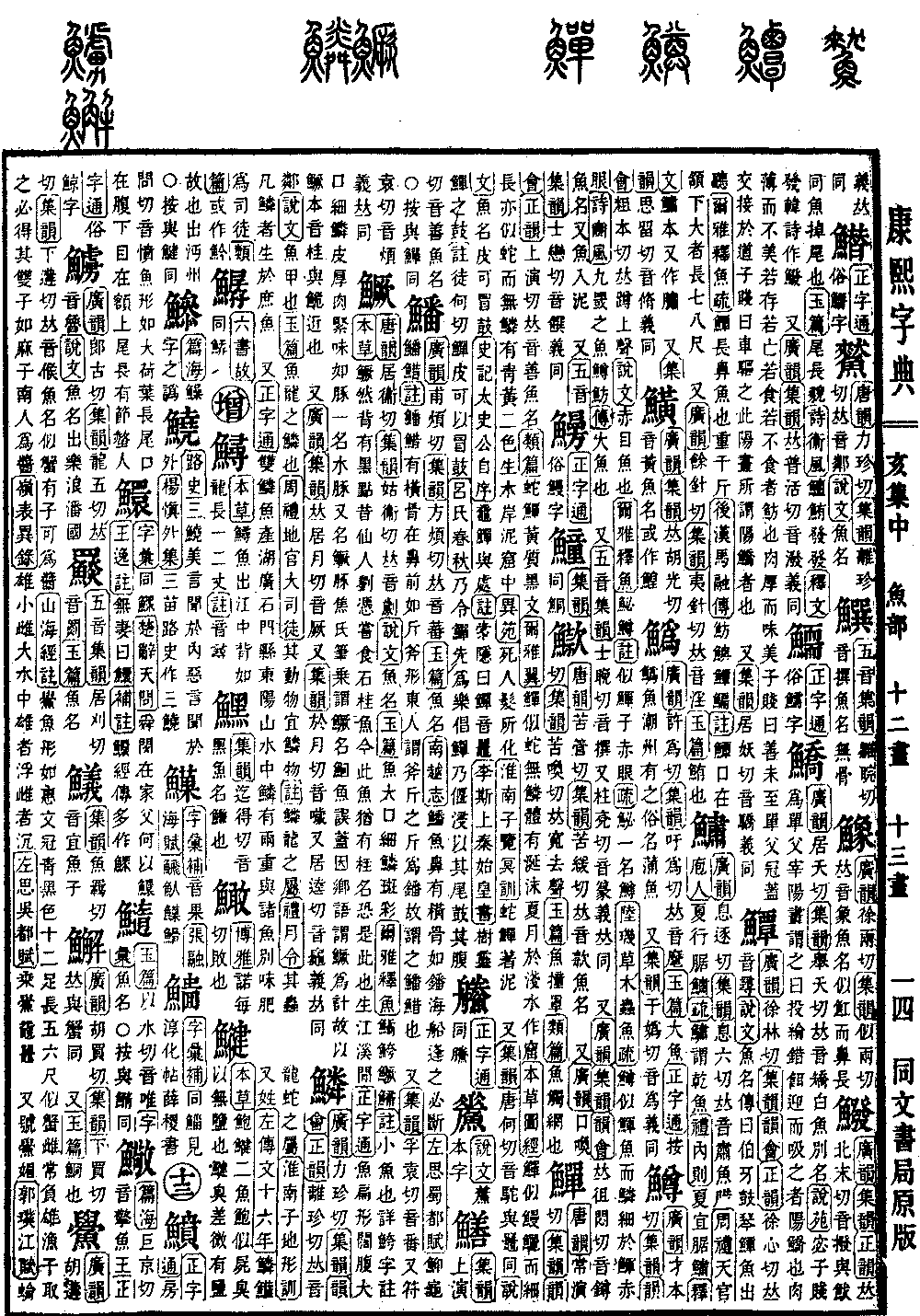
Hai Collection, Middle Volume
Radical: Fish (yú)
Entry: 23 strokes
Page 1478, Entry 01
Pronounced gui (falling tone).
According to the Shuo Wen Jie Zi (Explaining Graphs and Analyzing Characters): A type of fish.
According to the Yu Pian (Jade Chapters): A fish with a large mouth, fine scales, and colorful spots.
According to the Erya (Approaching Elegance), section on fish: The guo, the gu, the gui, and the chou.
Commentary: This refers to a small fish. See the entry for gu for further details.
According to the Bencao (Materia Medica): The gui fish has black spots on its back. In the past, the immortal Liu Ping once ate a stone-cassia fish; today, this fish still bears the name cassia, which is likely this one. It lives in rivers and streams.
According to the Zhengzitong (Proper Character Guide): The fish is flat in shape with a wide belly, a large mouth, fine scales, thick skin, firm flesh, and tastes like pork. It is also called water-pig and gui-pig. Jiao's Bicheng (Brush Notes) claims that the gui is named the hui fish, which is a mistake. This is because, in local dialect, gui is pronounced like ji, and since the original pronunciation of gui is similar to hui, the confusion arose.
Also pronounced jue (entering tone).
Also pronounced hui (entering tone).
Also pronounced gui (rising tone).
The meaning is the same.
According to the Bencao (Materia Medica): The gui fish has black spots on its back.