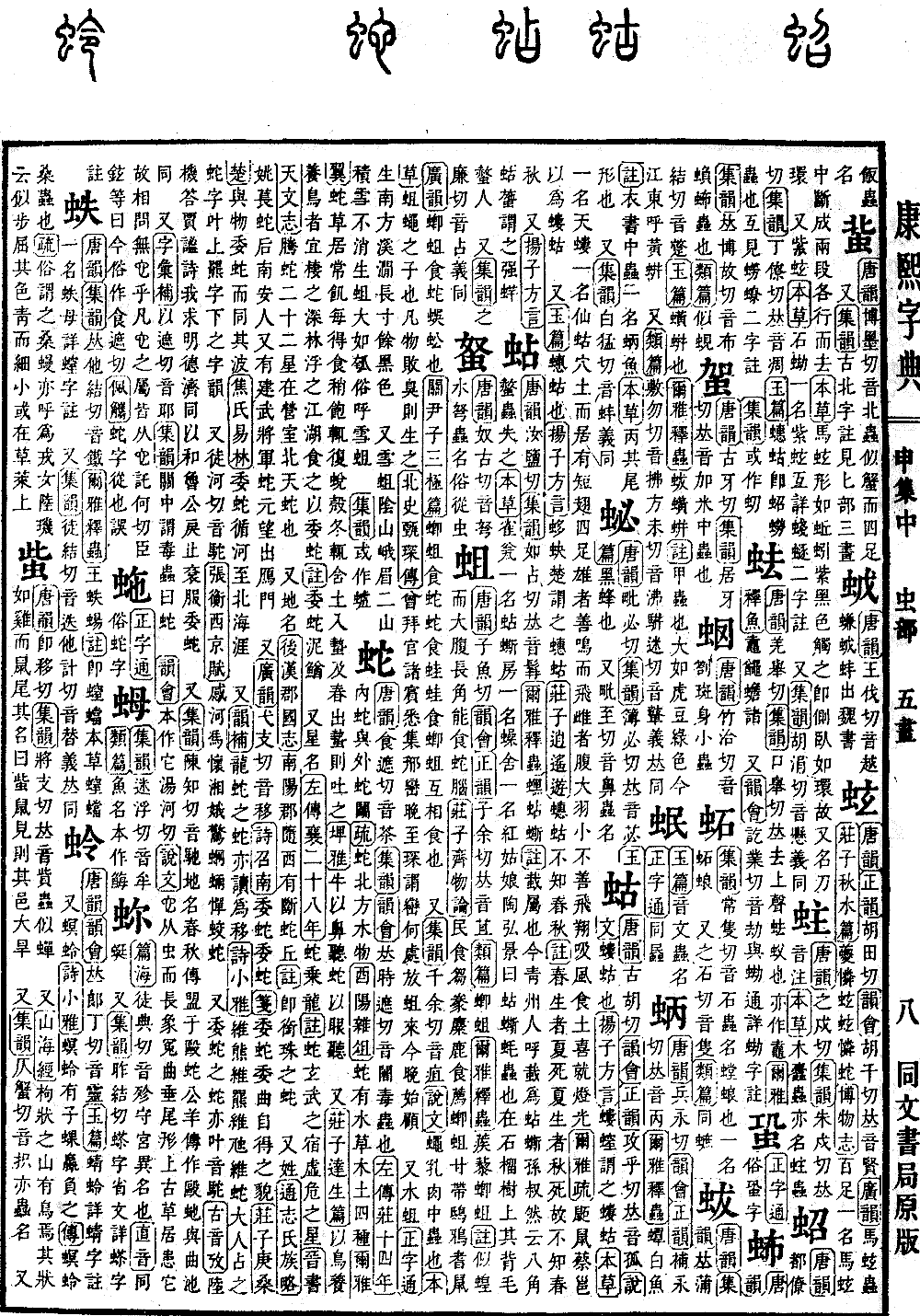
Shen Collection, Middle Volume
Radical: Insect (chóng)
蛄
Kangxi Stroke Count: 11
Page 1080, Entry 16
Pronounced gu.
According to the Explaining Graphs and Analyzing Characters (Shuowen Jiezi), it is the mole cricket. In the Dialects (Fangyan) by Yang Xiong, it is stated that the lou-die insect is called the mole cricket. In the Materia Medica (Bencao), one name for it is heavenly mole, and another is immortal mole. It digs holes in the earth to dwell, has short wings, and four legs. The male is adept at calling and flying, while the female has a large abdomen and small wings and is not adept at flying. It breathes wind, eats earth, and is fond of gathering near light. The Commentary on the Erya (Erya Shu) suggests that the rock squirrel is considered by Cai Yong to be a mole cricket.
Furthermore, according to the Jade Chapters (Yupian), it is the cicada known as hui-gu. In the Dialects (Fangyan) by Yang Xiong, the cicada known as zhe-que is called hui-gu in the Chu region. In the Zhuangzi, section Carefree Wandering (Xiaoyao You), it is stated that the hui-gu does not know of spring or autumn. The commentary explains that those born in spring die in summer, and those born in summer die in autumn, hence they do not know the spring or autumn seasons. Additionally, according to the Dialects (Fangyan) by Yang Xiong, the gu insect is also called qiang.