Chen Collection, Middle Volume
Radical: Tree (mù)
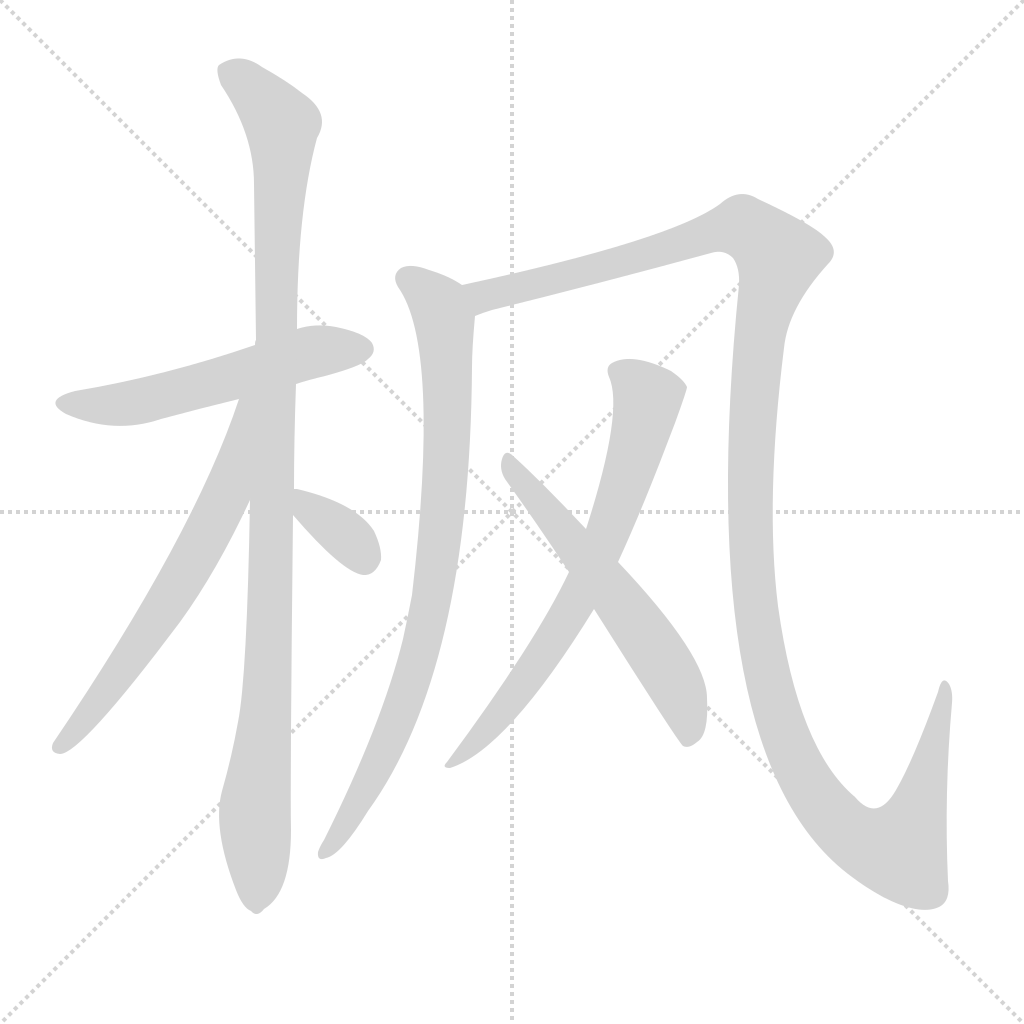
Feng (maple)
Kangxi stroke count: 13
Page 539, Entry 02
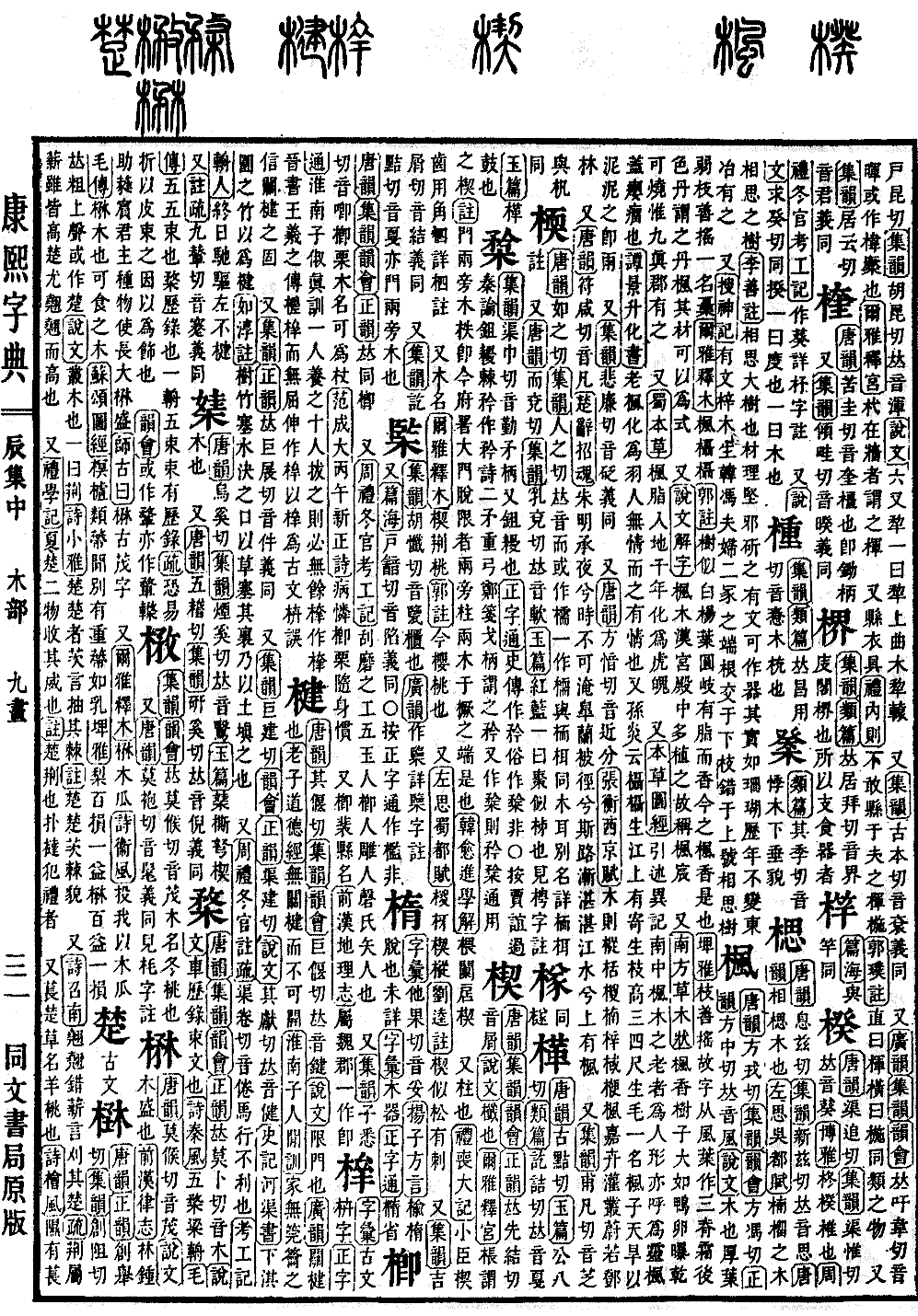
Pronounced feng. According to the Shuowen Jiezi, it is a type of tree with thick leaves and weak branches that sway easily. It is also known by another name. In the Erya: Interpreting Trees, it is described as a maple tree, which sways and trembles. The commentary by Guo Pu states that the tree resembles a white poplar, with round leaves that are divided into forks; it has a fragrant resin, which is what we now call maple resin. The Piya states that because its branches sway easily, the character is composed with the element for wind. Its leaves have three points and turn red after the frost, hence it is called the crimson maple. Its wood can be used to craft the horizontal bars on the sides of a carriage.
Furthermore, according to the Shuowen Jiezi, maple trees were frequently planted in the palaces of the Han dynasty, hence the term maple imperial court. According to the Southern Regions Flora and Fauna, the fruit of the maple incense tree is the size of a duck egg and can be dried and burned; it is found only in Jiuzhen Prefecture. According to the Shu Materia Medica, the resin of the maple tree turns into amber if buried underground for a thousand years.
According to the Illustrated Materia Medica, which cites the Book of Strange Accounts, ancient maple trees in the south sometimes turn into the shape of a human, also known as the spirit maple; these are actually tree burls. Tan Jingsheng's Book of Metamorphosis states that old maple trees turning into immortals is an example of an inanimate object becoming animate.
Sun Yan states: It grows by the river, with parasitic branches three to four feet high and long hairs. Another name is maple seed; during a drought, applying mud to it will bring rain.
Also, pronounced bian. The meaning is the same.
Also, pronounced close to fen. In Zhang Heng's Rhapsody on the Western Capital: As for the trees, there are firs, cypresses, palms, nanmu, catalpas, oaks, nanmu, and maples. Beautiful flowers and grasses and clustered shrubs grow as luxuriantly as the Deng Forest.
Also, pronounced fan. In the Songs of Chu: Summoning the Soul: The day joins the night, and time cannot be held for long; the fragrant orchid covers the path, and the road is already obscured; the water of the clear river flows, and on the bank, there are maple trees.
Also, pronounced fan. It is the same as the character for a type of small tree.