Wu Collection, Lower Volume
Radical: Cave (xué)
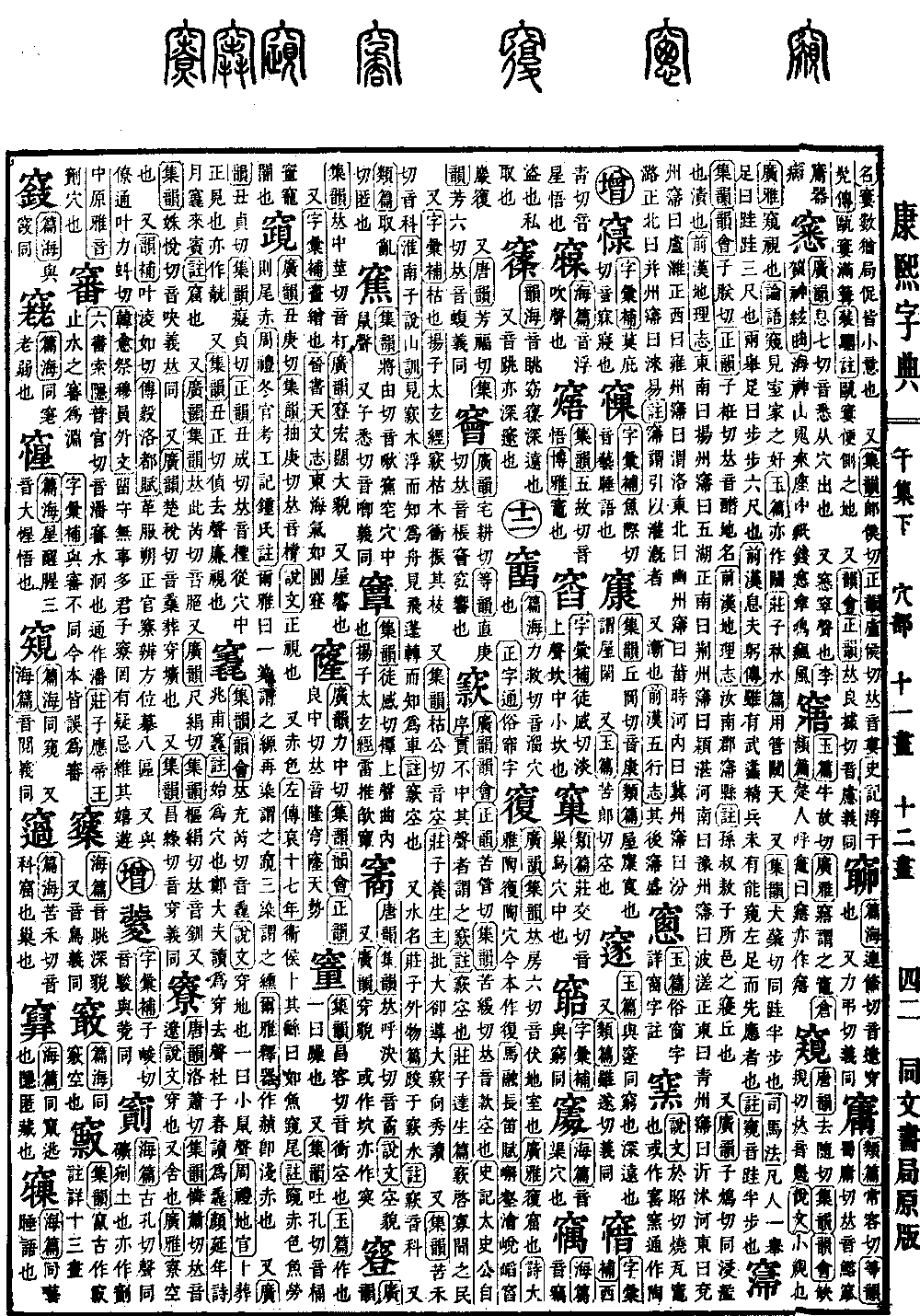
Kuan; Kangxi strokes: 17; Page 868, Entry 25
Broad Rhymes (Guangyun), Dictionary of Rhymes (Yunhui), and Correct Rhymes (Zhengyun) state the pronunciation is kuan (rising tone). Collected Rhymes (Jiyun) states the pronunciation is kuan (rising tone). It means empty. Records of the Grand Historian (Shiji), Preface by the Grand Historian states: That which in reality does not match its reputation is called kuan. The commentary says: Kuan means empty. Zhuangzi, Chapter on the Understanding of Life (Dasheng) states: The kuan and ignorant people. Also, Supplement to the Dictionary (Zihui bu) states it means withered. Yangzi, Great Mystery (Taixuan jing) states: Strike the kuan withered wood, and vibrate its branches.
Also, according to Collected Rhymes (Jiyun), pronounced kong. Zhuangzi, Chapter on Nourishing the Principle of Life (Yangsheng zhu) states: Slice into the great gaps and guide into the great kuan. Xiang Xiu reads it this way.
Also, according to Collected Rhymes (Jiyun), pronounced ke. Huainanzi, Discourses on the Mountains (Shuoshan xun) states: Seeing the kuan wood float, one knows it can be made into a boat; seeing the flying tumbleweed roll, one knows it can be made into a carriage. The commentary says: Kuan means empty.
Also, a river name. Zhuangzi, Chapter on External Things (Waiwu) states: Dwelling at the Kuan River. The commentary states: Kuan is pronounced ke.
Also, according to Classified Dictionary (Leipian), pronounced luan. It means to conceal.