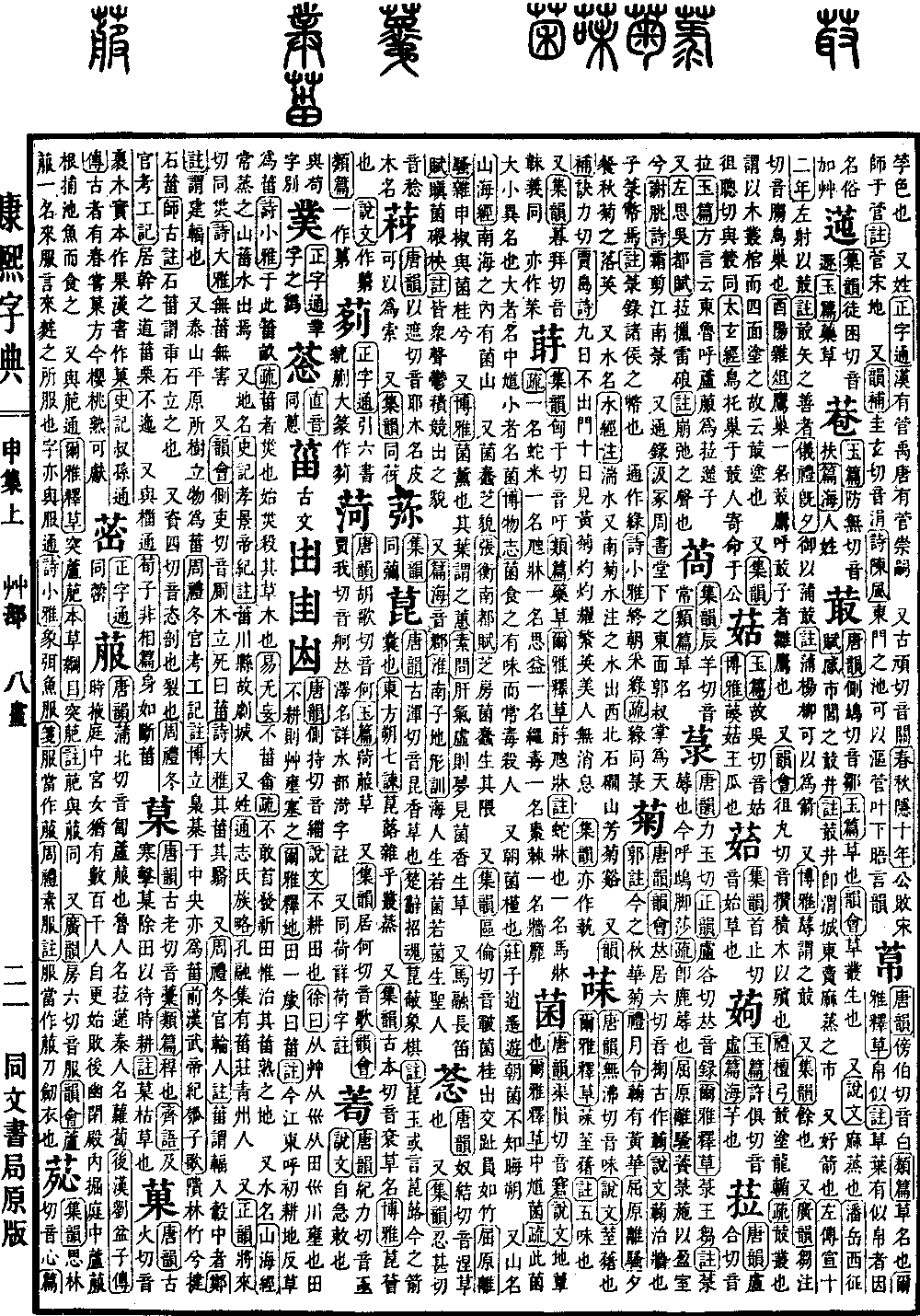
Shen Collection, Upper Volume
Radical: Grass (cǎo)
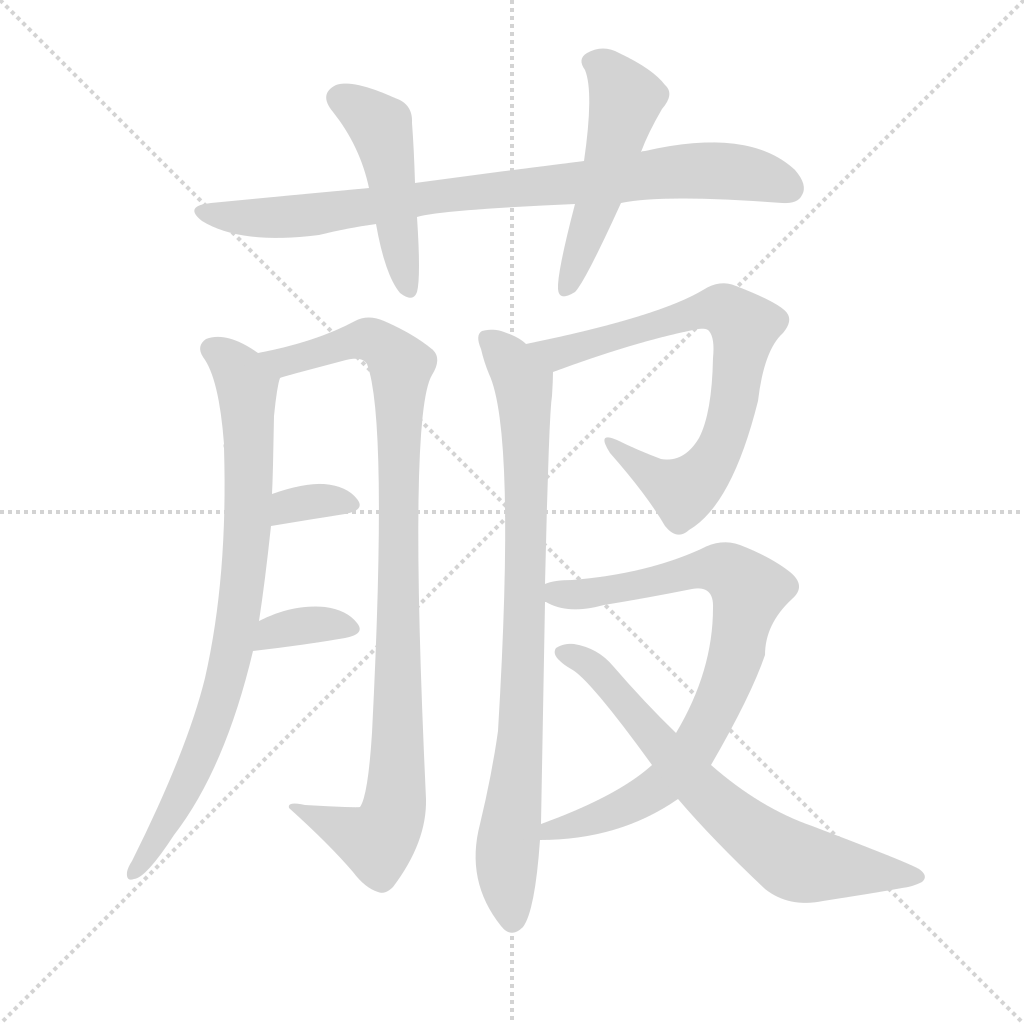
菔
Kangxi strokes: 14
Page 1037, Entry 31
Tang Rhymes (Tangyun): Pronounced fu. The pronunciation is the same as fu (crawling). It refers to the radish. People in the Lu region call it la, and people in the Qin region call it luobo.
Book of the Later Han (Hou Hanshu), Biography of Liu Penzi: It is recorded that there were still hundreds or thousands of palace women in the Ye Office. After the failure of Emperor Gengshi, they were imprisoned in the palace, digging up radish roots in the courtyard and catching fish in the pond to satisfy their hunger.
It is also interchangeable with the character fei.
Classic of Rites (Erya), Explanation of Plants (Shicao): It is recorded that tu is the radish.
Compendium of Materia Medica (Bencao Gangmu): It is written as cufei. Note: This indicates that fei and fu are the same.
Guangyun: Pronounced fu. The pronunciation is the same as fu (to submit/clothing).
Collection of Rhymes (Yunhui): It is recorded that the radish is also called laifu, which means it is suitable for wheat. The character is also interchangeable with fu (clothing).
Book of Odes (Shijing), Lesser Odes of the Kingdom (Xiaoya): It contains the phrase elephant-bone bow-ends and fish-skin sword sheaths.
Zheng Xuan's Commentary (Jian): The commentary states that fu should be written as fu (radish).
Rites of Zhou (Zhouli), Commentary on Plain Clothing (Sufu Zhu): It states that fu should be written as fu (radish), referring to a sword scabbard.
Textual Research: The original text of the Erya, Explanation of Plants reads tu lufei. The original text of the Compendium of Materia Medica reads tufei. Now, carefully following the original text, the character tu in the previous sentence has been corrected to tu, and the character tu in the following sentence has been corrected to cu.