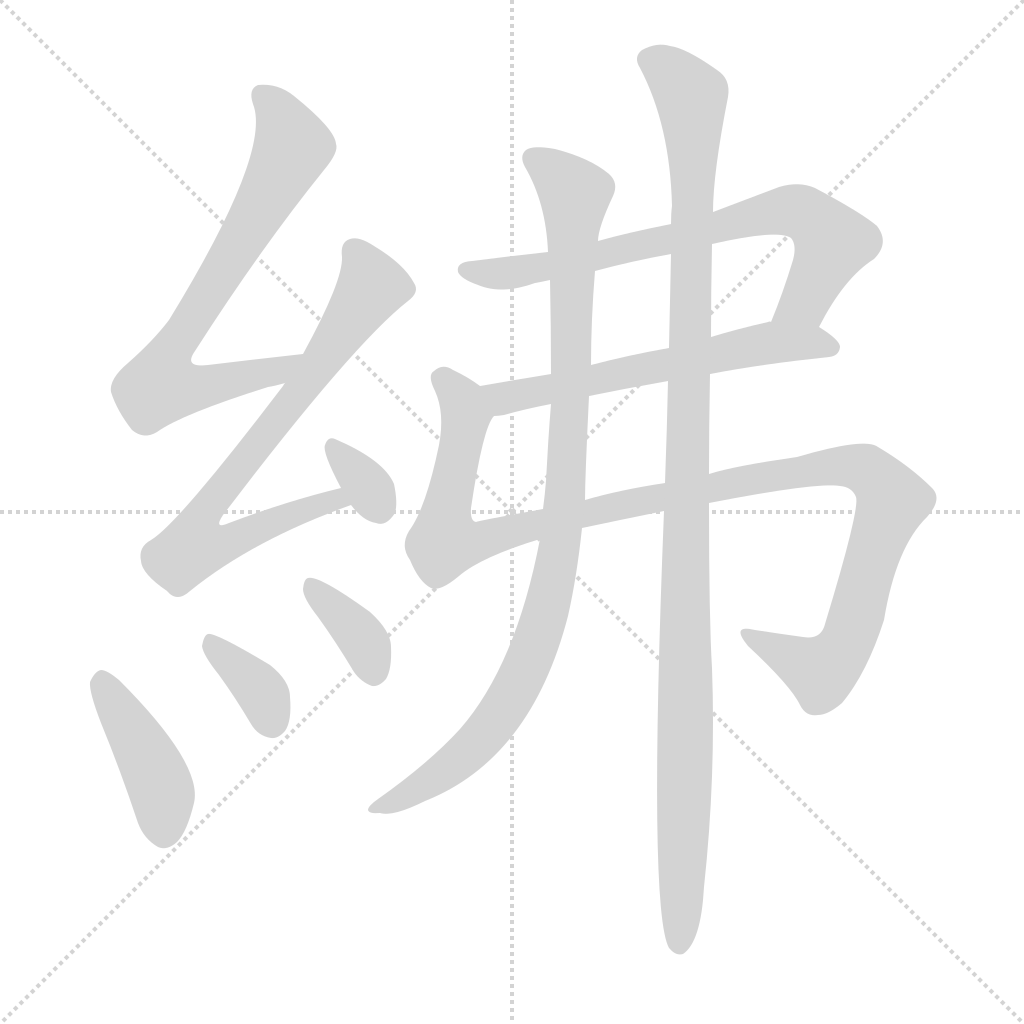
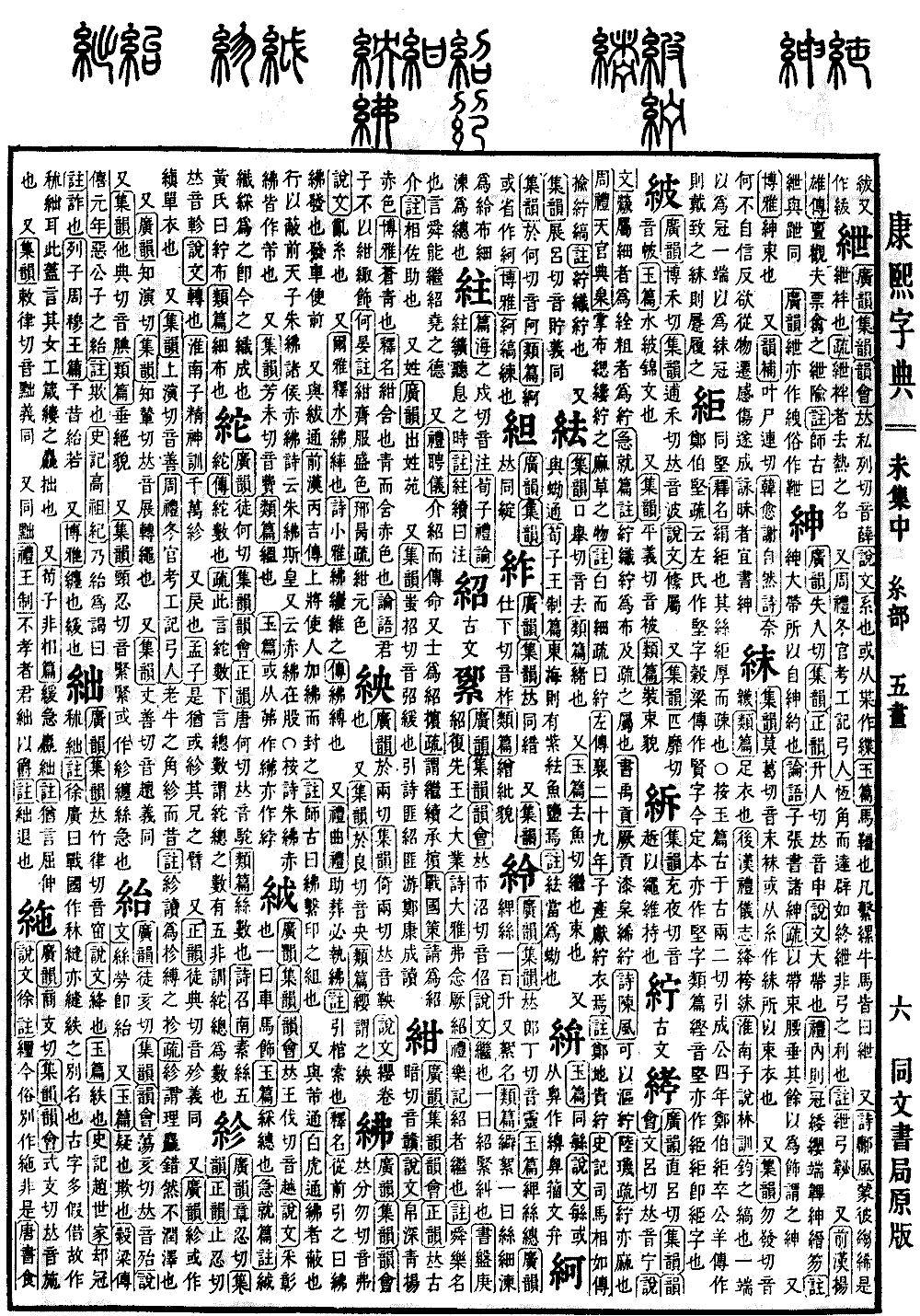
Wei Collection, Middle Volume
Radical: Silk (mì)
Kangxi Strokes: 11
Page 920, Entry 20
Guangyun, Jiyun, and Yunhui all define it as pronounced fu (entering tone).
Shuowen Jiezi states: Tangled silk threads.
Erya, Explaining Water states: A fu is a rope.
Book of Odes (Shijing): With the ropes tied to it. The commentary states: Fu means to bind.
Book of Rites (Liji): When assisting at a funeral, one must hold the ropes. The commentary states: These are the ropes used to pull the coffin.
Shiming states: That which pulls from the front is called a fu. Fu signifies setting out, as one pulls a carriage to make it move forward.
It is also used interchangeably with the character pronounced fu (falling tone).
History of the Former Han Dynasty (Qian Hanshu), Biography of Bing Ji: The Emperor ordered someone to attach a cord and seal it. The commentary by Yan Shigu states: A fu is the silk ribbon used to tie an official seal.
It is also used interchangeably with the character pronounced fei (falling tone).
Comprehensive Discussions in the White Tiger Hall (Baihu tong) states: A fu is something that covers, used to shield the front of the body while walking. The Son of Heaven uses a vermilion fu, while feudal lords use a crimson fu. The Book of Odes (Shijing) says: How glorious is the vermilion fu. It also says: The crimson fu is on the legs. Note: In the Book of Odes (Shijing), both vermilion fu and crimson fu are written with the character pronounced fei (falling tone).
Jiyun defines it as pronounced fei (falling tone).
Leipian defines it as tangled hemp.
Yupian notes that it is sometimes written with the radical for plants, and also as the variant form pronounced fu (rising tone).
Textual Research: Book of Odes (Shijing): With the ropes tied to it. The commentary states: Fu means to bind. In accordance with the original text, the character for bind has been corrected to the standard form.