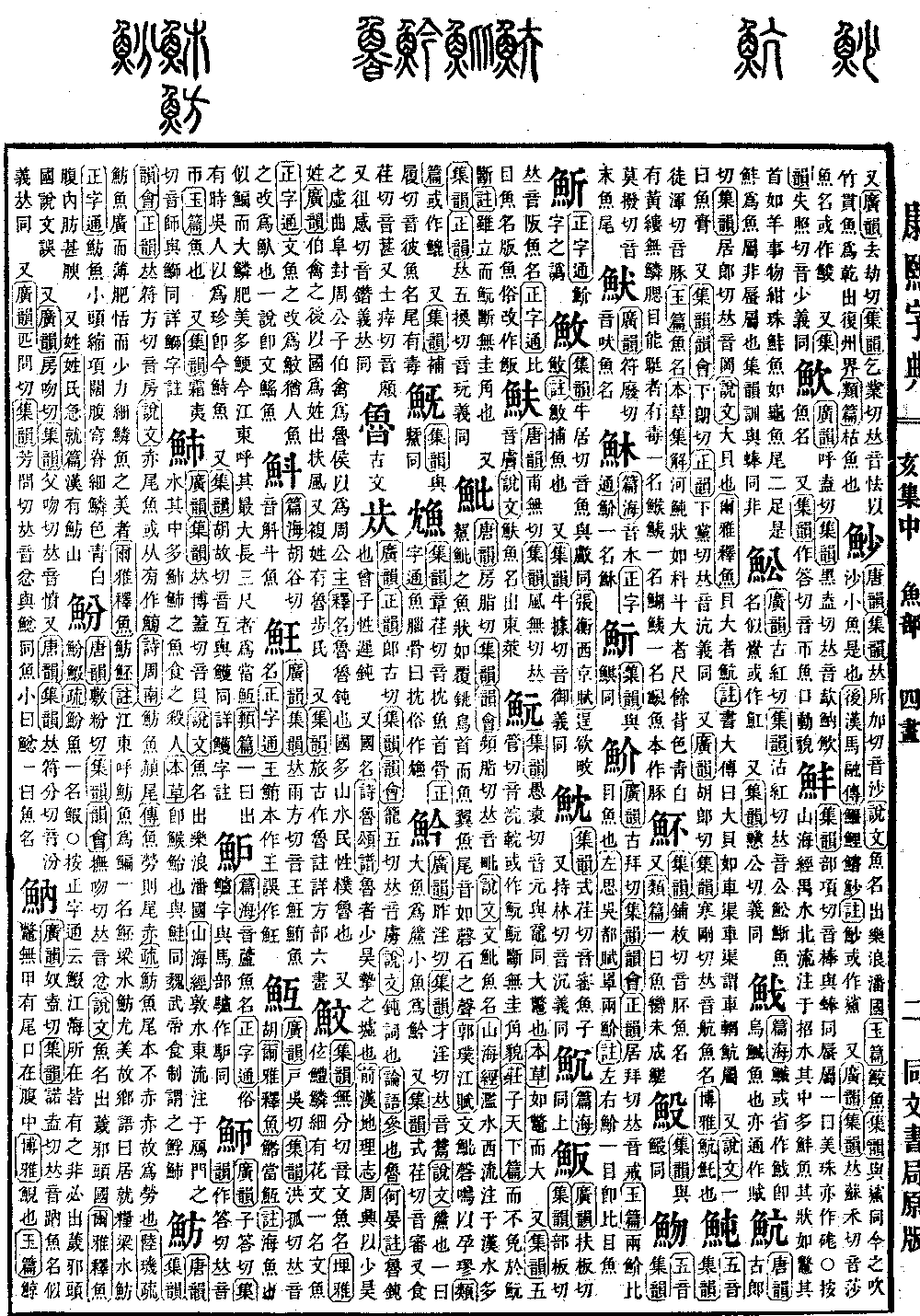
Hai Collection, Middle Volume
Radical: Fish (yú)
Character: Fang
Kangxi Stroke Count: 15
Page 1466, Entry 02
Tang Dynasty Rhyme Dictionary (Tangyun), Collected Rhymes (Jiyun), Dictionary of Rhymes (Yunhui), and Correct Rhymes (Zhengyun) all state: pronounced fang.
According to the Explaining Graphs and Analyzing Characters (Shuowen Jiezi), it is a fish with a red tail. Sometimes written in a variant form.
Book of Odes (Shijing), Zhou South section: The tail of the fang fish is red.
Commentary states: When a fish is fatigued, its tail becomes red.
Explication states: The tail of the fang fish is not naturally red; it becomes red because the fish is fatigued.
Lu Ji Commentary states: The fang fish is wide and thin, fatty and docile with little strength, has fine scales, and is a delicious fish.
In the Approaching Elegance (Erya), section Explaining Fish: The fang fish is known as the pi fish.
Note: In the region east of the Yangtze River, the fang fish is called the bian fish. It is also known as the pi fish. The fang fish from the Liang River is particularly delicious, thus the local saying: If you live and seek sustenance, seek the fang fish from the Liang River.
According to the Correct Meaning Thoroughfare (Zhengzitong), the fang fish has a small head, a shrunken neck, a wide abdomen, an arched back, fine scales, and a blue-white color; the fat inside the abdomen is very rich.
Also a surname.
According to the Quick Guide to Surnames (Xingshi Jijiu Pian), there was a Fang Mountain during the Han Dynasty.