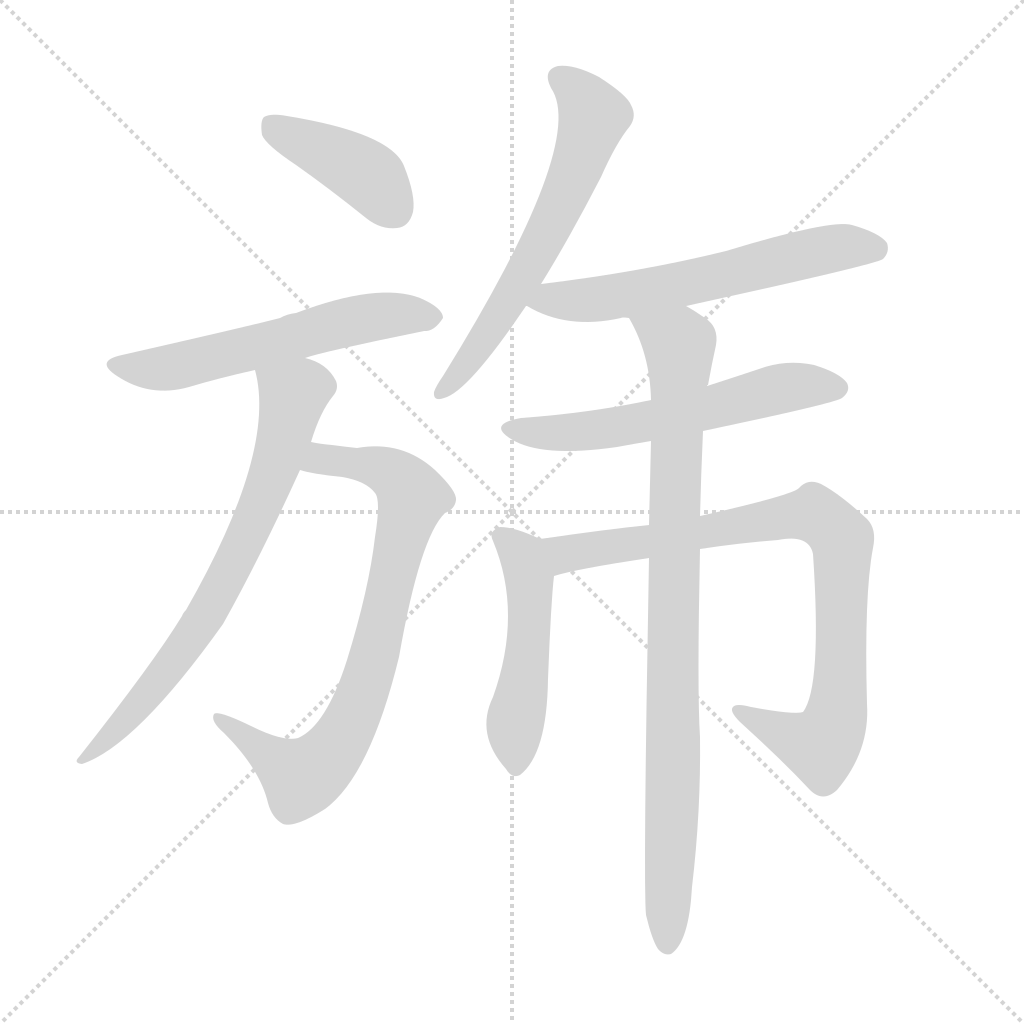
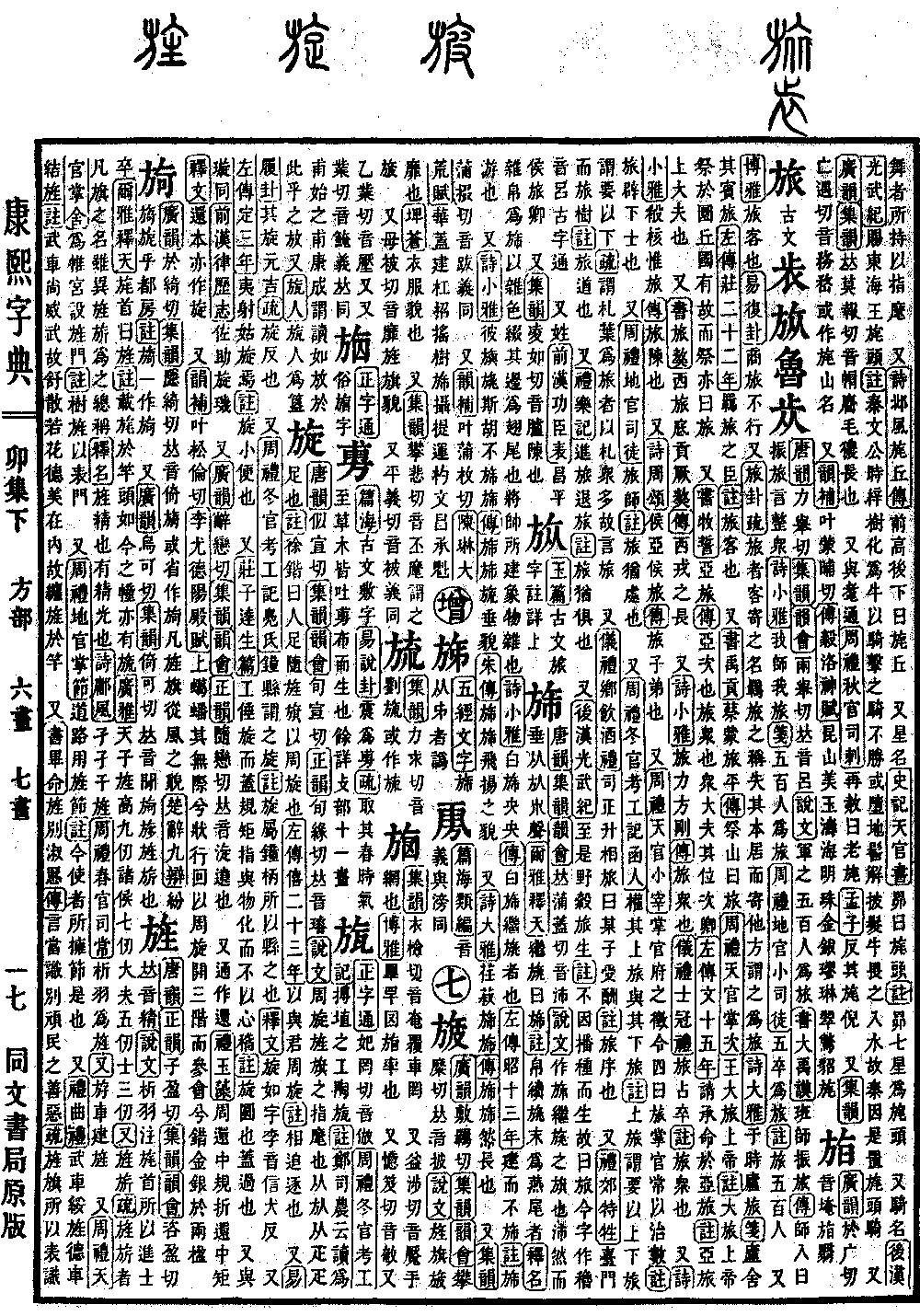
Mao Collection, Lower Volume
Radical: Square (fāng)
Kangxi Strokes: 10
Page 483, Entry 08
Pronounced pei.
As noted in the Explanation of Characters (Shuowen Jiezi), it is written as a banner following a small flag, hanging down in a waving manner. It is derived from the radical for banner, with a phonetic component.
In the Approaching Elegance (Erya), specifically in the Explanation of Heaven, it states that a small flag extended is called a banner. The commentary notes that it is a banner extended with silk, with the ends resembling a swallow tail.
The Explanation of Names (Shiming) states that various colored silks are used to make the banner, with multi-colored borders attached to act as wings or a tail. It is raised by generals, signifying a mixture of various objects.
The Book of Odes (Shijing), in the Minor Odes of the Kingdom section, mentions white banners shining bright. The commentary explains that a white banner is one that extends from a small flag.
In the Zuo Commentary (Zuozhuan), in the thirteenth year of Duke Zhao, it says to raise it but not let it flutter. The commentary notes that flutter means to sway.
Also in the Book of Odes (Shijing), it mentions those falcon banners and small flags, why do they not flutter? The commentary explains that fluttering refers to the appearance of pennants hanging down. The Zhu commentary states that it describes a fluttering, flying appearance.
Also in the Book of Odes (Shijing), in the Greater Odes of the Kingdom section, it describes lush beans growing long. The commentary explains that the term describes their long appearance.
According to the Collected Rhymes (Jiyun), it is also pronounced ba. The meaning is the same.
According to the Rhyme Supplement (Yunbu), it also rhymes with the sound mei. In the Great Wilderness Rhapsody (Dahuang Fu) by Lin, it says the magnificent canopy is set upon the pole, and the beckoning star raises the banner. Sheti turns the ladle, and Wenchang supports the dipper.